Kids Behavior Tracker: What to Track and What to Skip
How to use a kids behavior tracker so it builds good habits instead of fights: which behaviors to track by age, how to score them and when to stop.
By Famiyo Editorial TeamUpdated 6 min read
Most parents who search for a behavior tracker are tired of saying the same sentence forty times a day. A tracker can help, but the design matters more than the tool. A chart that lists everything the child does wrong becomes one more source of conflict, while a short, positive one gives you something specific to notice and your child something to see. This guide covers what research-backed parenting advice suggests tracking, how to write behaviors a child can understand, and when to retire the whole thing.
What does a behavior tracker actually do?
A behavior tracker makes a target behavior visible and pairs it with prompt, positive feedback. That is the whole mechanism. Child development guidance, including what the American Academy of Pediatrics publishes for parents, consistently points to the same pattern: children repeat what gets noticed, and specific, immediate praise works better than general approval given later.
The tracker helps in three ways. It forces you to choose what you want, which is harder than it sounds. It gives you a daily reason to catch good behavior rather than only react to bad. And it lets the child see progress, which matters because young children have a poor sense of how a week went.
What it does not do is fix an underlying problem. If a child is melting down because of hunger, a missed nap or a hard transition, a chart will not help in that moment. How well any approach works also depends on the child, so treat the ideas below as a starting point and adjust.
Which behaviors are worth tracking?
Track what you can see and count. "Be good" is not a behavior. "Hands to yourself during dinner" is. A reliable test: could a stranger watching your child tell whether it happened? If not, rewrite it.
Choose behaviors that are positive (do something) rather than negative (stop doing something). "Use your words when you're mad" gives a child something to do. "Don't hit" only describes the absence of something, and the tracker has nothing to reward except nothing happening.
| Too vague | Specific and trackable | Good for ages |
|---|---|---|
| Be nice to your brother | Ask before taking a toy from your brother | 4-8 |
| Listen better | Start the task within one minute of being asked | 4-10 |
| Have a good attitude | Say "okay" instead of arguing, then do it | 6-12 |
| Be calm | Take three slow breaths when you feel angry | 3-9 |
| Be responsible | Put the school bag by the door before dinner | 6-12 |
| Respect your parents | Speak without yelling, even when you disagree | 8-14 |
Pick one to three from a list like this. If you are stuck, choose the behavior that causes the most friction in a normal week, not the one that bothers you most in the abstract. For more on building the underlying skill, our guide to kids self-discipline explains how self-control grows with age.
How to set up a behavior tracker in five steps
- Pick one behavior. Write it as an action, in words your child uses. Read it aloud together and ask, "What would that look like?"
- Decide what counts. "Asked before taking the toy" is yes or no. Avoid partial scores, because children argue about them.
- Choose a small reward with your child. It should be reachable within a few days at the start, then stretch over time.
- Notice the behavior out loud, right away. "You asked Maya first. That's why she said yes." Do this every time at the start.
- Review once a week for five minutes. Look at what went well, and ask your child what was hard. Do not review failures in front of siblings.
A note on step 3: a reward does not have to be an object. Time with you, picking the music in the car or choosing the weekend pancakes all work. Children often value attention more than a prize, and these rewards cost nothing.
What to do when the tracker isn't working
Most trackers fail for predictable reasons, and each has a fix.
The child stops caring after a week. The novelty wore off, or the reward is too far away. Shorten the gap, refresh the reward and cut the number of behaviors.
The tracker becomes a source of arguments about fairness. Behaviors are probably too vague, or siblings are being compared. Use private tracking for each child and make the criteria yes or no.
The child behaves only when the chart is watching. This is normal at first. The reward is meant to start a habit, and the habit eventually carries itself. The goal is to fade the reward once the behavior sticks, for example by moving from daily to weekly rewards.
Points get taken away. This is the one most worth avoiding. Removing points already earned tends to teach a child that effort can vanish, and many give up. Keep the tracker for what you want to grow. Deal with misbehavior in the moment instead, and for ideas see our guides on consequences for kids who don't listen and on getting kids to listen without yelling.
If your child's behavior is intense, hard to predict or getting worse, a tracker is not the right tool alone. A pediatrician or child psychologist can help work out what is behind it.
A sample week for one target behavior
Say your 6-year-old keeps grabbing toys from a younger sibling. The target is "ask before taking a toy". Here is how a week could look.
| Day | What you do | What the child sees |
|---|---|---|
| Mon | Explain the target, practice once with a toy | One star for each time they ask |
| Tue | Praise the moment: "You asked first" | Stars add up, small reward at 3 |
| Wed | Remind once before play starts | Stars continue |
| Thu | Notice quietly if it was hard and they did it anyway | Stars continue |
| Fri | Add a bonus for asking without a reminder | Pick the weekend reward |
| Weekend | Short review: "What helped you remember?" | Reward day, then decide the next target |
After two to three weeks of mostly consistent use, you can drop the stars and keep only the praise. That is the sign the behavior has moved from the chart into the child.
When to stop tracking
Stop when the behavior happens on most days without a prompt. Say so: "You've been asking first for three weeks, so we're done with this one. What should we work on next?" Ending a target is a reward in itself, because it tells the child they grew.
Skip a tracker entirely in a few cases. If the child is under about 3, they cannot connect a chart to behavior, so use praise and routine. If the problem is a skill the child lacks, such as reading emotions, teach the skill first. And for older kids and teens, ask before you start. A teen who helped write the target is far more likely to take part, and our piece on getting teens to do chores has more on that age group.
Tracking behavior in Famiyo
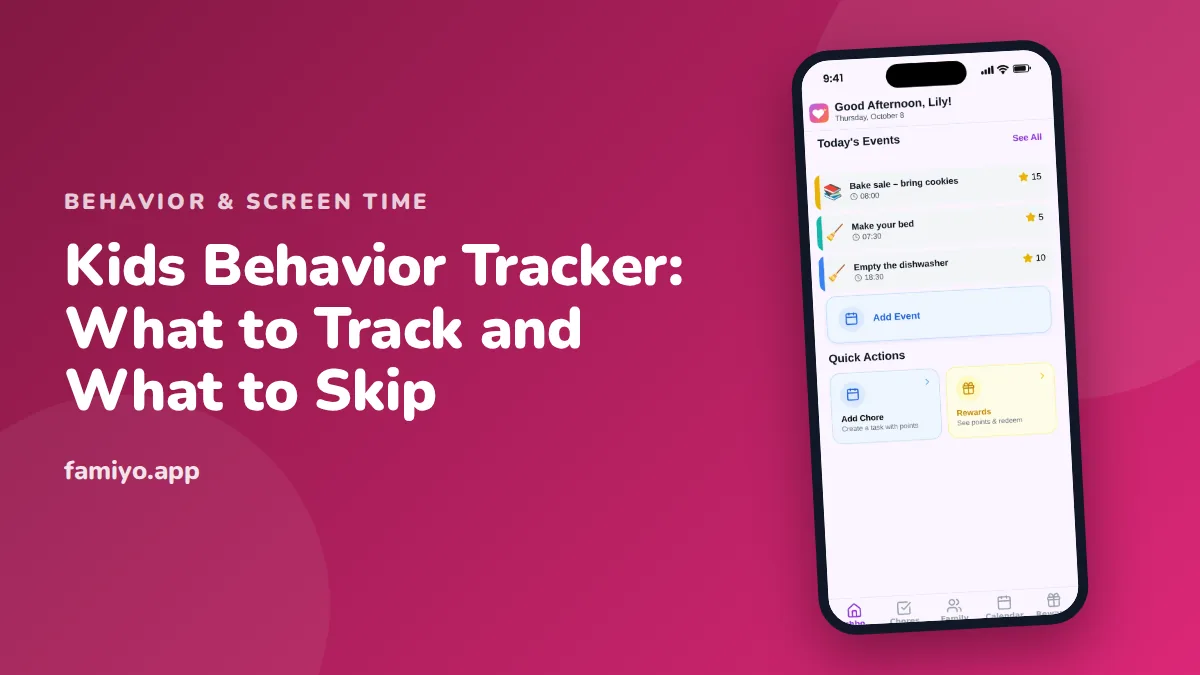
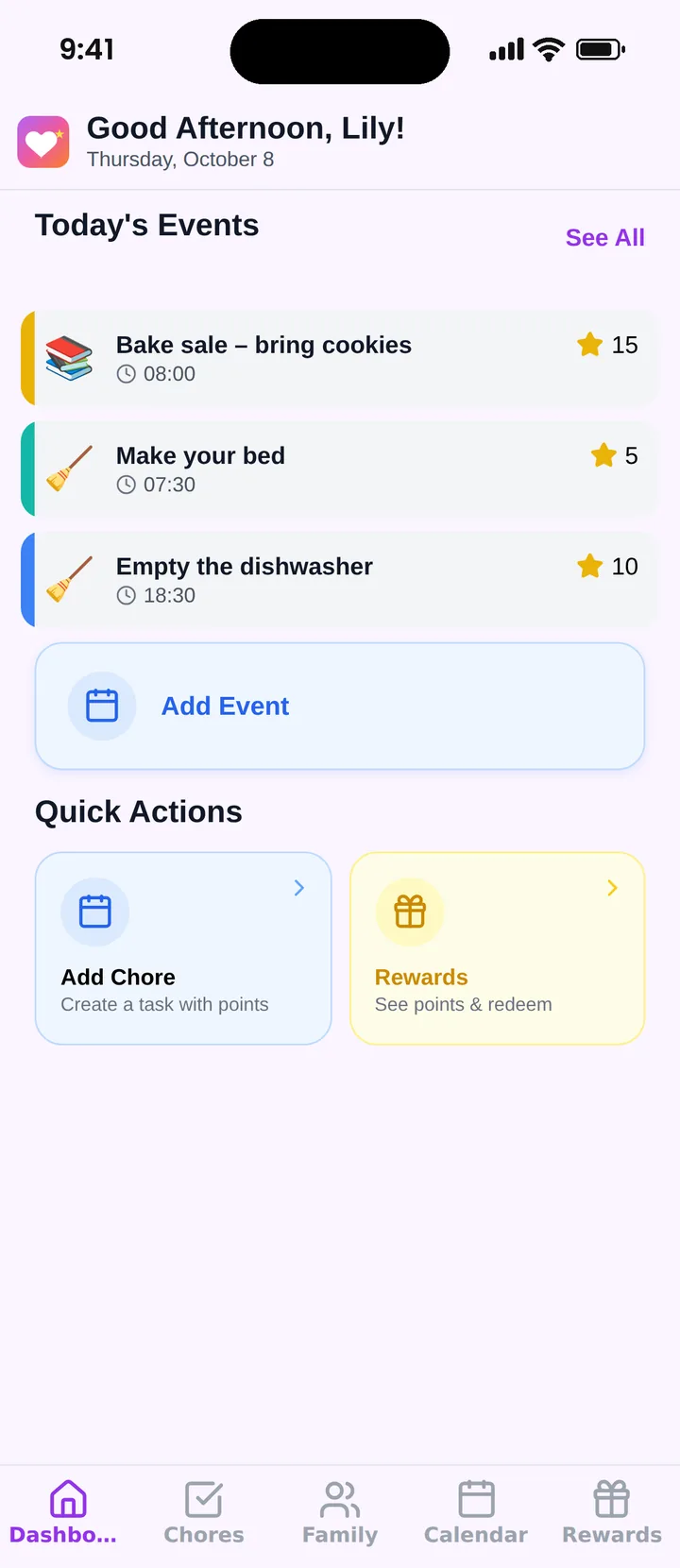
Famiyo is a free family app for iPhone and Android that combines a shared family calendar, chores with points and a rewards shop; kids join with a code, no email needed. For behavior, you can add a target such as "Asked before taking a toy" as a daily task and give it points, using different amounts for each child if they are at different stages. Kids tick it off themselves or a parent approves it, and the +2 bonus for done without a reminder fits the fade-out idea. Parents see a push notification when it is done, and the statistics screen shows the last 7 days per child. Rewards are priced in points. See our list of the best reward chart apps for kids to compare options.
Start with one behavior, one reward and one weekly check-in, and see how the first two weeks feel.
Frequently asked questions
How many behaviors should a kids behavior tracker have?
One to three at a time. Young children can hold one or two targets in mind, and school-age kids manage three. A long list spreads attention thin and turns the tracker into a report card. Add a new behavior only when an old one is automatic.
Should you take points away for bad behavior?
Most parenting guidance favors rewarding the behavior you want rather than punishing the one you don't. Taking points back can feel like a penalty for effort already made, and children often stop caring about the tracker. Handle misbehavior separately, with a calm and predictable consequence.
What age is a behavior tracker good for?
Roughly ages 3 to 10 get the most from one, because they respond well to visible progress and small rewards. Teens usually want a say in the targets and prefer private tracking over a chart the family can see.
How long should we use a behavior tracker?
Give a new target 2 to 3 weeks of consistent use before judging it. Once the behavior happens most days without a reminder, stop tracking it and move on. A tracker is a scaffold, not a permanent fixture.
Does a behavior tracker work for kids who don't care about rewards?
Sometimes the reward is the problem, not the tracker. Let the child help choose rewards, make them quick and small, and add parent attention such as a shared activity. If a child struggles a great deal with behavior, talk to your pediatrician.
Try Famiyo With Your Family
Chores with points, a rewards shop for kids and one shared family calendar. Set it up in a couple of minutes.



Free to download • No credit card required • Available on iOS & Android