How to Plan Family Time When Everyone Is Busy
How to plan family time when everyone is busy: find the real gaps in your week, schedule small rituals, keep them when plans slip and let each person choose.
By Famiyo Editorial TeamUpdated 4 min read
You love your family and you still have not sat down to a meal together since last Tuesday. Work runs late, practice runs later, and the weekend fills with errands. Family time does not disappear because you stop caring. It disappears because nothing holds a place for it. This page shows how to find the real gaps in your week, turn them into small rituals, and keep them going when plans change.
Count the time you actually have
Start with a real week rather than an ideal one. For seven days, note when most of the family is home and awake at the same time. Do not include the hour everyone is rushing out the door.
Most families find three to five windows. Typical ones are:
- Breakfast on a weekend morning
- Dinner on one or two evenings
- The 20 minutes before a younger child's bedtime
- The drive to a regular activity
- Sunday afternoon
Pick the three that look most realistic. A window with 20 to 30 minutes and a predictable time is better than a free Saturday that may or may not happen.
If you have kids in more than one house, your windows will be different, and that is fine. Our guide to the 50/50 co-parenting schedule shows how time splits in common arrangements. Make the time in each home count rather than copying the other home.
Turn the gaps into small rituals
A ritual is easier to keep than a plan, because nobody has to decide anything. The same thing happens at the same time, and it takes little preparation. Here are some that fit a tight week.
| Window | Ritual | Prep needed |
|---|---|---|
| Weekday dinner | One question each, phones in another room | None |
| Weekend morning | Pancakes or eggs, one person picks the music | Ingredients |
| Before bed (ages 3 to 8) | One story or two songs, lights low | None |
| Car ride | A game of 20 questions or a family playlist turn | None |
| Sunday afternoon | Walk, bike ride or board game | Pick on Friday |
| Once a month | Each child picks the activity, one on one | 1 to 2 hours |
For conversation help, see our dinner time conversation starters. For ideas with older kids, try family time ideas with teens, and for evenings in, family time ideas at home.
Put it on the calendar as a real event
If it is not scheduled, it loses to everything that is. Put family time on the shared calendar the same way you do a dentist visit: a title, a time, a repeat, and everyone invited.
Use a title people want to read. "Pizza and movie, 6:30" is more fun than "Family time." Add the details that save argument later, such as who picks and who cooks.
Then protect it. If you are asked to take something at that time, answer: "We have family plans, how about Thursday?" It sounds small, but kids notice what adults say no to.
If you use a calendar with repeating events, set the ritual to repeat weekly so you do not have to remember each time.
Let everyone take a turn choosing
Family time goes better when it belongs to everyone. A simple rotation works: each family member picks the activity in turn, within a few rules (about an hour, nothing that needs a big purchase, everyone takes part).
Some ground rules keep it fun. Nobody mocks a choice. The chooser gets to explain why they picked it. Teens can veto only if they offer an alternative. Even a 3-year-old can choose between two things, and the choice is the point.
A child who picks the activity every fourth week learns that their taste matters, and that makes the other three weeks easier. You can also keep a jar of ideas on the shelf, on little slips of paper, for the nights when nobody can decide.
Keep it going when plans slip
Plans will slip, and what you do next decides whether the ritual survives.
- Move it, do not drop it. If Tuesday dinner is gone, say "we will do it Thursday" and write that down.
- Keep a five-minute version. When the evening is a mess, ten minutes at the table with a snack still counts.
- Ask whether the cancellations are a pattern. If family time is canceled more than twice in a row, the week is too full, not the ritual too ambitious.
- Do not turn a missed night into a guilt trip. Say "I missed that, I'm glad we're doing Saturday" and move on.
For families blending households, our blended family tips cover how to build shared rituals that include everyone, including stepsiblings who are only there some days.
Putting family time on the calendar in Famiyo
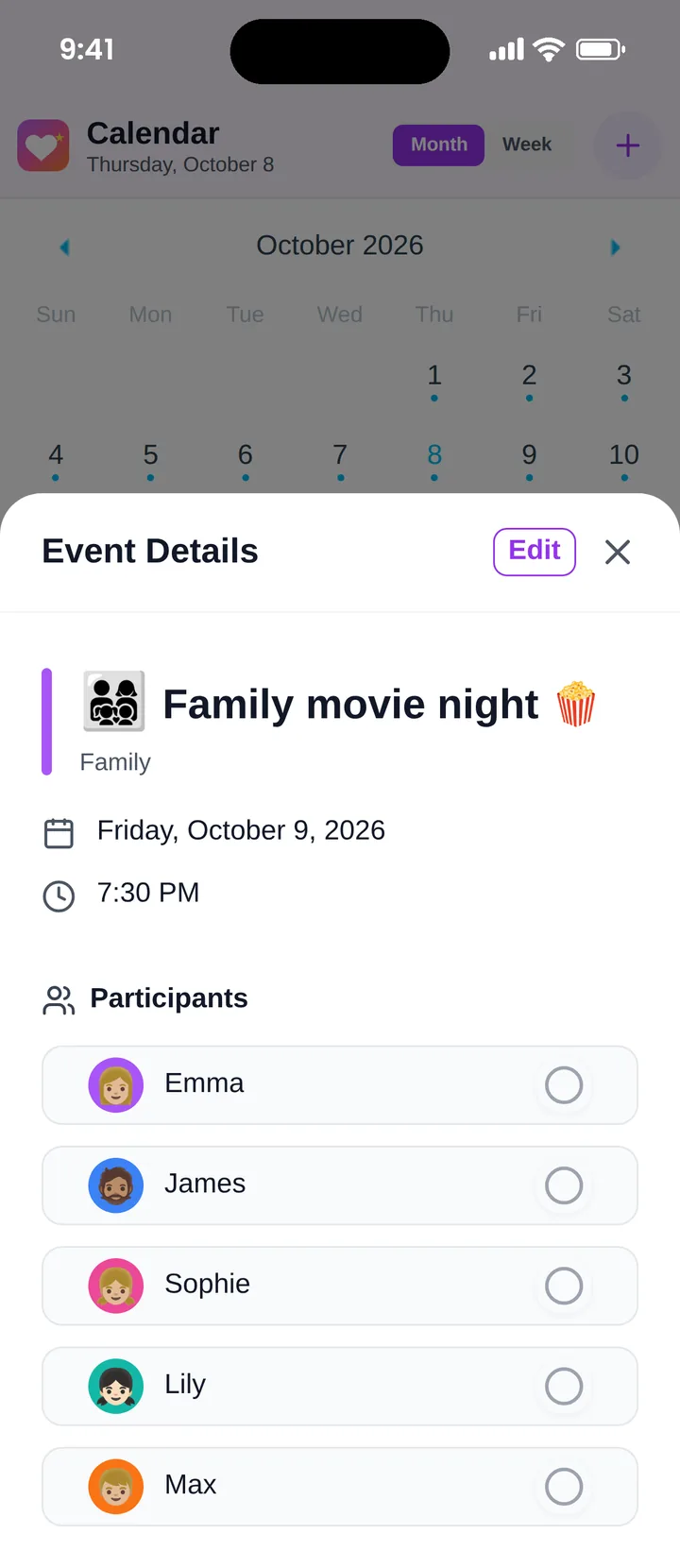
Famiyo is a free family app for iPhone and Android that combines a shared family calendar, chores with points and a rewards shop; kids join with a code, no email needed. For family time, you create an event, add every family member as a participant, and set it to repeat weekly. Each person sees it on their own phone, with a push notification, and the event details screen shows who is invited. Events can also carry points, so a family game night can count toward a reward the kids choose, such as picking the movie.
To compare options, see our list of the best shared family calendar apps.
This week, choose one window, name the ritual, and put it on the calendar before you close this page.
Frequently asked questions
How much family time is enough?
There is no standard number. A few regular points of real attention each week, such as shared dinners, a weekend morning and one-on-one time with each child, matter more than the total hours. Consistency is what kids notice.
What counts as family time?
Anything where people are together and paying attention: dinner without screens, a walk, a board game, cooking, a car ride with the music loud and everyone talking. Being in the same room while on separate phones usually does not.
How do we find family time with teenagers?
Go where they already are: late-night snacks, car rides, a show they pick. Offer short, optional things and let them choose. Pressuring a teen into a long outing usually backfires, so keep the ask small and regular.
What if family time keeps getting canceled?
Treat it like an appointment and move it rather than drop it. Have a backup slot and a five-minute version. If it is canceled more than twice in a row, the schedule is too full and something else should give.
How do we manage family time between two households?
Make the time you have count. Each home can have its own rituals, such as a handoff dinner or a Sunday walk, and both parents should keep them predictable. Consistency matters more than matching what the other home does.
Try Famiyo With Your Family
Chores with points, a rewards shop for kids and one shared family calendar. Set it up in a couple of minutes.



Free to download • No credit card required • Available on iOS & Android