Chore Chart for Couples: A Fair Weekly Template
A free chore chart for couples with a printable weekly template, a fair way to split household tasks, and a 15-minute check-in that keeps it from fading.
By Famiyo Editorial Team4 min read
Free printable
Chore Chart for Couples
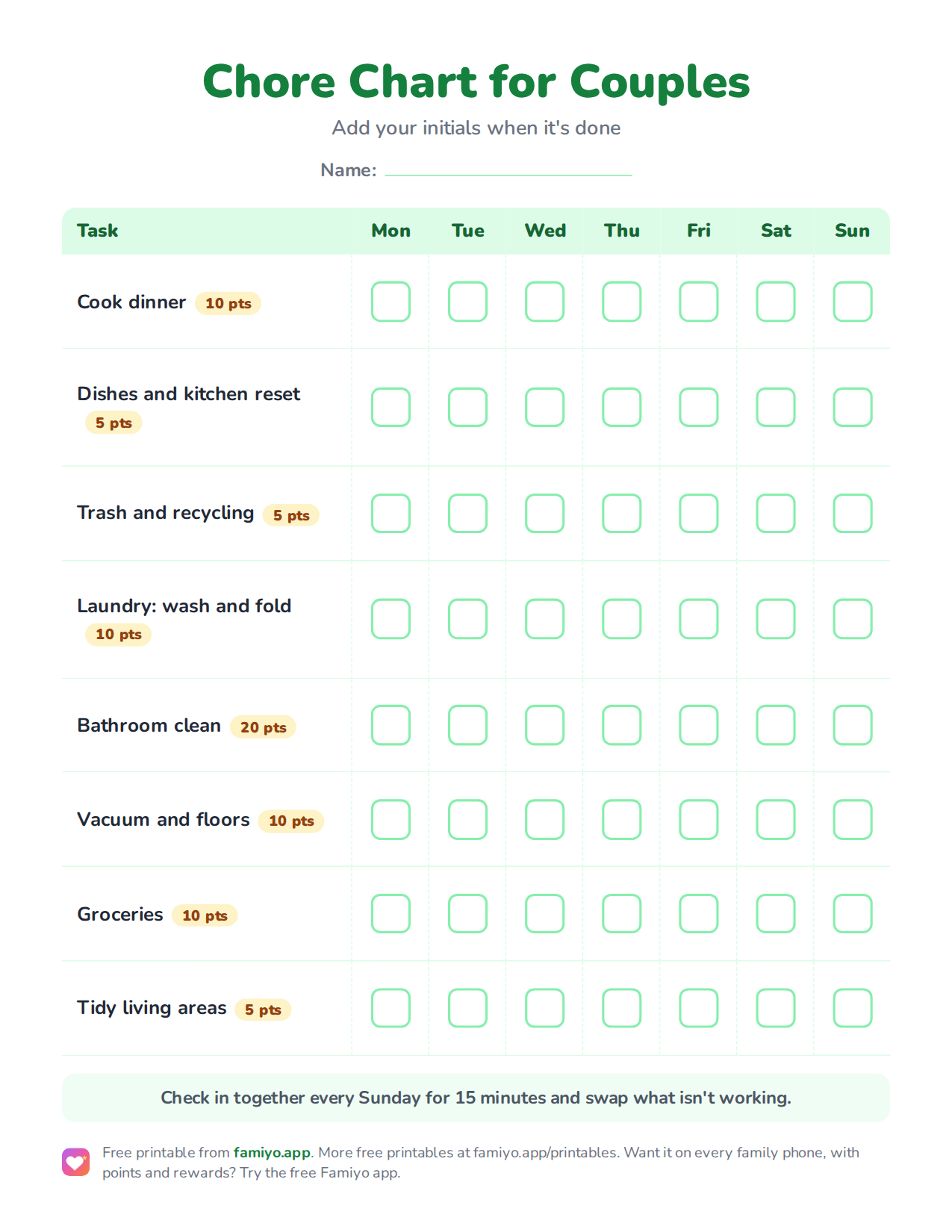
A weekly chart on one US Letter page. Download the PDF to print it, or save the image to use it on a tablet or in a document.
Free for home, classroom and nonprofit use, see the license. More free printables.
Two adults, one kitchen, and a sink that is full again. Most couples don't fight about chores because one person is lazy. They fight because nobody wrote down who does what, so each assumes the other is "supposed" to notice. A chart fixes that quietly. Below is a printable you can use today, a method for splitting the list, and a routine that keeps it from fading in three weeks.
What a couples chore chart should include
A chart for two adults is simpler than a chart for kids, but it needs the same basics: every recurring task, an owner, and a rhythm. Skip anything that happens once a year.
Start with the visible work: dishes, trash, laundry, cooking, cleaning the bathroom, vacuuming, groceries. Then add the invisible work that tends to sit with one person: planning meals, noticing when the toilet paper is low, booking the vet, managing the calendar. If it takes brain space, it belongs on the list.
The printable below has eight common tasks with point values, so you can see each person's effort at a glance. Points are optional. If you prefer, ignore them and use initials only. Edit the task names on the blank lines for your own home.
How to split the list fairly
Equal count is a trap. Cleaning the bathroom takes forty minutes and taking out the trash takes two. Here is a method that works better.
- Both of you write down every task separately, without comparing.
- Merge the lists, and add anything one of you forgot.
- Next to each task, write roughly how long it takes per week. Guess if you must.
- Mark the tasks each person dislikes. Everyone gets some of the ones they hate, no one gets all of them.
- Divide so the total time is close to even. If one person works longer hours, adjust the ratio, not the principle.
- Give each task a single owner for the week, even if you do it together sometimes. Shared ownership is how things fall through.
Fair does not have to mean 50/50 every week. It means that both people feel it is balanced over a month.
A sample week
Say one partner works from home and the other commutes. Here is one reasonable split.
| Task | Partner A | Partner B | When |
|---|---|---|---|
| Cook dinner | Mon, Wed, Fri | Tue, Thu | Evening |
| Dishes and kitchen reset | Tue, Thu, Sat | Mon, Wed, Fri | After dinner |
| Trash and recycling | Daily | Morning | |
| Laundry: wash and fold | Weekend | Saturday | |
| Bathroom clean | Weekend | Sunday | |
| Vacuum and floors | Weekend | Sunday | |
| Groceries | Weekend | Saturday | |
| Tidy living areas | Mon, Wed, Fri | Tue, Thu | Evening, 10 minutes |
Notice that nobody does everything on one day, and each person has a mix of small daily jobs and one or two bigger weekend ones. Swap columns every month so nobody is permanently stuck with the bathroom.
Make it stick with a weekly check-in
Charts rarely fail on day one. They fail around week three, when someone is tired and the chart stops being noticed. A short check-in prevents that.
Sit down for 15 minutes on a fixed day, such as Sunday evening. Ask three things: what felt fair this week, what felt heavy, and what needs to move. Change one thing, not five. Then look at the calendar for the week ahead, because a business trip or a late shift should shift the chores too.
A few ground rules help. Say what you need, not what the other person did wrong. Agree on a "good enough" standard so one person does not redo the other's work. And if a task keeps slipping, move it or drop it, rather than rewarding the cycle of reminding.
If you want a spreadsheet version instead of paper, we have a chore chart template in Google Docs and Sheets and a chore chart template in Excel. If you also have kids, our chore cards for kids page covers how to bring them into the same system.
Letting an app run the chart
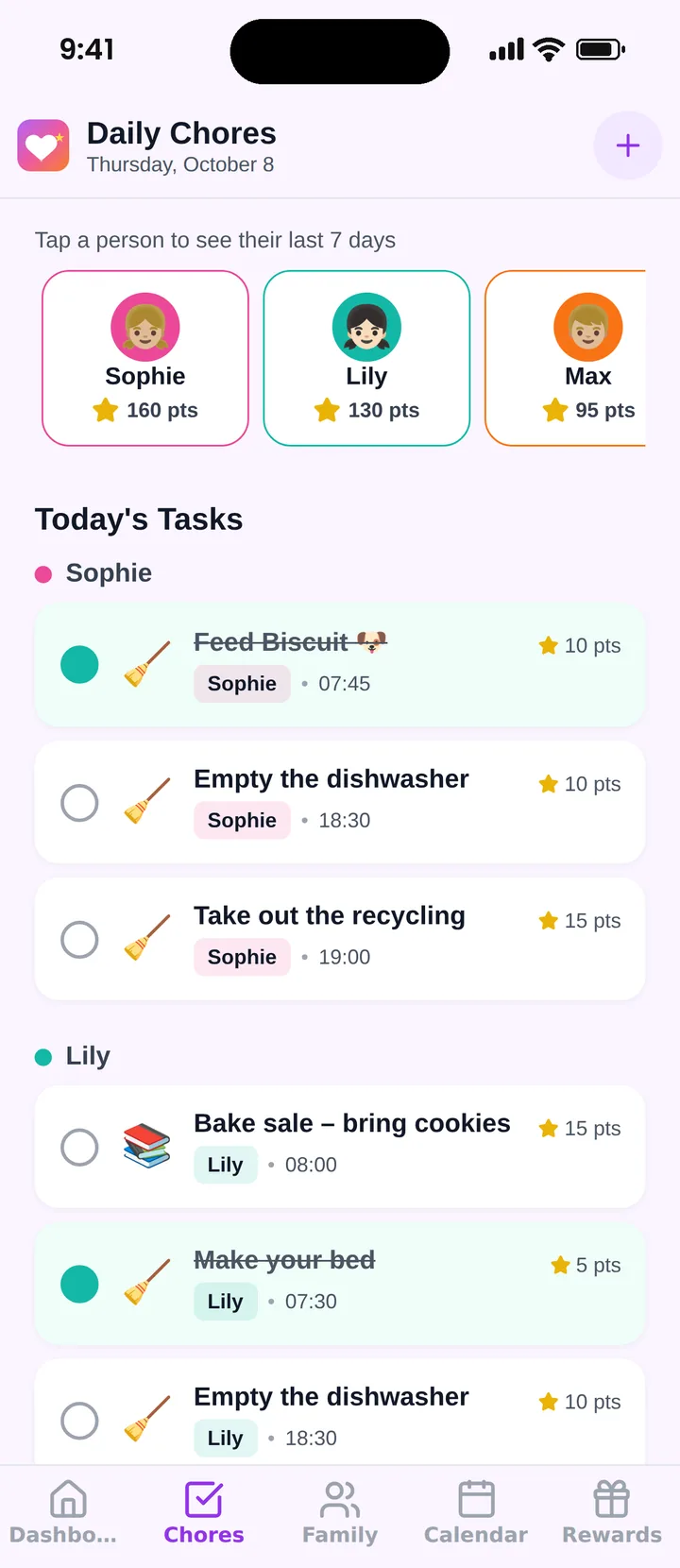
Famiyo is a free family app for iPhone and Android that combines a shared family calendar, chores with points and a rewards shop; kids join with a code, no email needed. For a couple, it can replace the paper chart: both adults can be administrators, chores can repeat daily or weekly so nobody has to rewrite the list, points show who has done what, and push notifications tell you when something is done. Everything syncs live between phones. The free plan includes 1 repeating task and up to 3 family members, so larger setups may need Premium. Our list of the best chore chart apps compares more options.
Print it and start
Print the weekly template, fill in the blank lines and put it on the fridge. Set the first check-in for next Sunday. After three weeks, you will know what to change.
Frequently asked questions
How do couples split chores fairly?
Fair means similar total time and effort, not an identical list. Write down every task, estimate how long each takes, then divide so both people carry about the same load. Swap the jobs neither of you likes, and revisit the split when schedules change.
How often should a couple review the chore chart?
A short weekly check-in of about 15 minutes works for most pairs, with a bigger review once a month or when work, health or family changes. Without a review, charts drift and resentment builds quietly.
What if one partner does more than the other?
Put the full list on paper first, including invisible tasks like planning, remembering and scheduling. Seeing the real totals makes the gap factual instead of emotional. Then move tasks, rather than asking for help, so one person owns the outcome, not just the assist.
Should couples use points or rewards for chores?
Some pairs like points as a light, playful way to track effort and see the balance. Others skip rewards entirely and just use the chart. Either works as long as both of you agree and nobody feels graded.
Try Famiyo With Your Family
Chores with points, a rewards shop for kids and one shared family calendar. Set it up in a couple of minutes.



Free to download • No credit card required • Available on iOS & Android