Chore Chart for Boys: Ideas by Age
A free printable chore chart for boys with jobs sorted by age from 4 to 13, point values, a sample week and ways to keep a busy boy checking boxes.
By Famiyo Editorial Team4 min read
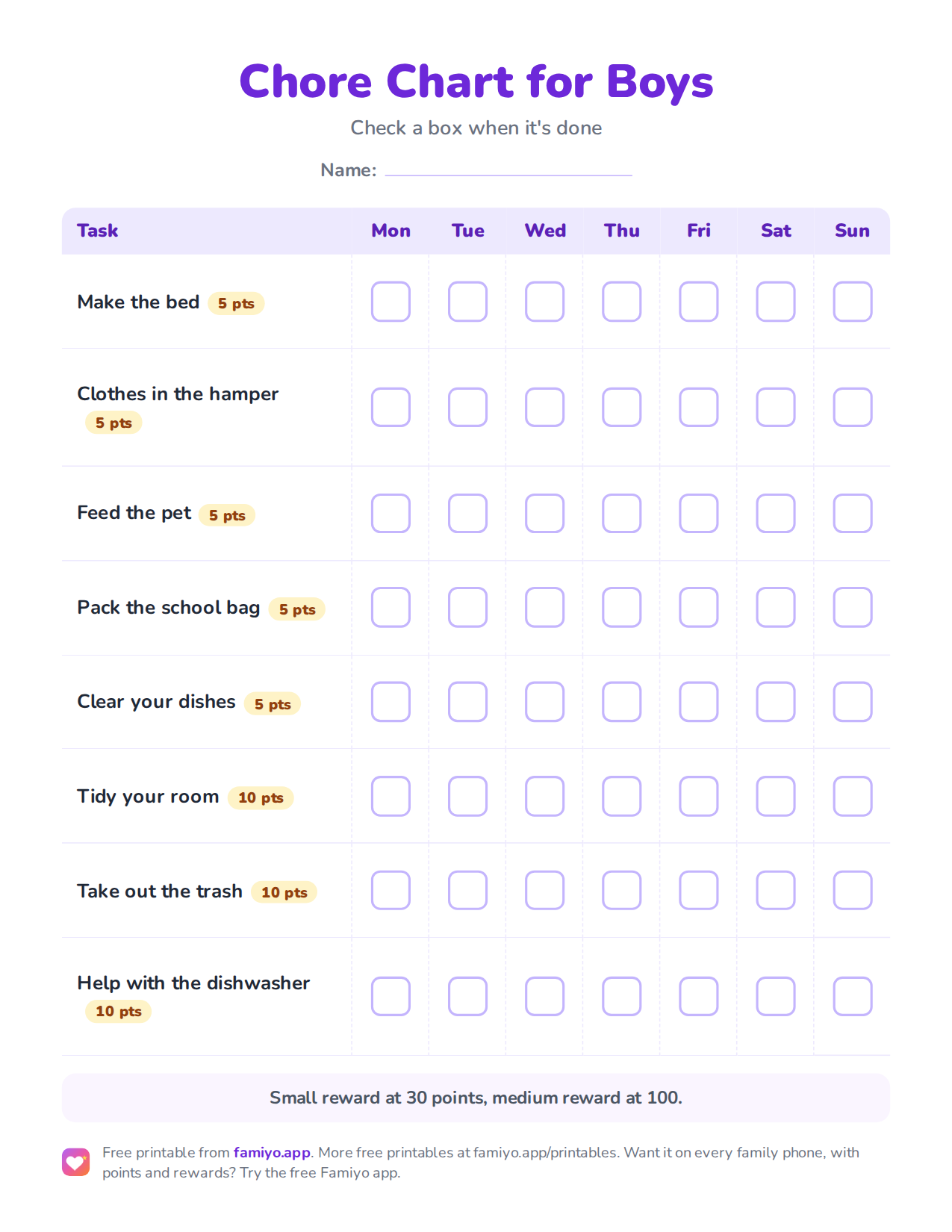
Free printable
Chore Chart for Boys
A weekly chart on one US Letter page. Download the PDF to print it, or save the image to use it on a tablet or in a document.
Free for home, classroom and nonprofit use, see the license. More free printables.
Boys can get "wait until you are older" about housework for a long time, and then a parent wonders why a 15-year-old has never used the washing machine. A good chore chart fixes that early by treating every job as a skill. This page sorts the jobs by age from 4 to 13, gives point values, and shows a sample week you can copy tonight.
What a boy's chore chart should look like
The best chart is plain. A short list of named jobs, a box for each day, and a place where he walks past it twice a day. Fancy themes wear off in about a week, so spend your effort on the list instead.
Sort by what a body and attention span can handle, not by gender. A boy who can carry a laundry basket can fold what is in it. Our kids responsibilities by age guide shows the wider picture if you want to see how these jobs fit into a childhood.
A few things do help with many boys, though they work for plenty of girls too. Jobs with a physical start and finish (hauling, sweeping, spraying, carrying) are easier to begin than open-ended tidying. A timer helps: "ten minutes, go." And a chart he can see his progress on beats one that only a parent reads.
Chores for boys by age
Use the row for his age and pick three or four jobs. Times are the daily total, not per job.
| Age | Daily jobs | Weekly job | Time per day |
|---|---|---|---|
| 4-6 | Make the bed (roughly), toys in the bin, clothes in the hamper, feed the pet, clear his own plate | Water plants | 10 to 15 minutes |
| 7-9 | Pack the school bag, tidy his room, empty the dishwasher, set the table, sweep | Take out the trash, vacuum one room | 15 to 30 minutes |
| 10-12 | Load the dishwasher, fold and put away laundry, wipe the bathroom sink | Clean the toilet, change bed sheets, wash the car | 30 minutes |
| 13 | Start to finish laundry, cook one dinner with a recipe, help with a younger sibling | Mow the lawn, shop from a list | 30 to 45 minutes |
Older boys keep their earlier jobs. A 10-year-old still makes his bed, and by then it takes him one minute. For the oldest row, our page on chores for a 13-year-old goes into the details, and the outdoor and yard chores for kids page has the yard jobs many boys like best.
Points that make sense to a boy
Points work well when the numbers are easy to do in your head. A simple scale:
| Task size | Example | Points |
|---|---|---|
| Small (2 to 5 minutes) | Make the bed, feed the pet | 5 |
| Medium (10 to 15 minutes) | Tidy the room, empty the dishwasher | 10 |
| Big (30 minutes or more) | Wash the car, mow the lawn | 20 |
| Bonus | Done without a reminder | +2 |
Then price the rewards so a boy reaches a small one every two or three days. Fifteen extra minutes of screen time or choosing dessert costs 30 to 50 points. Picking the family movie or staying up 30 minutes later is 100. A day out or a toy around $20 is 300 to 500, which is a goal for about a month. If you convert to money, 100 points equals $1. For more on keeping boys interested after the first week, see how to motivate kids to do chores.
A sample week
Say you have a 9-year-old boy. Daily: make the bed (5), pack the school bag (5), clear his dishes (5), tidy his room (10). Tuesday and Friday he empties the dishwasher (10). Saturday he takes out all the trash and vacuums the living room (30 together).
On a normal week that is about 35 points a day on school days and 60 on Saturday, so he earns a small reward by Wednesday and a movie pick by the weekend. If he forgets the bag twice, nothing dramatic happens. He just earns less, and you say, "Bag first, then screens, same as always."
Making the chart stick
Agree on the rules before you start. A page of household chores rules every adult agrees on keeps the chart from becoming a negotiation each evening.
- Tie each job to a moment: bed before breakfast, dishes right after dinner.
- Say what done looks like in plain words: "Floor clear, books on the shelf."
- Praise the effort: "You did the corners," not "good boy."
- Start small. Three jobs for two weeks beats eight jobs for two days.
Running the chart in Famiyo
Famiyo is a free family app for iPhone and Android that combines a shared family calendar, chores with points and a rewards shop; kids join with a code, no email needed. For a boys' chart, it replaces the paper: you set each chore to repeat daily or weekly, give it points, and your son gets a notification when a new task shows up. He checks it off on his own phone, or you approve it first, and you get a notification when it is done. Everything syncs live between phones, so a parent in another room sees the same list.
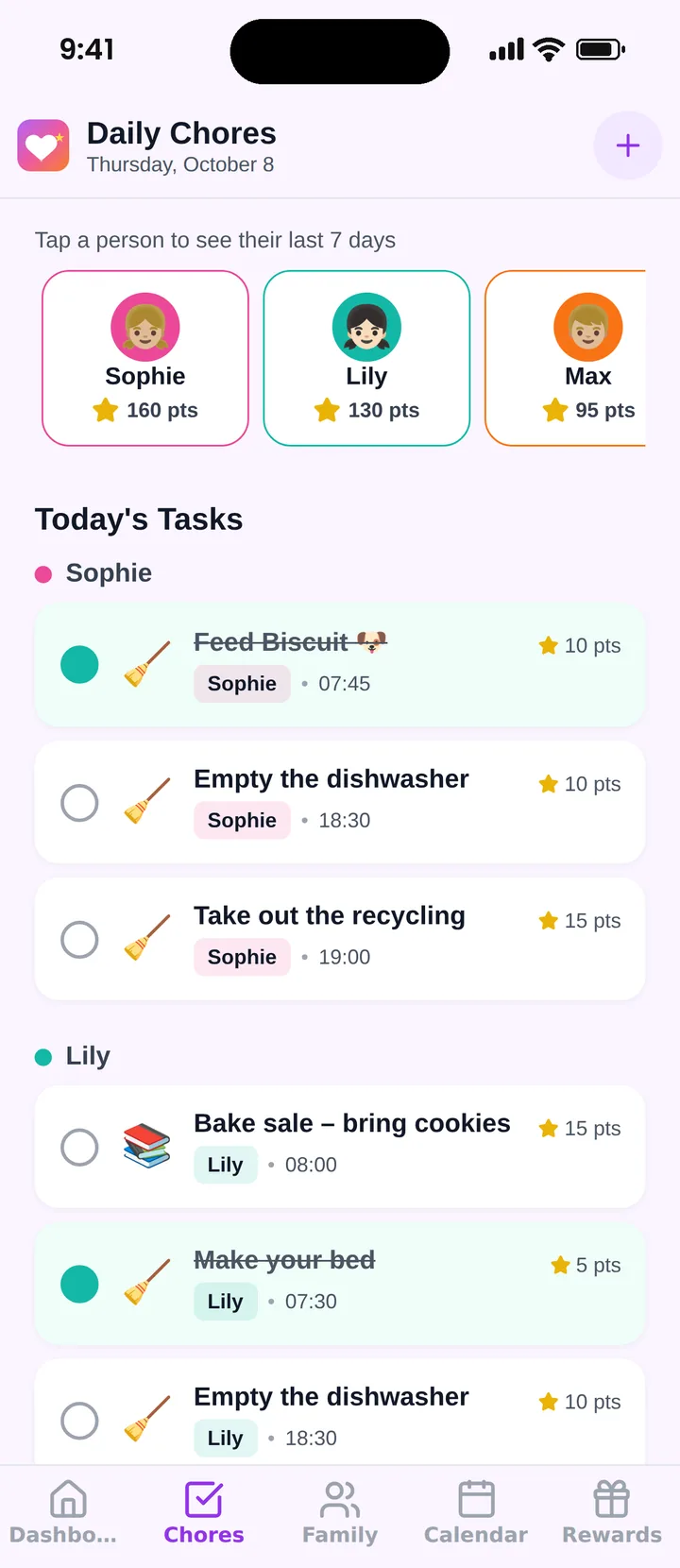
Compare options in our list of the best chore chart apps if you are choosing between several.
Print the chart above, pick three jobs from your son's age row and put it on the fridge today.
Frequently asked questions
What chores should a boy do?
The same ones as any child of his age. A 5-year-old makes his bed and feeds the pet, an 8-year-old loads the dishwasher and takes out the trash, and a 12-year-old cleans a bathroom sink and does laundry. Skills matter more than whether a job is traditionally for boys.
How many chores should a boy have on his chart?
Two to three daily jobs for preschoolers and three to four for school-age boys, plus one bigger weekly job from age 8. If the chart is full and still gets ignored, the list is usually too long, so cut it back before adding rewards.
How do I get a boy who hates chores to use the chart?
Make the jobs short with a clear end, tie them to a daily moment such as right after dinner, and let him choose between two jobs now and then. Movement-heavy tasks like sweeping, hauling the trash or washing the car often go over better than sitting tasks.
Should boys get paid for chores?
Most families keep everyday jobs unpaid and use points toward rewards, and pay a small amount only for extra jobs. A common weekly allowance range is $3 to $7 for ages 5 to 7, $7 to $10 for ages 8 to 10 and $10 to $15 for ages 11 to 13.
Try Famiyo With Your Family
Chores with points, a rewards shop for kids and one shared family calendar. Set it up in a couple of minutes.



Free to download • No credit card required • Available on iOS & Android