Chore Chart for Kids: How to Make One That Sticks
Choose a chore chart format for your child's age, pick the right chores, build it in one evening, introduce it well and run the first three weeks.
By Famiyo Editorial Team6 min read

A chore chart is the simplest tool for getting kids to help at home, and also the easiest one to abandon. The setup decides most of that. Here's how to choose a format, decide what goes on the chart, build it in one evening and introduce it so it's still running a month from now.
Choose a chart format that fits your child's age
The right format depends mostly on whether your child can read and how much novelty they need. Siblings don't have to share a format; a 4-year-old and an 11-year-old rarely want the same thing.
| Format | Best ages | Why it works | Downside |
|---|---|---|---|
| Picture chart with magnets or Velcro | 3 to 6 | No reading needed, and moving a picture to "done" feels great | Pieces go missing, so make spares |
| Sticker chart | 3 to 7 | Instant small reward for each chore | The novelty fades after a few weeks |
| Printed weekly grid | 6 to 11 | Shows the whole week at a glance | Needs a pen nearby and a fresh sheet each week |
| Dry-erase board | 6 to 12 | Reusable and easy to change | Gets wiped by accident |
| App on a phone or tablet | 9 and up | Goes where they go and updates live | Needs a device and a little setup |
If you're unsure, start with a printed weekly grid. It's cheap, it works for most school-age kids, and you'll learn quickly what your family needs before investing in anything fancier.
Decide what goes on the chart
Fewer chores than you'd like is the right number. The usual guide is 2 to 3 daily chores for preschoolers and 3 to 4 for school-age kids, with one weekly bigger job added from about age 8. Kids keep earlier chores as they grow, so a 10-year-old's chart still includes making the bed.
Every chore on the chart needs four things:
- a short name a child understands ("Feed Pepper," not "pet care"),
- a finish line you could check in five seconds,
- a time of day, such as before breakfast, after school or after dinner,
- a point value, if you use points.
Here is a quick pool to pick from:
- Ages 3 to 5: toys in the bin, clothes in the hamper, set and clear their own place, water the plants, help feed a pet.
- Ages 6 to 9: make the bed, pack the school bag, sweep, sort laundry by color, and from 8, load the dishwasher or vacuum one room.
- Ages 10 to 12: clean the bathroom sink and toilet, change the bed sheets, an after-dinner kitchen job.
- Ages 13 and up: their own laundry, cooking a family meal, mowing the lawn, helping a younger sibling.
If you're deciding which chores belong on the daily rows and which can sit on a weekly row, see our list of chores kids should do every day. For a fuller pool at each age, there's our age-appropriate chores list.
Leave two things off. Self-care, like brushing teeth, fits better on a separate morning or bedtime routine. And behavior goals ("be kind to your brother") don't belong on a chore chart at all. Mixing them makes every missed chore feel like a character judgment.
How to make a chore chart in 7 steps
Set aside about an hour one evening, after the kids are in bed.
- List what the house needs. Write down every recurring job, daily and weekly, without worrying yet about who does it.
- Match chores to each child by age. Give each child 2 to 4 daily chores and, from 8, one weekly job.
- Write the finish line. "Toys in the bins, floor clear" rather than "tidy the playroom." For pre-readers, draw it or take a photo of the finished result.
- Give each chore a slot. Morning, after school or evening. Kids follow sequences better than clock times.
- Lay out the grid. Chores down the left, Monday to Sunday across the top, one color per child.
- Decide what a check mark earns. If you use points, a simple scale is 5 for small chores, 10 for medium and 20 for big ones, with a small reward priced at 30 to 50 points.
- Post it at the child's eye level, where the chores happen or where they pass every morning.
A finished example for a 6-year-old and a 10-year-old
Here's what a completed chart might look like for two siblings. Each child has a color on the real chart; the table just shows the content.
| Chore | Who | When | Days | Points |
|---|---|---|---|---|
| Make the bed | Lily, 6 | Before breakfast | Every day | 5 |
| Put living room toys in the bins | Lily | Before bath | Every day | 5 |
| Pack the school bag | Lily | After dinner | Sun to Thu | 5 |
| Water the plants | Lily | After school | Wed and Sat | 5 |
| Make the bed | Noah, 10 | Before breakfast | Every day | 5 |
| Feed the cat and refill water | Noah | After breakfast | Every day | 5 |
| Load the dishwasher | Noah | After dinner | Every day | 10 |
| Clean the bathroom sink and toilet | Noah | Saturday morning | Sat | 20 |
A few things to notice. Both kids make their bed, which takes the sting out of "why do I have to?" Lily's chores are all small and spread across the day, so she never faces more than one at a time. Noah's are bigger, so he earns more: about 160 points in a full week against Lily's 105. Both can reach a small reward every 2 to 3 days.
How to introduce the chart
Give it ten minutes at a calm time, not right after an argument about a messy room. A simple order works well:
- Explain why. "Our family is a team, and the house needs work every day. Everyone has a part, including Mom and Dad."
- Show the chart and walk through each child's row.
- Offer one real choice. "Noah, do you want the dishwasher or taking out the recycling?"
- Explain what a check mark means and what points can buy.
- Explain what happens if a chore is missed. "The box stays empty. Tomorrow's a fresh start."
- Do a practice run that same evening, with you alongside.
Agree that you'll give one reminder per chore and then point at the chart. If that part is hard in your house, our guide to getting kids to do chores without nagging has scripts that help.
The first three weeks
Week one is for teaching. Do each chore together at least once: you show it, you do it together, then they do it while you watch. Expect to remind, and keep the tone light.
Week two is for stepping back. One reminder, then let the chart speak. Check the work briefly and name what went well: "The bins are full and the floor's clear. That's exactly it."
Week three is for review. Sit down for ten minutes on the weekend. What's easy now? What's annoying? Change one thing, not five. A new routine needs 2 to 3 weeks of steady use before you can fairly judge it, so resist rebuilding the chart on day four.
After that, a small monthly adjustment keeps it fresh. Move automatic chores off, add a harder one as skills grow, and rotate shared jobs between siblings. Our guide to rotating chores fairly covers the options.
Moving the chart onto a phone
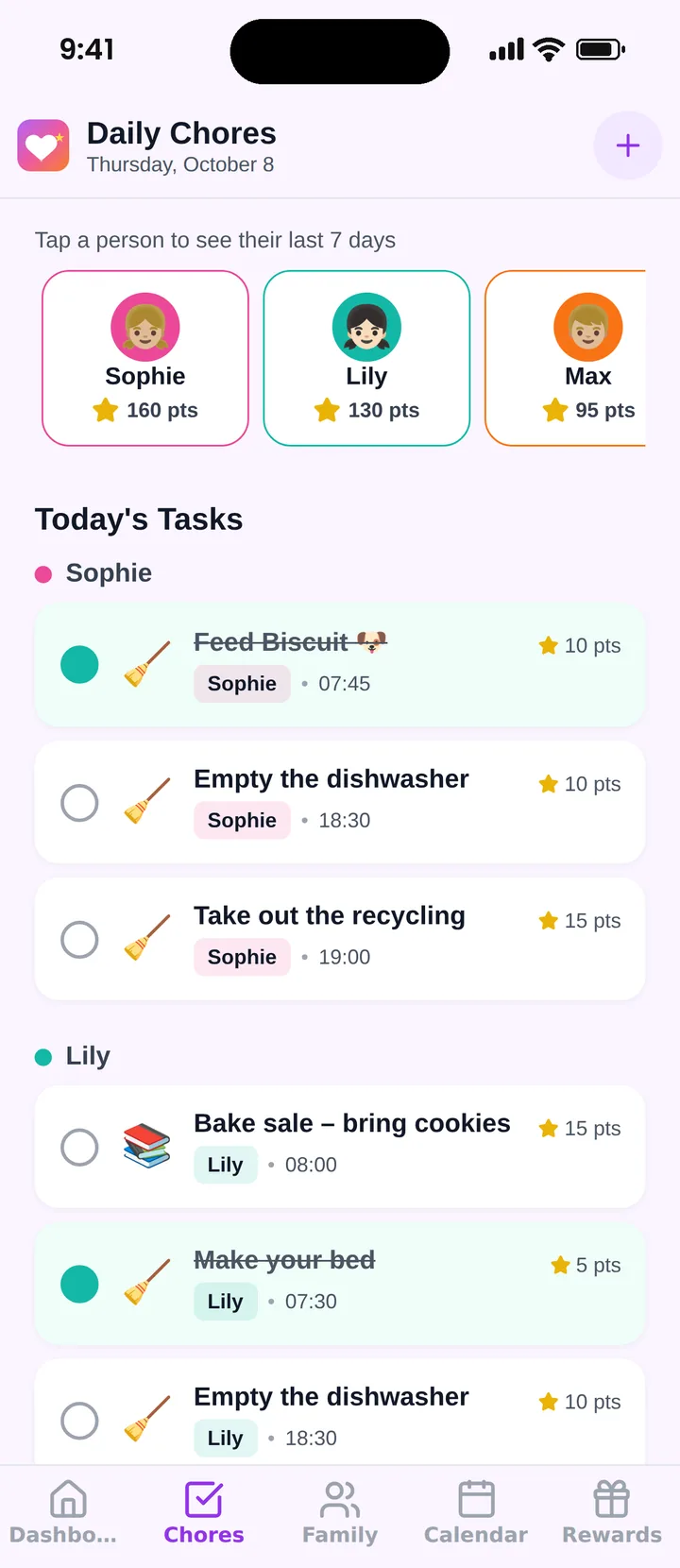
Famiyo is a free family app for iPhone and Android that combines a shared family calendar, chores with points and a rewards shop; kids join with a code, no email needed. Each chore on your chart becomes a task you add once: pick the child, set the points and choose whether it repeats daily, weekly or every few days. Kids get a notification about new tasks, see their list on their own phone and check chores off, or you approve them. Everything syncs live, so a parent at work sees the dishwasher is done. Points flow into the family rewards shop. The free plan covers up to 3 family members and 1 repeating task; Premium removes those limits.
For a broader comparison, see our list of the best chore chart apps.
Tonight, list what your house needs every day. Tomorrow, build the grid. By the weekend, you can hold the family meeting.
Frequently asked questions
What should be on a chore chart for kids?
Two to four daily chores that fit the child's age, one weekly bigger job from about age 8, and a clear finish line for each. Add the time of day each chore happens and, if you use points, the value next to it. Leave off anything you won't actually check.
How do you make one chore chart for several kids?
Use one shared grid with a row per child and a color for each, so everyone sees the whole family's work. Give each child age-matched chores rather than identical lists, and rotate shared jobs like taking out the trash every week so nobody is stuck with the least popular task.
What age is a chore chart good for?
Picture charts work from about age 3, once a child can match a picture to a task. Written charts suit kids who read comfortably, usually from around 7. Many older kids and teens prefer a list on their own phone. The format changes with age, but a few clear daily tasks stay at the core.
Where should you put a chore chart?
Put it where the chores start or where your child looks every day: the fridge, the back of their bedroom door, or beside the shoe rack. For older kids with phones, their own screen is often the place they actually look. A chart tucked in a drawer is a chart nobody uses.
Try Famiyo With Your Family
Chores with points, a rewards shop for kids and one shared family calendar. Set it up in a couple of minutes.



Free to download • No credit card required • Available on iOS & Android