Chores for 15 Year Olds: A Realistic List That Works
Chores for 15 year olds that fit a real school week: a list by area, minutes per job, a sample week, points and what to say when they push back.
By Famiyo Editorial Team6 min read

At 15, most kids can do almost anything on the family list. The hard part is not ability. It is that they have homework, practice, friends and a phone, and every request lands in a crowded evening. This page gives you a list that fits that reality: what a 15-year-old can own, how long it should take, how to spread it over a week and how to hand it over without a fight.
What chores can a 15-year-old do?
Nearly all of them, but they work best when grouped into whole jobs. "Take out the trash" is an errand. "Kitchen reset after dinner" is a job someone can own. The table below groups chores by area, with realistic minutes for a teen who knows what they are doing.
| Area | Chores a 15-year-old can own | Minutes | How often |
|---|---|---|---|
| Kitchen | Load and run the dishwasher, wipe counters and stove, cook a simple dinner (pasta, eggs, tacos, stir fry) | 10 to 40 | Daily, or one dinner a week |
| Laundry | Their own wash start to finish, plus towels or sheets | 15 active | Weekly |
| Bathroom | Clean sink, toilet, mirror and floor of a shared bathroom | 20 to 25 | Weekly |
| Floors and rooms | Vacuum the living room and stairs, tidy and vacuum their own room, change their bed | 15 to 30 | Weekly |
| Outside | Mow the lawn, rake leaves, shovel snow, wash the car | 30 to 60 | Weekly or seasonal |
| Pets | Feed, walk, scoop the litter box, brush | 5 to 20 | Daily |
| Family help | Pick up a younger sibling from the bus stop, help with homework for a short time, carry groceries | 10 to 20 | As needed |
| Errands | Shop from a list at a nearby store, return library books, post a package | 20 to 40 | Weekly |
You will not assign all of these. Pick the ones that match what your house really needs, and leave out anything that would feel like busywork. Teens spot make-work from across the street.
How much time is fair on a school night?
For a 15-year-old, 30 to 45 minutes of total chore time a day is a reasonable ceiling, and many days it will be less. Think in terms of a daily core of 10 to 15 minutes, and put the longer jobs on the weekend. A teen with a late practice should get a lighter list that day, not the same list at 9 p.m.
Sleep matters here too. The American Academy of Pediatrics and AASM recommend 8 to 10 hours for ages 13 to 18, and a lot of 15-year-olds are already short on it. Do not schedule a chore so late that it pushes bedtime. If the only gap is after 8:30 p.m., the chore belongs on a different day.
The counts that tend to work: three or four daily tasks, one or two weekly "big" jobs, and a seasonal job now and then. Anything past that and the list starts to feel like a second job.
A sample week for a 15-year-old
Here is a week for a teen with sports on Tuesday and Thursday. Notice how the heavy evenings stay light and the weekend takes the bigger work.
| Day | Daily core (about 10 minutes) | Extra job |
|---|---|---|
| Monday | Dishwasher after dinner, feed the dog | Their own laundry (15 minutes active) |
| Tuesday (practice) | Feed the dog | None |
| Wednesday | Dishwasher after dinner, feed the dog | Cook dinner (about 40 minutes) |
| Thursday (practice) | Feed the dog | None |
| Friday | Dishwasher after dinner, feed the dog | Take out trash and recycling |
| Saturday | Feed the dog | Clean the bathroom (20 minutes), vacuum their room |
| Sunday | Dishwasher after dinner, feed the dog | Mow the lawn or rake (45 minutes, in season) |
The one dinner a week is worth the trouble. A 15-year-old who cooks once a week for the family learns to plan, shop from a list, time several things at once and take feedback. Our guide to kitchen chores for kids by age has the steps that lead up to it, and laundry chores for kids by age covers how to teach the full wash cycle.
Which jobs should be theirs alone?
Ownership is the thing that changes at 15. A younger child does chores you assign. A 15-year-old can own a whole area, so you stop supervising and start checking the result.
Good candidates: their own laundry, one shared room such as the bathroom, the dog, the lawn, and one dinner a week. Each of these has a clear finished state, a regular time and no need for you to stand nearby.
A few rules make ownership work:
- Say what done looks like in a sentence. "Bathroom is done when the toilet, sink, mirror and floor are clean and the towels are swapped."
- Agree a deadline, not a time of day. "Before Saturday dinner" gives a teen room to choose.
- Let them be late once. Then ask what they need to change.
- Do not redo the job where they can see you.
If you also want a few jobs outside the house on the list, the ideas in outdoor chores for kids include yard work that suits a teenager well.
What to say when you hand over the list
Teenagers react badly to chores that arrive as an announcement. They react much better to a short conversation where they have a say. Try this order, on a calm evening and not in the middle of an argument.
- Say why: "The house runs on all of us, and you can handle more than you could two years ago."
- Show the draft list and the time it adds up to, such as "about 35 minutes on most days."
- Ask: "What would you change? Which of these would you rather own?"
- Let them swap one job for another, or move a day. Hold the total steady.
- Agree the deadlines and what happens if a chore is missed, in plain words, before it happens.
- Review it in two weeks and adjust.
A teen who helped shape the list will argue with it less. If the evenings still turn into battles, our piece on how to get kids to do chores without yelling goes through what to say when the answer is "later."
What to do when a chore does not get done
Start with the schedule, not the character. Say a chore keeps slipping on Thursdays. Look at Thursday. Practice, homework, dinner at 7:30. The chore may simply not fit that day.
If the schedule is fine and the chore is still missed, use a consequence that connects to the job and is agreed in advance. The dishwasher is not unloaded, so the next day it has to be done before the phone comes out. A repeated miss means a 5-minute talk, not a lecture: "This is the third time. What is getting in the way?"
Avoid taking away things that have nothing to do with the chore, such as a friend's birthday party. It teaches that the rules are about anger, not about the household.
Tracking it in Famiyo
Famiyo is a free family app for iPhone and Android that combines a shared family calendar, chores with points and a rewards shop; kids join with a code, no email needed. For a 15-year-old, that means a list on their own phone with only their own tasks, which works better than a note on the fridge they will not read. Give each chore a point value from the usual scale (5 for small, 10 for medium, 20 for big, plus 2 when done without a reminder) and let them check each one off, or have a parent approve the bigger ones.
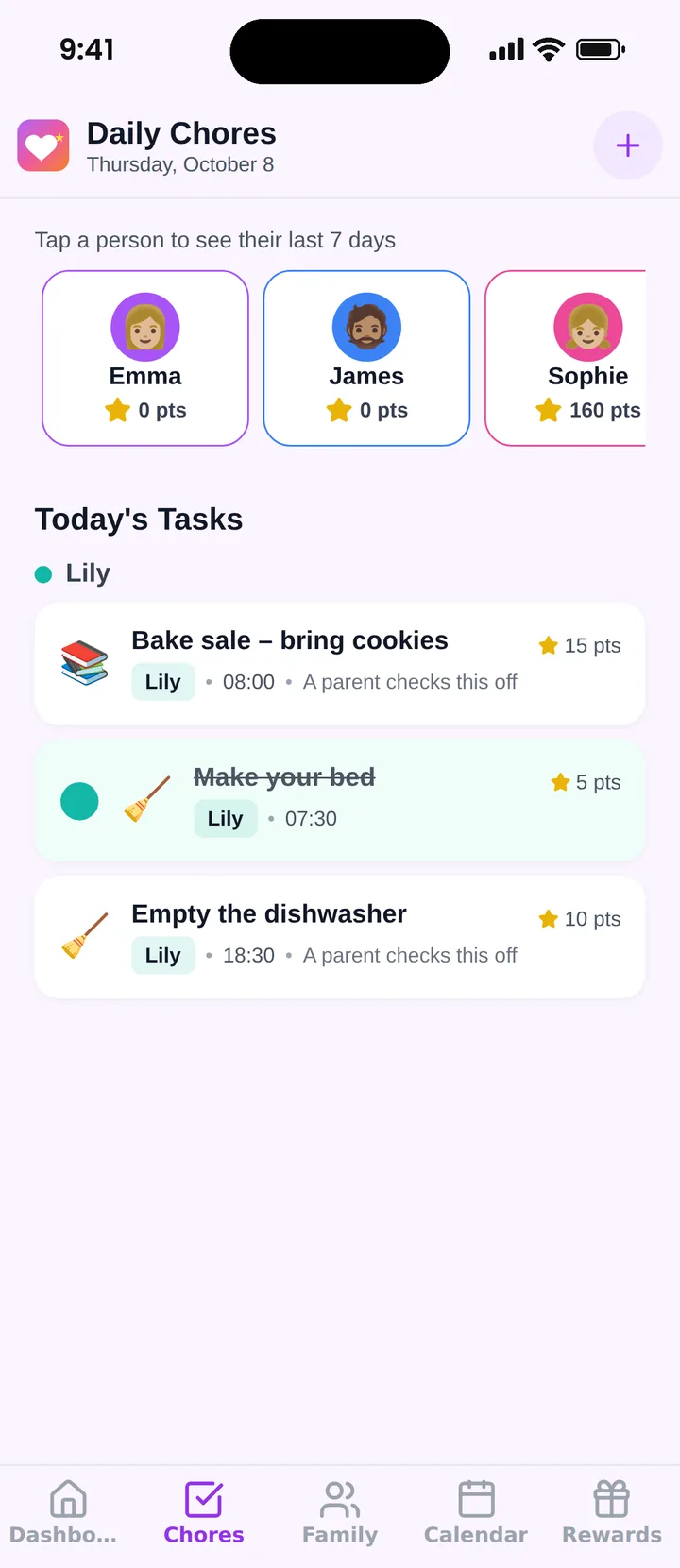
Repeating tasks cover the daily core, and the calendar shows practice nights so you can see why Tuesday is light. If you are comparing options, see our list of the best chore apps for kids.
This week, sit down with your teen, pick three daily tasks and one weekly job from the table, and agree on when each is due.
Frequently asked questions
How many chores should a 15-year-old have?
Three or four daily tasks plus one or two bigger weekly jobs is a good range. That adds up to roughly 30 to 45 minutes on a school day. Go lower during exams or a sports season, and say so out loud so it feels fair.
Should a 15-year-old do their own laundry?
Yes, this is a good age to hand it over completely: sort, wash, dry, fold and put away. Pick a fixed day, show them the settings once, and let one shrunken sweater do the rest of the teaching.
What if my 15-year-old says they are too busy for chores?
Take it seriously and look at the real week together. Chores can shrink in a heavy week, but they should not vanish. Swap daily tasks for one longer weekend job, and agree what counts as done before the deadline.
Should I pay a 15-year-old for chores?
Keep the everyday jobs unpaid because they are part of living in the house. Pay or award points for extra, bigger jobs such as washing the car or yard work. That keeps the line clear between helping and earning.
What chores are too much for a 15-year-old?
Anything that depends on a teen being the household's only adult, such as regular care of young children for long stretches, or work with dangerous tools without training. Chores should stay below the load of a part-time job.
Try Famiyo With Your Family
Chores with points, a rewards shop for kids and one shared family calendar. Set it up in a couple of minutes.



Free to download • No credit card required • Available on iOS & Android