Why Kids Don't Want to Do Chores (and What Actually Helps)
Why kids don't want to do chores, from unclear jobs to tired brains, and what helps: smaller tasks, fewer reminders, real choices and a system that nags for you.
By Famiyo Editorial Team6 min read
It is 6:40 on a Wednesday. You have asked three times. Your child is lying on the floor in what looks like a protest. The dishwasher is still full. If this is a regular scene in your house, you are in good company, and the problem is rarely that your child is lazy. This guide goes through the real reasons kids dig in, what to try for each and how to stop being the household alarm clock.
Why kids resist chores
Resistance is information. Look for which of these fits.
| What you see | What may be going on |
|---|---|
| "I don't know how" or sloppy results | The job was never shown, or "clean your room" is too vague to start |
| Stalling, wandering off | The task feels huge, so it is hard to begin |
| Big reaction to being told | It is a power struggle, and saying no is the only control they have |
| Fine on weekends, fighting on weekdays | Tired after school, hungry or overloaded |
| "It's not fair" | A sibling seems to do less, or the rules change from day to day |
| Works for others, not for you | Tone, nagging or a lecture attached to the request |
Sometimes it is simply that chores are boring and a screen is not. That is normal, and no chart will make a toilet brush more fun than a tablet. What a chart can do is make the chore predictable, so the fight is smaller.
Check the setup before you blame the kid
Most chore battles are setup problems in disguise. Run through this list.
- Is the job doable at their age? A 4-year-old cannot "tidy the playroom." A 4-year-old can put the blocks in the blue bin. Our piece on a chore chart for a 4-year-old shows what fits.
- Does your child know what done looks like? "Clothes in the hamper, books on the shelf, bed pulled up" is a finish line. "Clean your room" is not.
- Is the timing right? Asking mid-game, right after school or at 8 pm when they are fading is asking for trouble. Pick a calmer moment and attach the job to something that already happens.
- Are there too many? Three or four daily tasks is plenty for a school-age child.
- Is the rule the same every day? Kids resist most when the rules shift. Say it once, keep it steady.
What actually helps
Shrink the task
Break the job into one visible step. "Pick up everything red" beats "tidy up." Once they have begun, momentum tends to carry them through.
Give a real choice
Offer two options where both are fine. "Do you want to empty the dishwasher before dinner or after?" The chore is not up for debate, but the timing is. Choice shifts a child from "being told" to "deciding."
Say it once, then use the "when/then" line
Skip the repeated asks. Try: "When the dishwasher is empty, then tablets come out." Say it calmly, walk away and do not argue. This is not a threat. It is the order of the evening. For a deeper look at this approach, see our guide to cooperation without coercion in chores.
Start together
Do the first two minutes side by side, then step back. Kids often resist loneliness in a task more than the task itself.
Let them grumble
A sigh and an eye roll are not refusal. If they are still moving, let it go. Calling out every grumble keeps the fight alive.
Treat the room-cleaning fight as its own problem
Rooms are the most common battleground because the mess belongs to the child and the job feels endless. Our articles on why kids hate cleaning their room and how to break the job into steps go deeper.
What to say when your child flat-out refuses
Here are words that work better than the third repeat.
- "I can see you don't want to. The dishwasher still needs emptying before screens."
- "Do you want my help for the first minute, or do you want to start alone?"
- "I'm not going to argue about it. I'll be in the kitchen when you're ready."
Then stay calm and follow through. If the consequence is that screens wait, they wait, with no extra lecture. The next day, the same rule applies. Predictability, not intensity, changes the pattern.
Different ages, different reasons
The same "no" means different things at different ages, so the fix changes too.
| Age | Typical reason | What helps |
|---|---|---|
| 3 to 5 | Wants to be in charge, loses interest fast | Two choices, a game, doing it together |
| 6 to 9 | Unclear finish line, easily distracted | A short checklist, a "when/then" line, quick rewards |
| 10 to 12 | Feels it is unfair, wants a say | Let them pick which jobs are theirs, hold the standard, see our list of chores for 12-year-olds |
| 13 and up | Wants autonomy, resents being managed | Agree on deadlines instead of times, then step back |
For the youngest group, the point is to keep it playful. For tweens and teens, the point is respect: they will often do the same job if they chose when and how.
What not to do
Some responses feel natural in the moment and make the next fight worse. Skip the lecture about how much you do for them, since it teaches them that chores are a punishment. Skip comparing them to a sibling or a cousin. Skip redoing the job in front of them, because they learn that effort is pointless. And skip paying for every single task out of desperation. It works for about a week and then the price goes up.
A family with a few agreed rules fights less than one with none. Our article on household chores rules lists the ones worth agreeing on, like when chores happen, who checks and what happens if they do not get done. Keep it boring and predictable.
Rewards, points and when they help
A reward system can lower the temperature, because the child sees a clear trade: do the job, earn a point, spend points on something they care about. Used lightly, it moves the conversation from "you have to" to "you get to earn." Keep the points modest and the rewards quick, and skip rewarding behaviors that should be automatic like brushing teeth.
Do not expect points alone to fix resentment. If a child feels the whole thing is unfair or too heavy, extra points just buy a reluctant yes. Fix the load first.
Let the system do the reminding
Part of why chores turn into nagging is that you are the only reminder in the house. Every "did you do it yet?" adds friction. Handing the reminding to a system, a visual chart, a timer or an app notification, takes you out of the role of enforcer. The child still has to do the job, but they are answering to the list, not to you.
Using Famiyo to stop the nagging
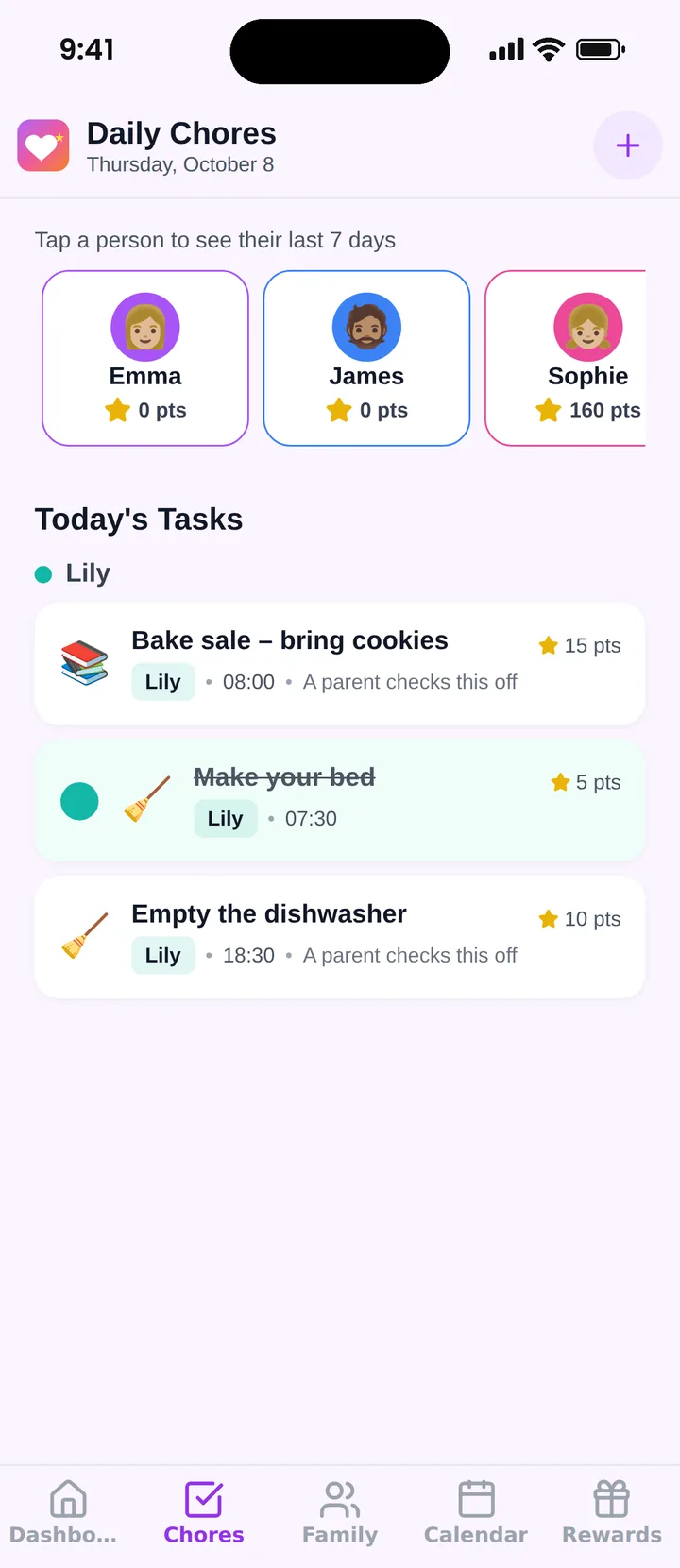
Famiyo is a free family app for iPhone and Android that combines a shared family calendar, chores with points and a rewards shop; kids join with a code, no email needed. Kids get a notification when a new task is added, see their own tasks and points on their own phone and check them off themselves, or a parent approves them if you prefer. You get a notification when a chore is done, so you can stop asking.
If you want to compare tools, see our list of the best chore apps for kids.
Give it three weeks
Pick one change this week, such as a shorter list or a "when/then" line, and hold it for two to three weeks before judging. Most families see the pattern shift in that window, and if it does not, trim the list again.
Frequently asked questions
Why does my child refuse to do chores?
Usually the job is vague, too big, interrupts something they enjoy or has turned into a power struggle. Ask what feels hard about it, shrink the task, say exactly what done looks like and give notice before it starts.
Is it normal for kids to hate chores?
Yes. Almost every child complains at some point, and plenty of adults do too. Complaining is not the same as refusing. Stay calm, keep the expectation and let them grumble while the work gets done.
Should I punish a child who won't do chores?
Punishment tends to turn chores into a battle. A better move is a calm, predictable consequence tied to the task, such as 'Screens come on after the dishwasher is empty.' Say it once, then follow through without a lecture.
How many chores is too many?
For school-age kids, 3 to 4 daily tasks plus one weekly big job is a reasonable load. For preschoolers, 2 to 3. If your child is in constant conflict about chores, try cutting the list in half for two weeks.
Try Famiyo With Your Family
Chores with points, a rewards shop for kids and one shared family calendar. Set it up in a couple of minutes.



Free to download • No credit card required • Available on iOS & Android