Chores for 17 Year Olds Getting Ready to Leave Home
Chores for 17 year olds as a practice run for adult life: skills to master, a 12-month plan, a run-the-house week and how to check progress.
By Famiyo Editorial Team6 min read
A 17-year-old has about a year left under your roof, give or take. Chores at this age are less about keeping the kitchen clean and more about a rehearsal: can this person feed themselves, wash their clothes, keep a schedule, spend within a budget and ask for help properly? This guide lays out which skills to focus on, how to structure the final year and what to say when your teen thinks they have it covered already.
Which skills matter most before a teen leaves home?
Most parents guess at the list. It helps to name it, because a teen who can recite the skills they already have is often surprised by the gaps. The table below pairs each skill with a way to practice it at home and a simple test that shows they can do it.
| Skill | Practice at home | How you know they have it |
|---|---|---|
| Laundry | Their own wash weekly, plus towels and sheets | They can read a care label and have not ruined anything in two months |
| Cooking | Plan, shop for and cook 2 or 3 dinners a week | They can feed themselves five different meals without a recipe card |
| Cleaning | Own bathroom and one common room to a written standard | You can inspect it in two minutes and it passes |
| Money | Monthly budget, pay one bill, check the balance weekly | They can say where last month's money went |
| Appointments | Book their own dentist or doctor visit | They call, confirm and show up on time |
| Home care | Change a lightbulb, unclog a drain, reset a breaker, find the water shutoff | They can do it while you watch, without help |
| Time | Keep their own calendar and deadlines | They miss fewer than one a month |
Do not try to teach all seven at once. Pick two for the next three months and keep the rest ticking over.
What does a good week of chores look like at 17?
Daily load stays at about 30 to 45 minutes, similar to the earlier teen years. What changes is how the time is arranged. A 17-year-old can run the day without a parent calling out each step.
A balanced week might look like this: a 10-minute kitchen reset each evening, one load of their own laundry, a bathroom clean, two or three family dinners, one outdoor or car job and a quick Sunday review. The table above is a baseline if you want a list to start from, with the larger jobs on the weekend.
The point is that none of these needs a reminder after the first couple of weeks. If you still say "have you done the dishes" every night, the structure is wrong, not the teen. Move the job to a fixed slot, such as right after dinner, and let the schedule do the nagging.
How to run a practice month
The most effective step is a trial run. For one month, your 17-year-old runs a piece of the household, as an adult would.
- Pick a window, such as the four weeks before exams end or a school break.
- Give them their own groceries. They plan the meals, write the list, shop with a set budget and cook for themselves, and often for the family.
- Hand over their own laundry and room completely. You do not touch either.
- Ask them to keep a one-line daily log: what was done, what slipped.
- Meet at the end for 20 minutes. Ask what was harder than expected and what they would change.
A teen who runs a shopping budget for four weeks learns more than one who reads about it. If groceries are a stretch, start with one dinner a week and add. Kitchen chores for kids by age shows the earlier stages if there are gaps, and laundry chores for kids by age does the same for the washer and dryer.
A 12-month plan for the final year
Spread across the year, the changes feel small and the result is large.
| Months | Focus | What the teen takes on |
|---|---|---|
| 1 to 3 | Food | Plan and cook 2 dinners a week, shop with a list |
| 4 to 6 | Money | Monthly budget, pay a bill, open a savings pot |
| 7 to 9 | Home | Practical repairs, deep clean one room, run the household for a week |
| 10 to 12 | Independence | Book appointments, handle paperwork, manage their own calendar |
If the year includes exams or applications, slow the plan down. A teen under heavy pressure should keep the daily list short and move the learning tasks to weekends.
What to say when they say "I already know how"
Sometimes they do. Sometimes they have watched the dishwasher run and think that counts. A calm test works better than an argument: "Great. Show me. Plan Wednesday's dinner, buy it with $25 and cook it." Then look at the result, not the confidence.
If they do have it covered, say so and move on to the next skill. If the dinner is a bag of chips and a frozen pizza, you have your answer and it did not require a fight. Our chore schedule for kids guide is a useful template for a written weekly plan that you can review together.
Resist the urge to rescue them. A teen who forgets to buy detergent and has to wear yesterday's shirt has learned something in a way a lecture never delivers. Rescue only when the safety or a school deadline is at stake.
Where payment fits
Keep everyday jobs unpaid. Use points or pay for extras, such as a big yard project. At 17, many teens are earning at a job, so household contributions can be framed as responsibility, not income. Some families ask for a modest contribution toward the phone bill or car costs. If you do, set the amount with your teen, explain what it covers, and keep it the same for the year.
What to check, and how often
Inspect less than you think, but do it on a schedule. A 10-minute weekly review on Sunday is plenty: look at the list, ask what was hard and sign off the week. Walk through the bathroom or the kitchen only if there is a question. Teens react well to a predictable check and badly to surprise inspections.
Keep notes on what slipped and why. If laundry was skipped three weeks running, the problem might be the slot you picked and not the skill. Move it, and look again in two weeks. If a skill is solid, stop checking it and move on. The goal is a teen who needs you less each month, and that only happens if you let go of the tasks they have already mastered.
Planning it in Famiyo
Famiyo is a free family app for iPhone and Android that combines a shared family calendar, chores with points and a rewards shop; kids join with a code, no email needed. A 17-year-old can see their jobs on their own phone, check them off, and use the shared calendar to plan around work shifts and exams. Give each recurring job a deadline, set point values with the default scale and let your teen pick rewards from the shop, such as a later curfew or a friend dinner out.
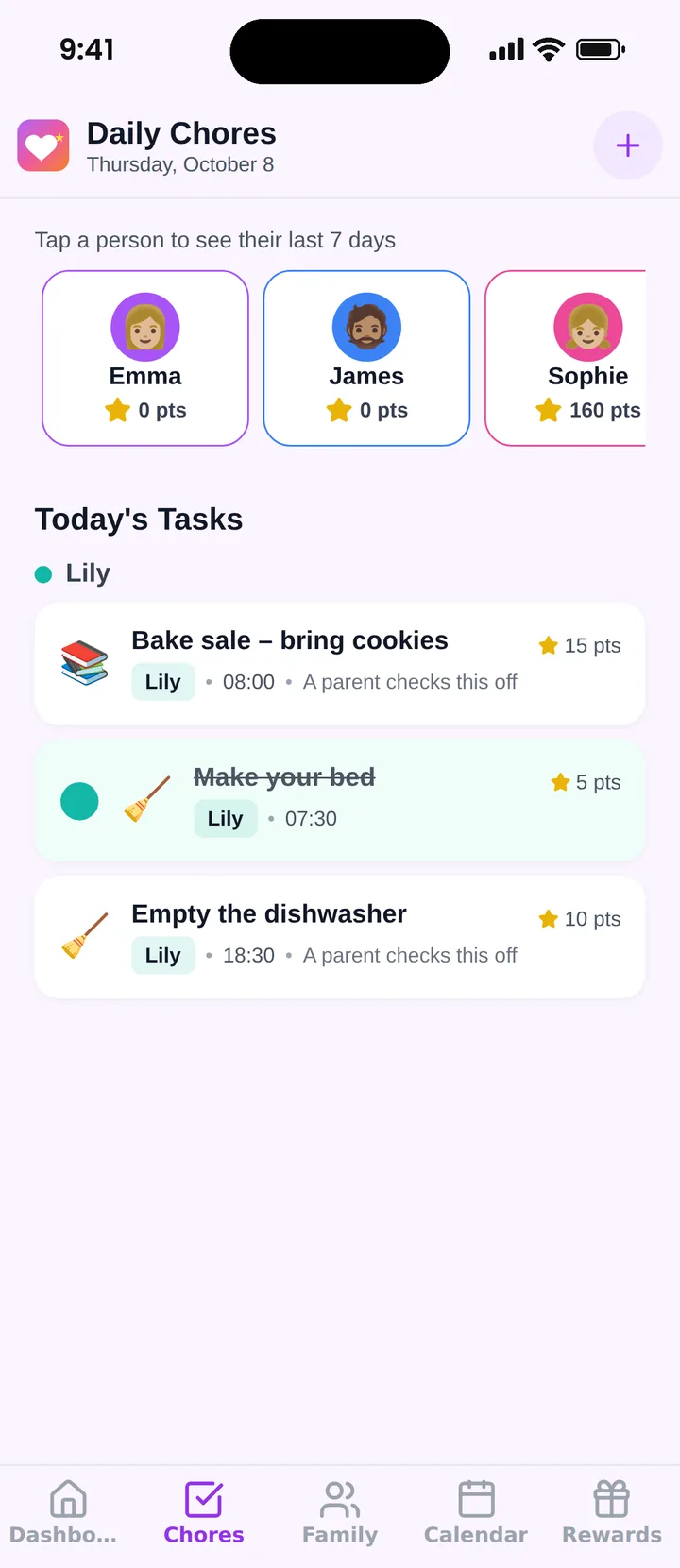
Parents see when each job is done, so the Sunday review takes minutes. If you are comparing apps, see our list of the best chore apps for kids.
Choose two skills from the table this week and put a date on the first practice run.
Frequently asked questions
What chores should a 17-year-old do?
Run their own laundry, cook two or three family dinners a week, clean a bathroom and kitchen to a standard, handle yard or car care, and manage a share of errands. The goal is full responsibility for an area, not a longer list.
How do I prepare my 17-year-old to live on their own?
Hand over real systems for a month at a time: their own food, laundry and schedule. Add money tasks such as a budget and paying a bill, and let them book their own doctor visit. Step in only for safety.
Should a 17-year-old still have a chore chart?
Yes, but it should look like a shared plan, not a star chart. A weekly list on their phone with deadlines works well. Reviewing it together for 10 minutes a week replaces most reminders.
What if my 17-year-old does not clean to my standard?
Agree the standard in writing first, in a sentence per job. When a job falls short, show the missed spot once and let them redo it. Expect a gap between your standard and theirs, and settle on one that is clean enough.
How much should a 17-year-old with a job contribute?
Chores stay, though the list can be lighter on work days. Some families also ask for a small contribution toward a phone bill or car insurance. Decide it together, keep it modest and tell your teen what it covers.
Try Famiyo With Your Family
Chores with points, a rewards shop for kids and one shared family calendar. Set it up in a couple of minutes.



Free to download • No credit card required • Available on iOS & Android