Why Do Kids Hate Cleaning Their Room?
Kids hate cleaning their room because the job is too big, too vague and too lonely. Seven real reasons, what each looks like, and the fix that matches it.
By Famiyo Editorial Team6 min read
You said "clean your room" an hour ago. Your kid went in, sat on the floor, found a Lego set from last spring, and is now building it. The room is messier than before. This is not a character flaw, and you're not raising a slob. Kids hate cleaning their room for a handful of predictable reasons, and once you know which one you're dealing with, the fix gets a lot more obvious.
The short list of reasons
Most rooms fail for more than one reason at once. Look for the two or three that sound like your house.
| Reason | What it looks like | What helps |
|---|---|---|
| The job is too big and vague | Kid stands in the middle of the room doing nothing | One category at a time, written down |
| Too much stuff, not enough places | Things get "cleaned" into piles | Fewer things, a home for everything |
| It's boring and lonely | Constant breaks, wandering off | Do it together, add a timer and music |
| It interrupts something better | Meltdown when you call them | Fixed time of day, not on demand |
| Your standard isn't theirs | "But I DID clean it" | A picture or list of what "done" means |
| It's their room, not yours | Teen slams the door | A few non-negotiables, the rest is theirs |
| The nagging is the trigger | Fight starts at the word "room" | Let a list or reminder do the asking |
"Clean your room" is too big to start
To an adult, "clean your room" is one task. To a 7-year-old, it's forty. Pick up the clothes, decide which are dirty, find where the cards go, figure out whether a broken crayon is trash, and do all of it in some order. That takes planning and sorting skills that develop slowly through childhood and keep developing into the teen years.
When kids can't see where to start, they don't start. Or they start with the most interesting thing on the floor, which is how a cleanup turns into a Lego session.
The fix is to break the room into categories and hand them over one at a time:
- Dirty clothes into the hamper.
- Clean clothes folded or hung up (or, honestly, put in the drawer).
- Trash into the trash can.
- Books on the shelf.
- Toys and games into their bins.
- Everything else onto the bed, then sorted from there.
For younger kids, say one step at a time and come back. For kids 8 and up, a written list taped inside the door works. Our list of chores kids should do every day shows how a quick daily room reset fits in, and that's the real secret: a room reset every day for 5 minutes never turns into the Saturday disaster.
There's too much stuff and nowhere to put it
Here's the uncomfortable one. Many kids' rooms hold more things than they have spaces for. If the toy bins are full, there is no "putting away." There's only stuffing, piling and shoving under the bed.
Do a quick check. Can every item on the floor go somewhere specific right now? If not, the problem isn't your kid. Pull out a bag of toys they haven't touched in a month and store it somewhere else. Give each category one container with a picture or label. Keep the bins open, since lids are one more step a 6-year-old will skip. When the room has fewer things, cleaning it takes minutes instead of an afternoon.
It's boring, lonely and it interrupts something better
Cleaning a room alone is dull. You'd also wander off if someone shut you in a messy room with no music and told you to come out when it's done. And it usually lands right in the middle of something good, because that's when parents notice the mess.
Two changes help a lot. First, keep them company, at least for younger kids. You don't have to do the work, just be in the room folding laundry or chatting. Second, make it a set time rather than an ambush. "Room reset is right after dinner" beats "go clean your room now" every time, because nobody gets yanked away from a game. A timer helps too: 10 minutes, a song playlist, done when it ends.
Your standard isn't their standard
Ask a 9-year-old if their room is clean, and they'll say yes while standing on a hoodie. They aren't lying. They genuinely see "clean" differently, and they've never been told what you mean by it.
Spell it out. Take a photo of the room when it's done to your standard and tape it by the door. Or write the finish line: floor clear, bed pulled up, clothes in the hamper, desk empty except for the lamp. Then check against the list, not against your mood that day. A clear standard also stops the "I DID clean it" argument, because the list settles it.
It's their room, and they know it
Somewhere around the tween years, the room turns into private territory. Being told how to keep it can feel like losing control of the only space that's really theirs. Pushing harder on a 12-year-old usually just makes the door close louder.
Pick a few rules that actually matter: no food or dishes, dirty clothes in the hamper, nothing that smells, a path to the bed. Agree on them together. Leave the rest, like how the desk looks or whether the posters are straight, to them. For what tweens can realistically own around the house, see our list of chores for 12-year-olds.
The nagging became the chore
After enough rounds, the fight isn't about the room anymore. It's about the asking. You say "room," your kid hears criticism, and both of you are annoyed before anyone has picked up a sock.
Changing the messenger breaks the loop. A list on the door, a fixed time and a reminder that isn't your voice all do the asking for you. When you do need to say something, try:
- "It's 7:00. Room reset, then you're free."
- "Clothes first. I'll come back in 5 minutes."
- "When the floor is clear, we can start the movie."
Each one is short, tells them the next step and doesn't comment on their character. Our guide to gentle parenting and chores has more ways to hold the line without a lecture.
When it's more than a messy room
Most messy rooms are just messy rooms. But if your child struggles to start or finish lots of everyday tasks, not only cleaning, or gets very upset at the idea of throwing anything away, mention it at their next pediatrician visit. That's not a diagnosis, just a conversation worth having. Visual lists, short steps and doing it together help whatever the reason.
Letting the reminders come from Famiyo
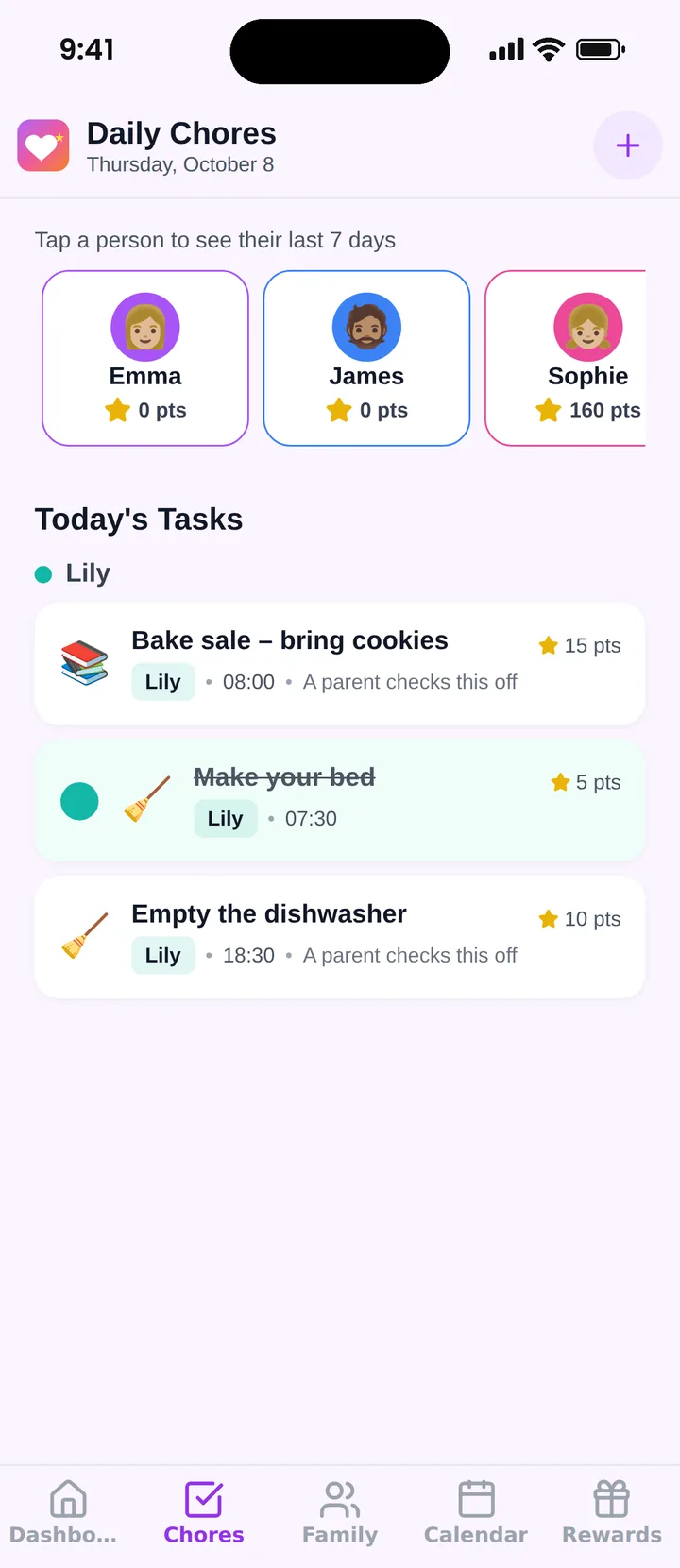
Famiyo is a free family app for iPhone and Android that combines a shared family calendar, chores with points and a rewards shop; kids join with a code, no email needed. For room cleaning, add "Room reset" as a daily repeating chore worth 10 points. Your child sees it on their own phone with their other tasks and gets a push notification about new tasks, so the reminder isn't coming from you in the hallway. When they check it off, you get a notification too, and you can choose to approve it after a quick look at the floor. The points go toward rewards you set in the shop, like an extra 15 minutes of screen time. For other options, see our list of the best chore apps for kids.
Tonight, skip the big cleanup. Pick the one reason from the table that fits your kid best and change just that.
Frequently asked questions
Why does my child get overwhelmed cleaning their room?
A messy room is dozens of small decisions at once: where does this go, is this trash, what do I do first. Kids under about 10 often can't break that into steps on their own. Give one category at a time ('all the clothes first') and the overwhelm usually drops right away.
Is it normal for kids to hate cleaning their room?
Yes. Very few children enjoy it, and many adults don't either. Disliking it is normal. What you can change is how hard it is to start and how long it takes. A room that can be reset in 10 minutes gets cleaned far more often than one that needs an hour.
Why do teenagers hate cleaning their room so much?
For teens the room is private territory, so cleaning on a parent's order can feel like losing control of their own space. Agree on a short list of non-negotiables, like no food and dirty clothes in the hamper, and leave the rest of the room to them.
Should I clean my child's room for them?
Doing it for them now and then won't ruin anything, but if it becomes the routine, the room never becomes theirs to manage. A better middle ground is cleaning together: you take one category, they take another, and you leave before the last few minutes so they finish it.
When is a messy room a sign of something more?
If your child can't start or finish many everyday tasks, not just cleaning, or gets very distressed about throwing anything away, mention it to their pediatrician. A messy room alone is rarely a red flag, but it can be one piece of a bigger pattern worth talking about.
Try Famiyo With Your Family
Chores with points, a rewards shop for kids and one shared family calendar. Set it up in a couple of minutes.



Free to download • No credit card required • Available on iOS & Android