Chores for 18 Year Olds Living at Home
Chores for 18 year olds living at home: what is fair to expect, a household agreement, a sample list, and how to talk to an adult child without a fight.
By Famiyo Editorial Team6 min read

An 18-year-old is a legal adult and still eats your food, uses your Wi-Fi and may still leave a cereal bowl in the sink. The old chore chart with stars feels wrong at this age, and no list at all is not fair to the rest of the household. What works is a different frame: they live in a shared home, so they carry a share of keeping it running. This guide covers what that share can look like, how to agree it and what to do when it is not working.
What is a fair set of chores for an 18-year-old?
The test is simple: would a roommate be expected to do this? If yes, an 18-year-old can do it. The table below sorts jobs into three groups, based on how much ownership they involve.
| Group | Jobs | Time |
|---|---|---|
| Their own life | Laundry, bedroom, bed linen, own dishes, own appointments | 20 to 30 minutes a day, on average |
| Shared spaces | Kitchen reset after meals, one bathroom, vacuuming a living area, trash and recycling | 10 to 15 minutes a day |
| Family jobs | Cook 2 or 3 dinners, mow the lawn, walk the dog, wash the car, shop for the week | One or two a week, 30 to 60 minutes each |
Add them up and you get about 30 to 45 minutes on a normal day, a bit more than younger teens, with the big jobs landing on the weekend. If your 18-year-old works or studies full-time, the numbers drop on busy days.
For the stage before this one, see our page on chores for 17 year olds, which covers how the same jobs were handed over earlier.
Chores, rent or both?
These are two different questions and it helps to keep them apart.
Chores are the baseline of sharing a household. They do not depend on income. A student with no job still does their share, since living there means using the space.
Rent or a contribution is a money decision, and the answer depends on income, whether they are in school and what your family can afford. Some families charge nothing during school and ask for a modest contribution once there is a full-time job. Others ask for a small amount toward a phone plan or car insurance from the start. There is no single right answer, but there is a wrong one: leaving it unsaid and resenting it.
If you are unsure, try this order: agree on chores first, then talk about money after a month, once the first conversation has settled.
How to set up a household agreement
A written agreement is the best tool for adult children, because it replaces reminders. It does not need to be formal. A single page works.
- Set a time for a calm conversation, not right after a clash.
- Open with what the house needs: "Here is what keeps the place running."
- List the jobs and ask what they will take. Let them choose first.
- Fill in the rest so the load is fair for everyone living there, including you.
- Agree on deadlines, not times. "By Saturday evening" beats "at 10."
- Say what happens if a job slips, in plain terms, and keep it related to the job.
- Put a review on the calendar for one month out.
Write it somewhere you can both see it. A shared note, a fridge sheet or a family app all work. Our chore checklist for kids has a simple layout you can adapt, even though the wording is for younger kids.
What to say when it is not working
Say the 18-year-old has promised to run the dishwasher and the kitchen is still a mess by Sunday. Three approaches, in order.
First, ask, without heat: "Dishes were on your list this week. What got in the way?" Sometimes there is a real answer, such as an exam or a double shift.
Second, point to the agreement: "We agreed on this. Can you do it tonight?" A direct request, with a reasonable deadline, is not nagging.
Third, if it keeps happening, use the consequence you set at the start. Charging a small fee for a service you cover for them, such as laundry done by you or a ride they could have walked, is a fair adult approach. Do not take away things unrelated to the job, and do not do the work in silence and resent it.
If the conflict is constant and about more than chores, say, drifting, mood or sleep, it may help to talk with a counselor or your doctor. That is not a chore problem and should not be handled as one.
How is this different from clearing a teenager's room?
It is different in tone. A younger teen needs reminders and rules about the mess. An 18-year-old may keep their room as they like, as long as it does not affect others: no food that attracts pests, no wet towels that cause mold, no blocked hallways. If you are still fighting about the room, our guide to getting a teenager to clean their room covers practical ways to set the standard without the war.
Shared spaces are where your expectations are firm. The kitchen, living room and bathrooms belong to everyone.
A sample agreement
Here is a one-page example for an 18-year-old with a part-time job and community college classes.
| Area | Jobs | When |
|---|---|---|
| Own | Laundry, bedroom, own appointments | Weekly, by Sunday |
| Shared | Kitchen reset after dinner four nights, vacuum living room | Daily, weekly |
| Family | Cook dinner Tuesday and Thursday, walk the dog on weekends | As listed |
| Seasonal | Yard cleanup in spring and fall, help with holiday setup | See our holiday chores for kids for ideas |
| Money | Pays their own phone bill | Monthly |
When your 18-year-old works or studies full-time
Chores still apply, but the load needs to match reality. A teen on a 40-hour week or a heavy course load cannot also run a full home list. Agree a short version for busy weeks: their own laundry, their own room and one shared job. Then agree what moves to a day off, so the bigger jobs are done and not forgotten.
Also think about what they do in exchange for what you do. If you still cook, wash their clothes and drive them to work, say what you will keep doing and what is now theirs. Often the cleanest split is a service list: "I will cook on weekdays, you cook on weekends. I will do the shared laundry, you do your own." It reads like a housemate arrangement, which is exactly the point.
Check in at set moments, such as the start of each semester or after a job change. The agreement from last spring may not suit a new schedule, and a quick rewrite shows that you take their time seriously.
Using Famiyo for this
Famiyo is a free family app for iPhone and Android that combines a shared family calendar, chores with points and a rewards shop; kids join with a code, no email needed. For an 18-year-old, the points are optional and some will find them childish, so many families use only the calendar and the shared task list: set repeating jobs with deadlines, let them check off their own work, and keep the household plan in one place that everyone can see.
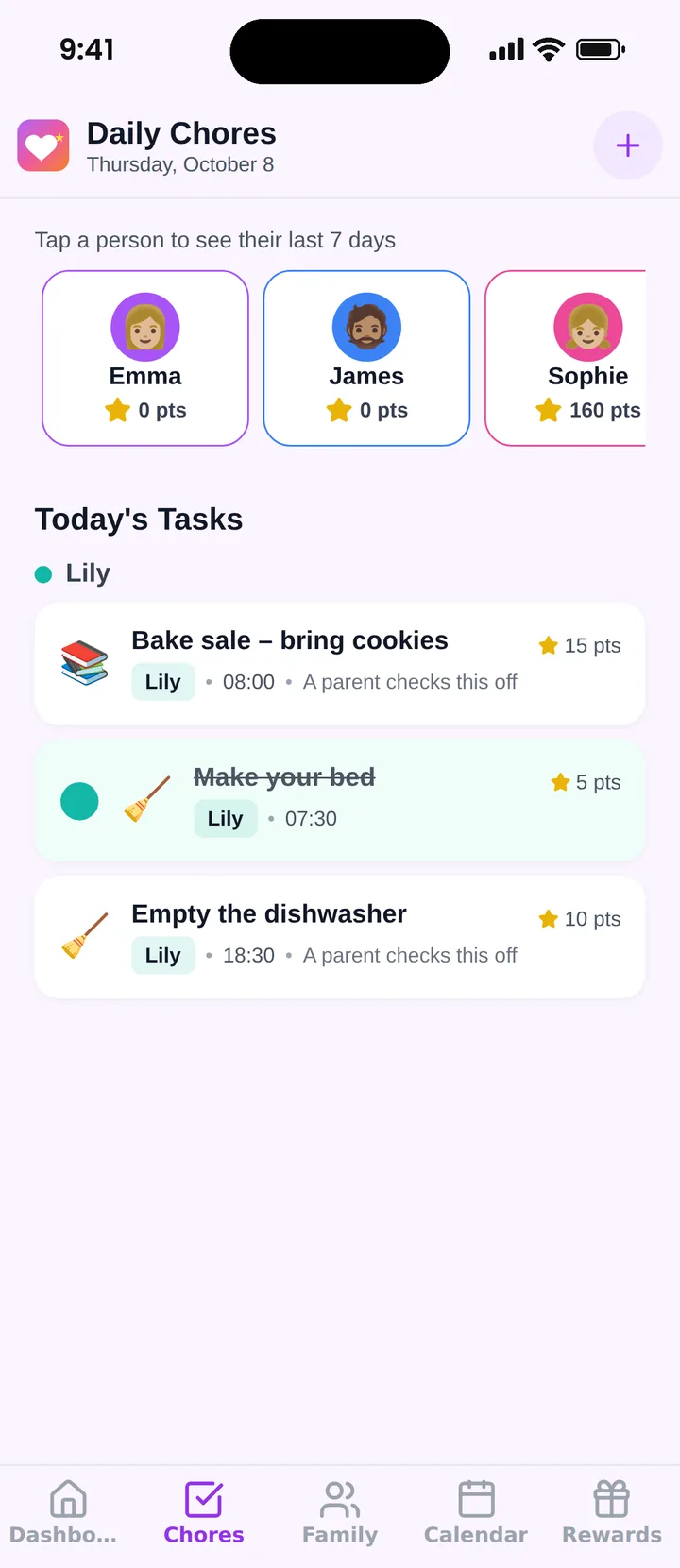
If your 18-year-old likes a challenge, points toward rewards you both agree on, such as a night out or a gas voucher, can work. See our list of the best chore apps for kids if you are comparing options.
Pick a calm evening this week to start the conversation, and bring a draft with just three jobs on it.
Frequently asked questions
What chores should an 18-year-old living at home do?
Their own laundry and room, a weekly bathroom or kitchen job, two or three family dinners, yard or pet care and shared errands. That is roughly what any adult housemate would carry, about 30 to 45 minutes a day on average.
Should an 18-year-old pay rent or do chores?
Many families do both, in different amounts. Chores are the baseline for living in a shared house. Rent or a contribution is a separate decision based on income, school and your finances. Agree it in writing so it feels fair.
How do I talk to an 18-year-old about chores without a fight?
Treat it as a housemate conversation. Pick a calm time, say what the house needs, ask what they will take on and write the agreement down. Review it after a month. Avoid raising it while you are angry about a mess.
What if my 18-year-old is at college and comes home on breaks?
Keep it light and agreed in advance: their own laundry and room, a couple of dinners, and one shared job. They are a guest and a family member at once, so a short list that really gets done beats a long one.
Can I charge or penalize an adult child who will not help?
You can set clear house rules and consequences, such as a charge for services you would otherwise do for them. Keep it proportionate and agreed beforehand. If conflict is constant, a calm third party, such as a family counselor, can help.
Try Famiyo With Your Family
Chores with points, a rewards shop for kids and one shared family calendar. Set it up in a couple of minutes.



Free to download • No credit card required • Available on iOS & Android