Chore Chart for a 6-Year-Old: Ideas That Actually Get Done
A free printable chore chart for a 6-year-old with seven age-right jobs, point values, a sample week and tips for keeping a first grader on track.
By Famiyo Editorial Team4 min read
Free printable
Chore Chart for a 6-Year-Old
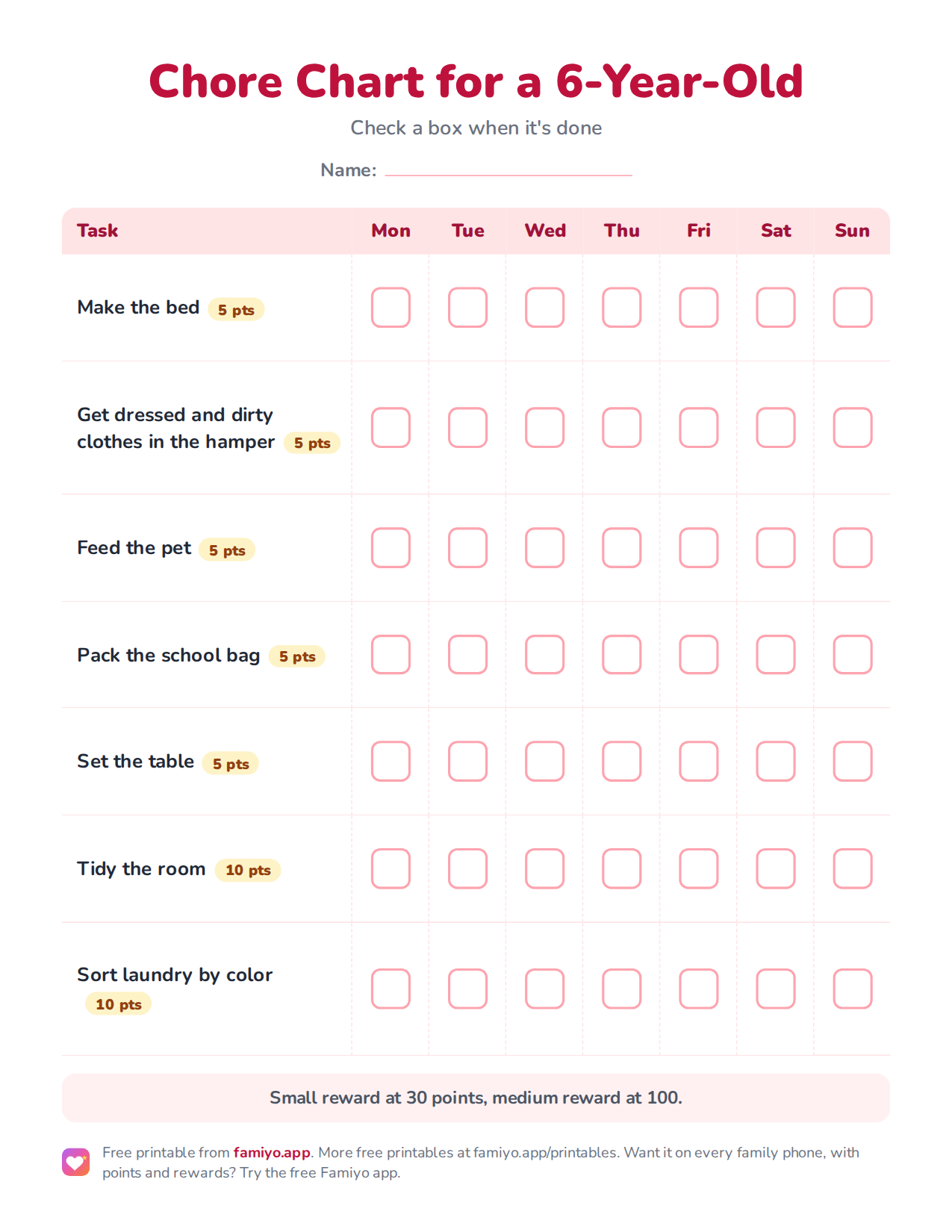
A weekly chart on one US Letter page. Download the PDF to print it, or save the image to use it on a tablet or in a document.
Free for home, classroom and nonprofit use, see the license. More free printables.
Six is a good age for a first real chore chart. A 6-year-old can read a few words, follow a three-step job and feel proud when it is finished. The chart below has seven age-right jobs, a sample week, and the details that decide whether it gets used past the first Sunday.
The printable chart
The printable below has seven jobs and boxes from Monday to Sunday, with points beside each task. It suits a child in first grade or an older kindergartner, and you can cross out anything that does not fit your house. Print it, pick a spot at your child's eye level and add a pen on a string.
Three to four of these jobs per day is plenty, and the weekly job is optional. In total, a typical day with this chart should take 15 to 20 minutes.
What a 6-year-old can really do
Six-year-olds are steadier with their hands and better at remembering than they were at five. They can sort, carry and sweep. They still need the job to have a clear end and an adult nearby to start it.
| Chore | Time | Points | What "done" looks like |
|---|---|---|---|
| Make the bed | 3 minutes | 5 | Blanket pulled up, pillow at the top |
| Get dressed, dirty clothes in the hamper | 5 minutes | 5 | Nothing on the floor |
| Feed the pet | 3 minutes | 5 | Bowl filled to the line, water changed |
| Pack the school bag | 5 minutes | 5 | Folder, water bottle and library book in |
| Set the table | 3 minutes | 5 | One plate, cup, fork and napkin per person |
| Tidy the room | 10 minutes | 10 | Floor clear, toys in bins, books on the shelf |
| Sort laundry by color | 10 minutes | 10 | Lights and darks in two piles |
Other jobs that suit this age: sweep with a hand broom, empty unbreakable dishes from the dishwasher, wipe the table, water plants. Nothing from the 5-year-old chart needs to be dropped. Each age adds to the last.
A sample week
Here is a week you can copy. It uses four daily jobs and rotates one bigger job across the weekend.
| Day | Daily jobs (5 points each) | Extra job |
|---|---|---|
| Monday | Bed, dress and hamper, feed the pet, pack the bag | Set the table |
| Tuesday | Bed, dress and hamper, feed the pet, pack the bag | |
| Wednesday | Bed, dress and hamper, feed the pet, pack the bag | Set the table |
| Thursday | Bed, dress and hamper, feed the pet, pack the bag | |
| Friday | Bed, dress and hamper, feed the pet, pack the bag | Set the table |
| Saturday | Bed, dress and hamper, feed the pet | Tidy the room (10) |
| Sunday | Bed, dress and hamper, feed the pet | Sort laundry (10) |
That works out to 165 points over a full week, plus +2 for any job done without a reminder. At a small reward price of 30 to 50 points, your child can afford a treat every two to three days. A bigger reward at 300 points takes a few weeks.
Making a chart for a first grader stick
A few details matter more than the design.
Pair each job with a moment. "After breakfast, bed and dirty clothes." "Before dinner, set the table." Without an anchor, jobs depend on someone remembering, which means you.
Use words and pictures. Next to each task, draw a small bed, a pet bowl or a backpack. Even a child who reads well likes the picture.
Let them do the checking. A 6-year-old loves putting the tick in the box. It is the best part of the chart. Look at the result with them and say what you see, not just "good job."
Keep rewards close. Six-year-olds can wait a few days, not a few weeks. See our ideas for reward charts for 6- and 7-year-olds for prizes that work.
Skip the guilt. An empty box is information, not a punishment. If a job is skipped three days in a row, the job is probably too hard or at the wrong time.
If your child agrees to jobs and then needs constant prompting, our guide to getting kids to do chores without asking covers what to try before you add more rules.
Using Famiyo as a digital chart
Famiyo is a free family app for iPhone and Android that combines a shared family calendar, chores with points and a rewards shop; kids join with a code, no email needed. You can run this chart there instead of on paper: add each job once, set it to repeat, and give it points. Your 6-year-old sees today's jobs on their own phone, ticks them off, and spends their points in a rewards shop you stock.
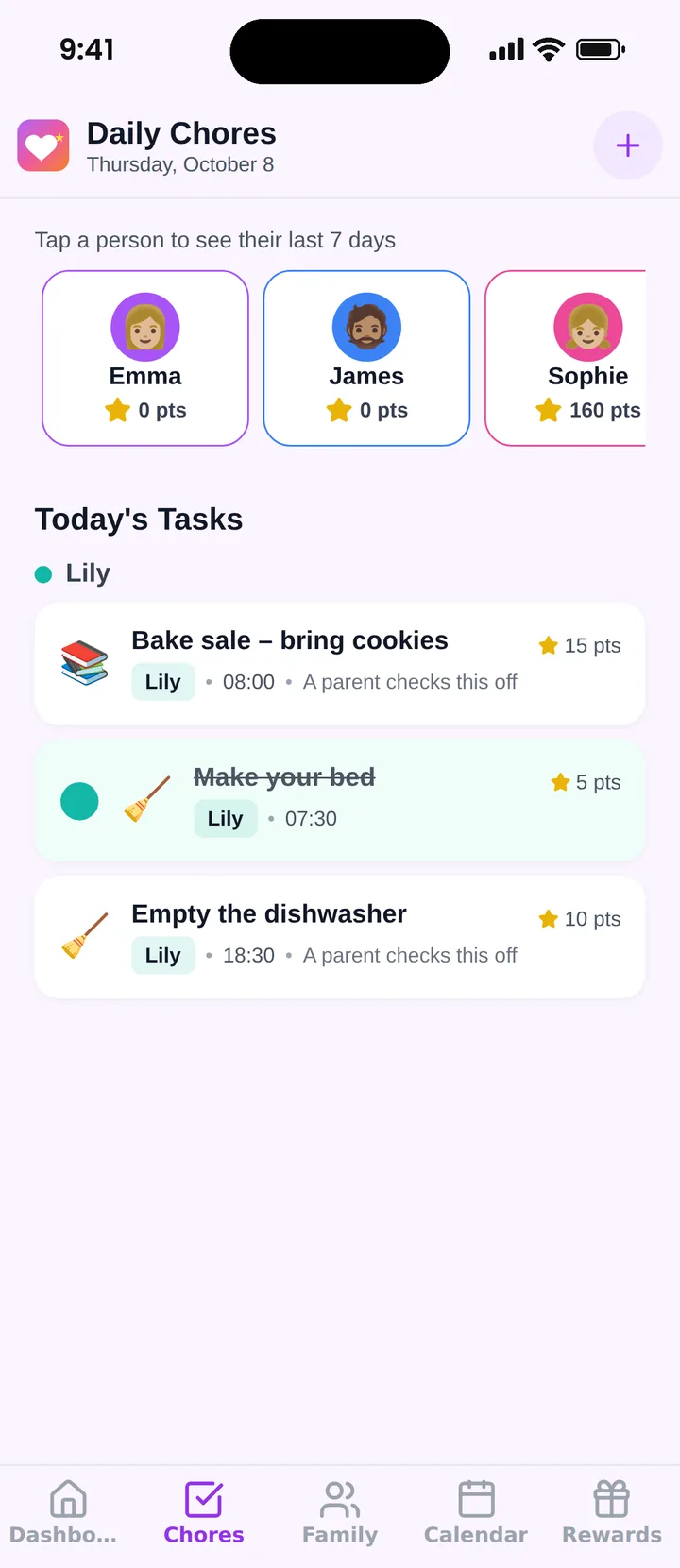
You choose whether they check jobs off alone or you approve each one, and you get a notification when something is done. The free plan covers up to 3 family members and 1 repeating task. To see how it compares with other tools, read our list of the best chore chart apps.
When to change the chart
Run the chart for two to three weeks before you judge it. If nearly everything is ticked without a nudge, add one job or move up to the next age. If half the boxes are empty, remove one job rather than adding pressure. The next step up is our chore chart ideas for 8-year-olds, once your child is ready for more.
Frequently asked questions
How many chores should a 6-year-old have on a chart?
Three to four daily tasks and one weekly job is a good range, about 15 to 20 minutes in total. Begin with two or three if chores are new, and add one more after two or three weeks of the first ones sticking.
Should a 6-year-old get paid for chores?
Most families keep everyday jobs unpaid and use points toward small rewards instead. If you do give an allowance at this age, $3 to $7 a week is a common range for ages 5 to 7, and it works best when it is not tied to basic family chores.
Can a 6-year-old read a chore chart?
Many can read simple words, but not all fluently. Use short phrases, such as 'Feed the dog', with a small picture beside each one. Reading the chart out loud together for the first week helps it feel like theirs.
What if my 6-year-old forgets the chart?
Tie each job to a daily moment (after breakfast, before dinner) and put the chart where they pass it. A reminder from the chart's location beats a reminder from you. Reminders by phone notification work for families using an app.
Try Famiyo With Your Family
Chores with points, a rewards shop for kids and one shared family calendar. Set it up in a couple of minutes.



Free to download • No credit card required • Available on iOS & Android