Behavior Chart for a 4-Year-Old: How to Make It Work
A behavior chart for a 4-year-old that works: which 3 or 4 behaviors to track, how to word them, rewards that fit the age, plus a free printable weekly chart.
By Famiyo Editorial Team5 min read
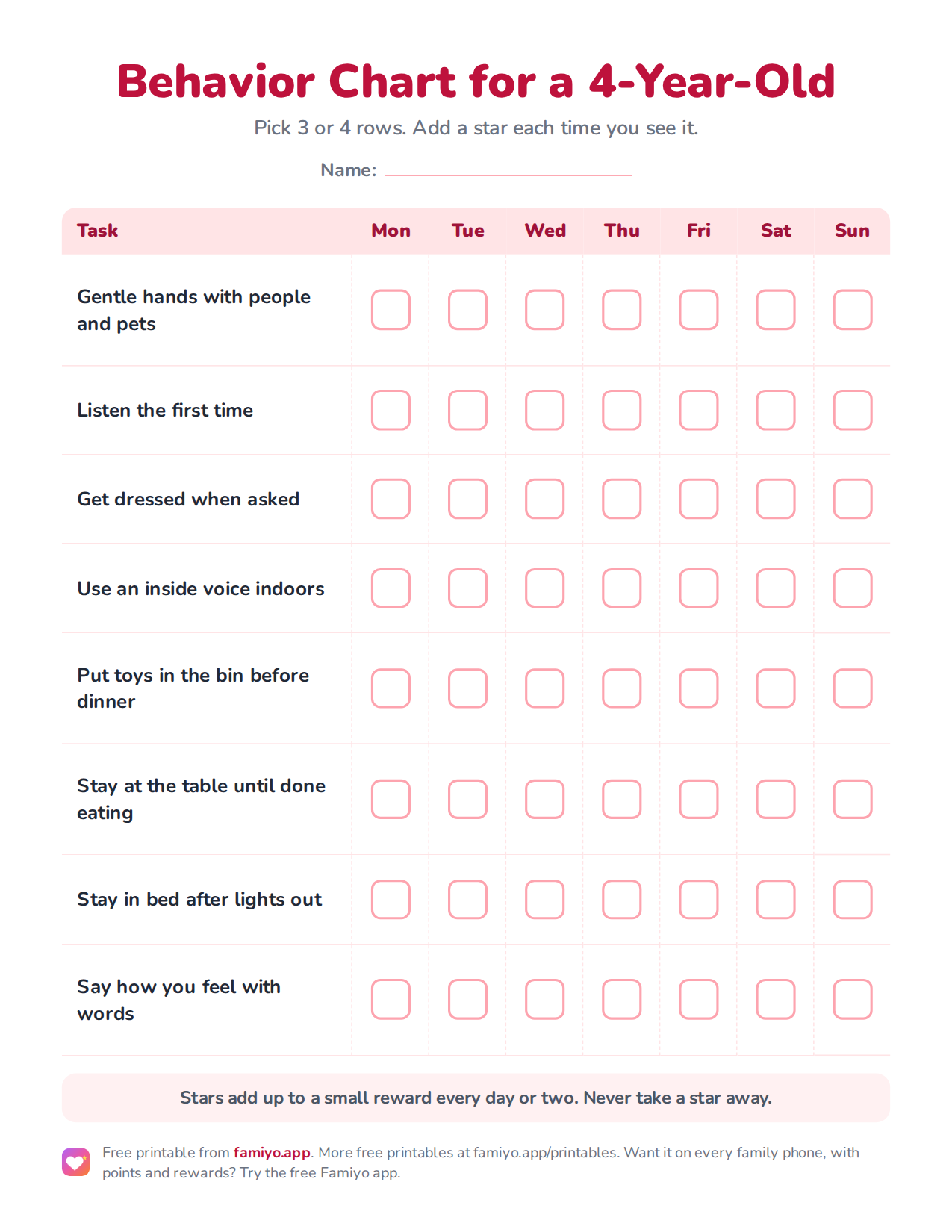
Free printable
Behavior Chart for a 4-Year-Old
A weekly chart on one US Letter page. Download the PDF to print it, or save the image to use it on a tablet or in a document.
Free for home, classroom and nonprofit use, see the license. More free printables.
Four is the age of big feelings, big opinions and very little patience for waiting. A behavior chart can help, but only if it fits how a 4-year-old actually thinks: in the next hour, not the next week. Here's what to put on the chart, the exact words to use, what to reward and a printable weekly chart you can fill in tonight.
What a 4-year-old can handle on a behavior chart
Most 4-year-olds understand cause and effect when the effect comes quickly. "You put your shoes on, here's your star" makes sense to them. "Be good all week and we'll go to the zoo" mostly doesn't, because a week is a very long time at four.
They also take words literally and respond better to a goal than a ban. "No hitting" names the thing you don't want and leaves them guessing what to do instead. "Gentle hands" gives them a picture. That's why every row on a good preschool chart describes the behavior you want to see.
Three things follow from this:
- Keep the chart to 3 or 4 behaviors. More than that and the chart fills with empty boxes.
- Mark it right away, ideally with your child putting the sticker on themselves.
- Pay out small rewards often, every day or two, with a slightly bigger one at the end of a good week.
A behavior chart for a 3-year-old is usually even simpler, with one or two goals and a reward the same day. By five, many kids can handle a full week, as our behavior chart for a 5-year-old shows. Four sits in between, which is exactly why the chart below uses daily stars with a short-term payoff.
Behaviors to put on the chart (and what to say)
Pick the moments that cause the most friction in your house right now. These are the common ones at four, worded the way they appear on the printable, with what you can say when you catch it happening.
| Situation | Row on the chart | What you can say |
|---|---|---|
| Playing with siblings or pets | Gentle hands with people and pets | "You gave the cat soft pets. That's gentle hands. Star time." |
| Being asked to stop or come | Listen the first time | "I asked once and you came. That's listening the first time." |
| Getting ready in the morning | Get dressed when asked | "Shirt, pants, socks, all on. You did it before the timer." |
| Indoors, at the store | Use an inside voice indoors | "You used your quiet voice the whole time in the library." |
| Before dinner | Put toys in the bin before dinner | "Every block is in the bin. The floor is clear for dinner." |
| Meals | Stay at the table until done eating | "You stayed in your seat until you were finished. Nice." |
| Bedtime | Stay in bed after lights out | "You stayed in bed all night. Let's put your star on." |
| Frustration or sadness | Say how you feel with words | "You said 'I'm mad' instead of throwing. That was hard and you did it." |
Notice what the praise does. It names the exact behavior instead of saying "good job", which tells your child what to repeat. Short, specific and immediate is the whole formula.
Using the printable chart
The printable below has eight behaviors down the side and a box for each day from Monday to Sunday. Don't use all eight. Pick the three or four that matter most this month, cross out or cut off the rest, and stick the chart on the fridge or a door at your child's eye level.
It suits a 4-year-old who is starting preschool, a child going through a rough patch with a new sibling, or any preschooler whose day keeps snagging on the same few moments. If your child also does simple jobs around the house, keep those on a separate chore chart; mixing chores and behavior on one sheet blurs both. For jobs that fit this age, see our list of age-appropriate chores for kids.
A few habits make the chart work:
- Let your child place the star or draw the check. Owning the chart is half the fun at four.
- Count stars together at bedtime. "Look, three stars today: gentle hands, toys in the bin and staying at the table."
- Leave blank boxes blank. No crosses, no sad faces.
Rewards that work for a 4-year-old
The best rewards at this age are small, quick and often about time with you. Try picking the bedtime story, 10 extra minutes at the park, choosing the music in the car, baking something simple together, or being the one who presses the elevator button all day.
Decide on a simple rule your child can follow, such as five stars earns a small pick from the reward list. Show the list as pictures. For a bigger weekly reward, keep it modest: a trip to the library or a picnic in the backyard.
Be careful with screen time as a prize. The American Academy of Pediatrics suggests about 1 hour a day of high-quality programming for ages 2 to 5, ideally watched together, so a chart that hands out extra screen time can push past that quickly. Food rewards are best kept occasional too.
When the chart stops working
Expect a dip around week two, once the novelty wears off. That's normal. Give it 2 to 3 weeks of steady use before you decide it isn't working.
If stars are still rare after that, the behavior is probably too big. "Listen the first time" might need to shrink to "come when I call you for dinner". If stars are everywhere, celebrate, retire that row and add the next behavior. And never take earned stars away for something else that went wrong. Handle the problem on its own, then come back to catching the good stuff.
A digital behavior chart in Famiyo
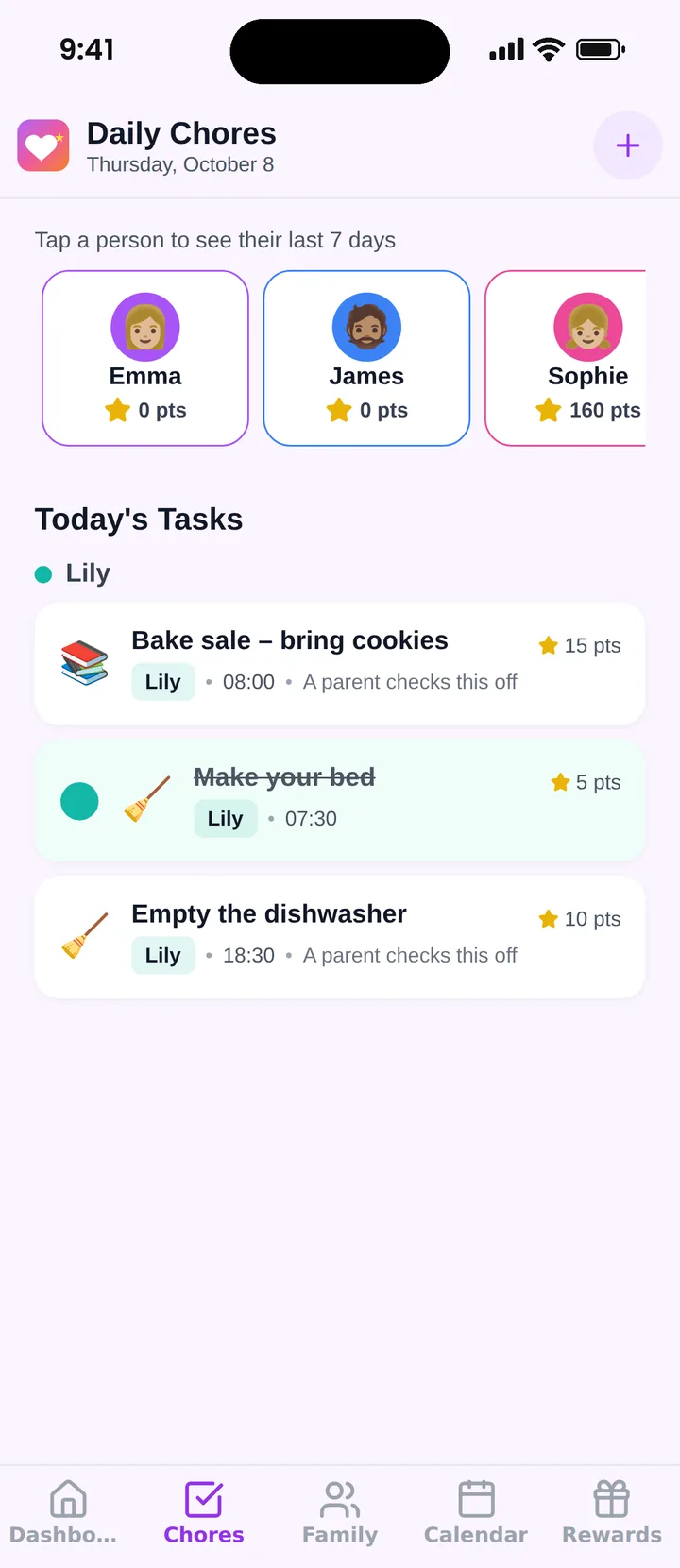
Paper works well at four, but some families want the chart on a phone so both parents can add stars from anywhere. Famiyo is a free family app for iPhone and Android that combines a shared family calendar, chores with points and a rewards shop; kids join with a code, no email needed. Each behavior can be a daily task with its own points (the free plan includes 1 repeating task; Premium removes that limit), and you choose whether your child checks it off or a parent approves it, which is the better setting at this age. Your child can see their own tasks and points on a family iPad, and the rewards shop holds the prizes they're saving for.
For more options, see our list of the best chore chart apps.
Print the chart, choose three rows with your child, and put the first star on it before bed tonight.
Frequently asked questions
How many behaviors should be on a 4-year-old's chart?
Three or four. A 4-year-old can keep a handful of goals in mind, but a longer list turns the chart into a grid of empty boxes, which feels like failing. Start with the behaviors that cause the most daily friction, and add a new one only when an old one has become a habit.
Should a 4-year-old lose stars for bad behavior?
No. Taking stars away teaches a preschooler that the chart is a threat, and the progress they earned disappears for something unrelated. Handle the misbehavior on its own, calmly and right away, and leave the chart for catching what they do well.
What rewards work for a 4-year-old behavior chart?
Small, quick and concrete ones: picking the bedtime story, an extra 10 minutes at the park, being the helper who presses the elevator button, or a sticker for the chart. Four-year-olds struggle to wait a full week, so plan a small reward every day or two.
How long should you use a behavior chart with a preschooler?
Give it 2 to 3 weeks of consistent use before deciding whether it works. Once a behavior happens most days without prompting, retire it from the chart with a little celebration and replace it with the next one, or phase the chart out entirely.
Try Famiyo With Your Family
Chores with points, a rewards shop for kids and one shared family calendar. Set it up in a couple of minutes.



Free to download • No credit card required • Available on iOS & Android