Chores for Preschoolers (Ages 3 to 5): What Works and What Doesn't
Chores for 3 to 5 year olds that really work: 20 jobs by age, how long they take, what to skip, and how to teach each one so it sticks.
By Famiyo Editorial Team5 min read

Between three and five, a child goes from "I do it!" with a spilled cup to making a bed that is only slightly lopsided. That is a lot of development packed into three years, and it shows in what chores they can handle. This page lists what works at each age, how long it takes, what to skip, and how to teach the tasks so they last longer than a week.
What changes between ages 3 and 5
At 3, children can follow a single instruction and enjoy helping, but their hands and attention are still limited. By 4, they can manage two-step tasks, like clearing a plate and putting it by the sink. At 5, they can finish a short routine on their own, with a picture list as a reminder.
Chores at this age are about the habit and the feeling of contributing, not about a clean result. Expect a bed that looks slept in and a table with the forks on the wrong side. That is fine.
How much time? Ages 2 to 3 manage about 5 to 10 minutes a day. Ages 4 to 5 can reach 10 to 15 minutes. A good rule is to start with two or three daily tasks for a preschooler and build from there.
Chores for 3-year-olds
Keep tasks to one step, make them physical and stay close.
- Put toys in a bin after playing
- Put dirty clothes in the hamper
- Wipe up a spill with a cloth
- Help feed a pet by pouring pre-measured food
- Carry their own plate to the counter (unbreakable)
- Put books back on a low shelf
Good to know: a 3-year-old will usually do a task more willingly as a game. "Can you beat the song?" works better than "clean up now."
Chores for 4-year-olds
At four, tasks can have two steps, and children begin to take pride in doing "their" jobs.
- Make the bed (a pulled-up blanket counts)
- Set their own place at the table
- Clear their own place after meals
- Match and pair socks
- Water plants with a small cup
- Put away groceries that go on low shelves
- Wipe the table with a damp cloth
Notice the pattern as the years go up: tasks get a little longer and need a little less help. By age 9 it looks like what we describe in chores for 9-year-olds, where kids can fully own a job.
Chores for 5-year-olds
Five-year-olds can handle short routines and are starting to read simple cues.
- Make the bed a bit more neatly
- Feed a pet with a measured scoop
- Pack their own backpack with a picture checklist
- Sort laundry by color
- Tidy their room with a short checklist
- Help sweep with a small broom
- Help put away clean silverware (no knives)
For a printable plan around this year, see our chore chart for a 5-year-old.
Quick reference by age
| Age | Daily tasks to start with | Time per day | Help needed |
|---|---|---|---|
| 3 | Toys in the bin, clothes in the hamper | 5 to 10 minutes | Stay beside them |
| 4 | Make bed roughly, set and clear their place | 10 to 15 minutes | Show first, check after |
| 5 | Bed, pet feeding, pack the bag, tidy room | 10 to 15 minutes | Picture checklist, a quick check |
Add a weekly job only if the daily ones are going well. A "big job" such as a bathroom clean begins around age 8, so preschoolers do not need one.
What doesn't work at this age
Some chores look reasonable on paper and fall apart in practice.
- Long lists. More than three tasks overloads a preschooler. A list of eight is for you, not them.
- Vague instructions. "Clean your room" is too big. "Put the books on the shelf" is clear.
- Chores on top of tiredness. Right before dinner or bedtime is the worst time.
- Redoing the job in front of them. If you fix the bed while they watch, they learn their effort does not count. Fix it later, or leave it.
- Sharp, hot or breakable items. No knives, stove or glass.
- Rewards that are far away. A preschooler cannot wait a month for a prize.
How to teach a new chore
Use "I do, we do, you do." First you do it while your child watches and you narrate. Then you do it together. Finally they do it alone while you stay in the room. Praise the specific part: "You put every sock in a pair."
Show what "done" looks like. A photo of a finished bed or a picture of a tidy toy corner helps a child who cannot read yet. Tie each chore to a moment that already exists: plates go to the counter after dinner, and toys go in the bin before the bath.
When your child resists, keep it light. Do it together for a few days. Many 3- and 4-year-olds will join in if you are doing a chore beside them, and shut down if they feel watched. For other age groups, our guide to chores for toddlers covers the step before this one, and the list of chores for 7-year-olds shows where these skills go next.
Rewarding preschoolers
Keep it small and quick. Praise right away, a sticker, or a few points that add up to a small reward every 2 to 3 days. For this age, a reward might be a choice of bedtime story, 15 extra minutes of screen time or picking dessert. Avoid money for daily basics. Preschoolers do not need payment, and these are family jobs.
If you want a chart to go with the list, our reward chart ideas cover formats that suit young children.
Tracking chores in Famiyo
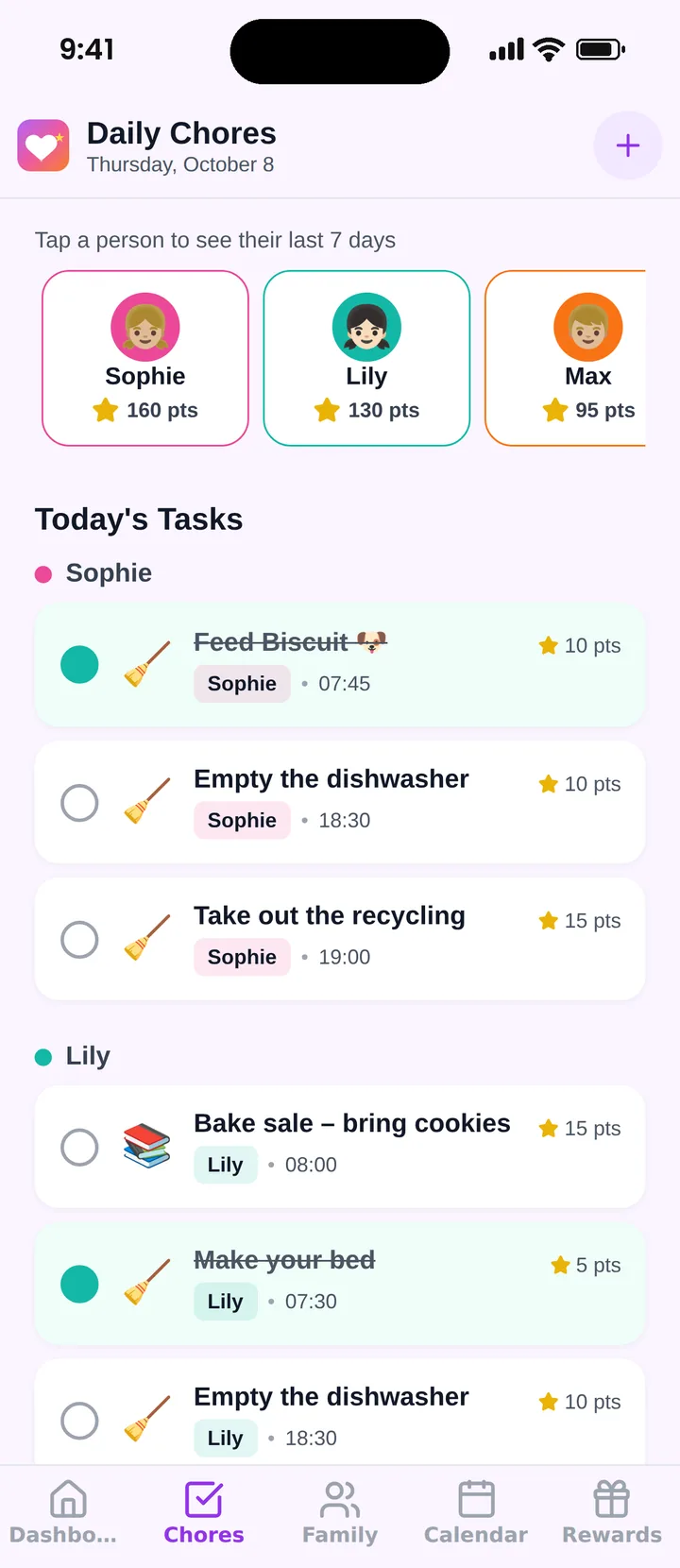
Famiyo is a free family app for iPhone and Android that combines a shared family calendar, chores with points and a rewards shop; kids join with a code, no email needed. For preschoolers, you add each chore once, set it to repeat daily and give it points, such as 5 for a small task. Your child sees their own tasks on their phone or a tablet and checks them off, or you approve them, as you choose. You get a notification when a chore is done. Our list of the best chore apps for kids compares your options.
Start with two
Pick two tasks from the lists above, one for the morning and one for the evening, and show your child how each one is done. Run them for two weeks before you add a third.
Frequently asked questions
What chores can a 3-year-old do?
A 3-year-old can put toys in a bin, put clothes in the hamper, wipe up a spill with a cloth and help feed a pet. Expect uneven results and plan on 5 to 10 minutes a day with you nearby.
What chores can a 5-year-old do?
A 5-year-old can make the bed roughly, set and clear their own place, match socks, water plants, feed a pet and put away toys. A total of 10 to 15 minutes a day is realistic.
How many chores should a preschooler have?
Two to three daily tasks is a good start. Preschoolers do best with a short list they can remember or see in pictures. Add one only after the current tasks happen most days.
Should preschoolers get paid for chores?
Not for daily basics. At this age, praise, time with you and a small point-based reward do the job. If you want to pay for something, save it for a clear extra job, and keep it small.
What if my preschooler refuses to do chores?
Check the basics first: is the task small enough, did you show them how, and is it the right time of day? Do it together, make it a game, and keep your tone calm. Refusal at this age is common and usually passes.
Try Famiyo With Your Family
Chores with points, a rewards shop for kids and one shared family calendar. Set it up in a couple of minutes.



Free to download • No credit card required • Available on iOS & Android