Chore Chart for a 3-Year-Old: Ideas That Actually Get Done
A chore chart a 3-year-old can follow: 2 or 3 picture chores tied to daily moments, done side by side with you, plus a free printable weekly chart.
By Famiyo Editorial Team5 min read
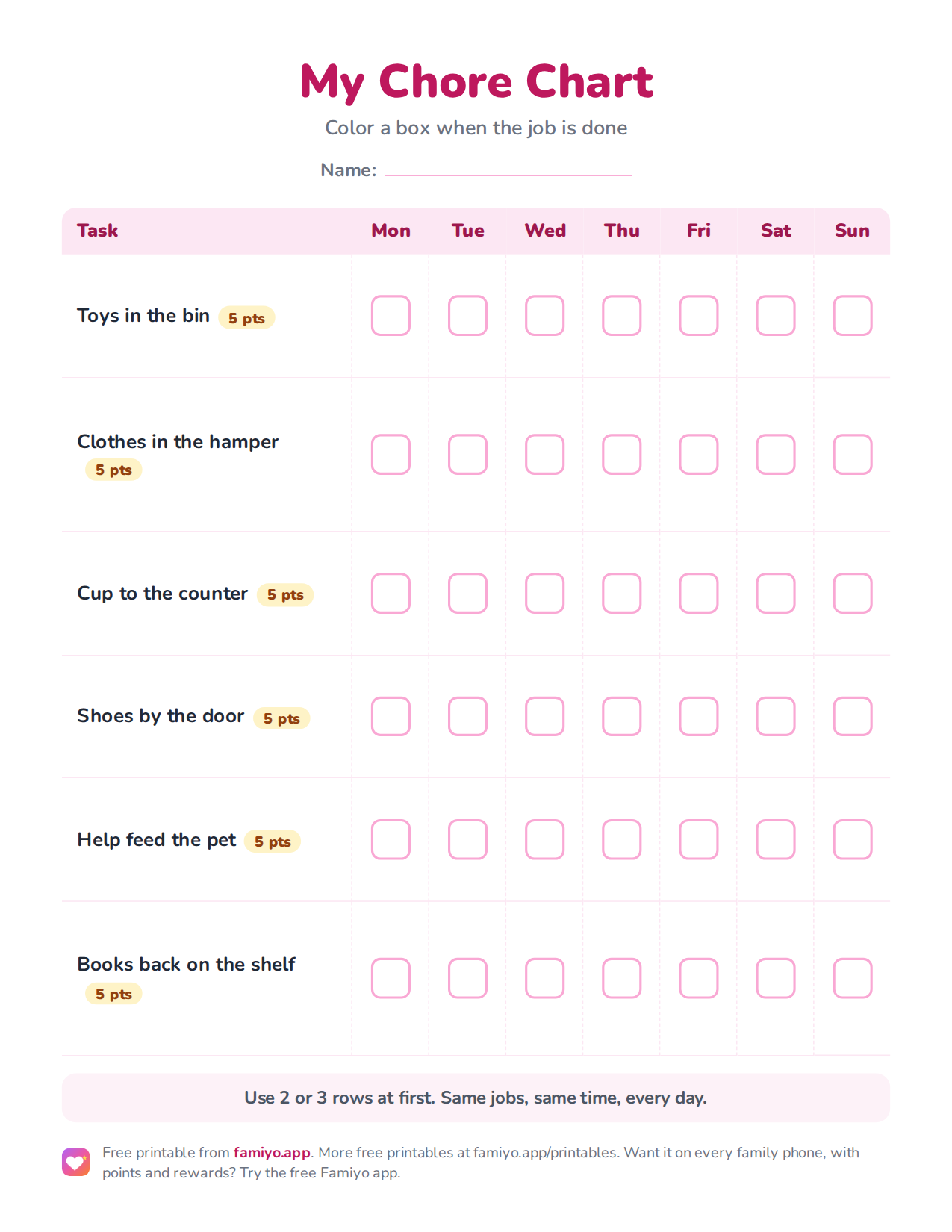
Free printable
My Chore Chart
A weekly chart on one US Letter page. Download the PDF to print it, or save the image to use it on a tablet or in a document.
Free for home, classroom and nonprofit use, see the license. More free printables.
A 3-year-old will happily "help" you unload groceries for four minutes and then wander off with a lemon. That's normal, and it's also the raw material for a good chore chart. This page covers which jobs fit a 3-year-old, how to set up the chart so it runs on routine instead of reminders, and a printable weekly chart you can fill in tonight.
What a 3-year-old can really handle
At three, most children can follow a one-step instruction, carry small things across a room, and put objects into a container. They love doing what adults do. They can't yet hold a list in their head, work alone for long, or judge when a job is "done well."
That shapes the chart. Each job needs one clear action, a container or spot that makes "done" obvious, and a picture instead of a word. Expect about 5 to 10 minutes of help across the whole day, spread over a few short moments. Two or three jobs is the right number to start with. You can find the full progression of what comes next in our list of age-appropriate chores for kids.
Chore ideas for the chart
Each of these works because the finish line is visible. The bin is full, the floor is clear, the cup is on the counter.
| Chore | What "done" looks like at 3 | When it happens | Picture to draw |
|---|---|---|---|
| Toys in the bin | Floor toys go in one big bin, no sorting | Before bath | A bin with a teddy |
| Clothes in the hamper | Dirty clothes go in the hamper, not next to it | While undressing for bath | A hamper |
| Cup to the counter | Their own cup or plate carried to the counter | After breakfast | A cup |
| Shoes by the door | Both shoes on the mat or in a basket | Coming home | Two shoes |
| Help feed the pet | Scoop of dry food into the bowl, with you holding the bag | Morning | A bowl |
| Books back on the shelf | Books from the floor go on a low shelf, any order | After quiet time | A book |
| Wipe a spill | Small spill wiped with a cloth they can reach | Whenever it happens | A cloth |
Keep "wipe a spill" off the daily rows, since spills don't happen on schedule. Praise it when it comes up instead.
How to set up the chart in one evening
- Pick 2 or 3 chores from the table, starting with one your child already does sometimes. That row guarantees an early win.
- Draw or print a picture for each row. A photo of your child putting their own shoes on the mat works even better.
- Hang the chart at your child's eye level, near where most jobs happen. The fridge or the back of the bedroom door are common spots.
- Tie each job to a moment that already exists in the day. "When the bath starts running, toys go in the bin." The moment becomes the reminder, so you don't have to be.
- Do the job together for the first week. You put one toy in, they put one in.
- Let your child mark the box: a sticker, a crayon tick, a stamp. Doing it themselves is half the fun.
- At bedtime, look at the row together and say what they did: "You put your shoes by the door every day this week."
Words that help a 3-year-old start
Questions invite a "no." Short statements tied to the moment work better.
- Instead of "Can you clean up your toys?" try "Bath is running. Toys go in the bin. I'll take the blocks, you take the cars."
- Instead of "Why are your clothes on the floor?" try "Clothes go in the hamper. Can you throw them in from here?"
- When they stall, give a small choice: "Do you want to carry your cup or your plate?"
- When the job is done, name it: "Your cup is on the counter. That's your job, and you did it."
Avoid praising the result as perfect when it isn't. Three crayons left under the couch are fine. You're building the habit of starting, not the standard of finishing, and that standard rises over the next couple of years. A 4-year-old can handle more steps, and by seven a chart looks very different, as you'll see in our chore chart ideas for 7-year-olds.
When the chart stops getting done
Interest often drops around day five. That's the novelty wearing off, not failure. Change the sticker type or let your child pick a new crayon color, but keep the same jobs at the same times.
If your child refuses a job every day, it's usually too big. "Clean up the playroom" is too much for a 3-year-old. "Blocks in the bin" is not. Shrink the job until they can finish it in under two minutes. If they melt down at a certain time, like right before dinner when everyone is tired, move the job to a calmer moment.
Never remove a mark as punishment. The chart should stay a record of things that went well. For more on keeping a chart alive past the first month, see our rules for chore charts that actually work.
About the printable
The printable below has six chore rows with a picture space on the left and a box for each day from Monday to Sunday. Cross out all but two or three rows for now and add the others one at a time. It suits 3-year-olds and young 4-year-olds who are new to charts. Print a fresh copy each Monday so the week starts clean, and let your child color the boxes in.
The chart as an app with Famiyo
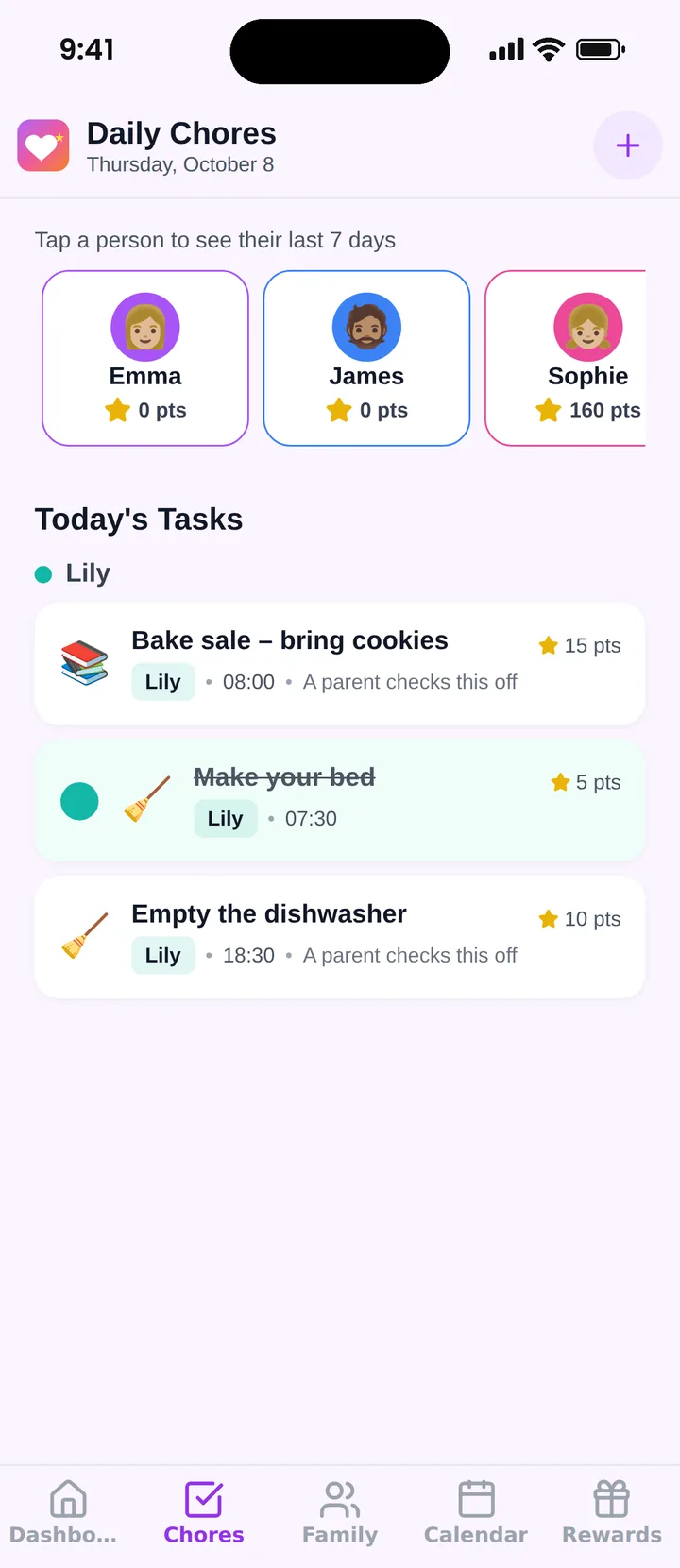
Famiyo is a free family app for iPhone and Android that combines a shared family calendar, chores with points and a rewards shop; kids join with a code, no email needed. For a 3-year-old, it works as a digital version of the paper chart that a parent runs. Add "Toys in the bin" as a daily repeating chore worth 5 points and set it so a parent approves it. Your child can see their tasks and points on a family tablet, and you can put "choose the bedtime book" in the rewards shop. The free plan includes one repeating task, so a chart with two or three daily jobs needs Premium. To compare other options, see our list of the best chore chart apps.
Start tonight with one job and one moment: toys in the bin when the bath runs. Add the second job once the first one happens without you asking.
Frequently asked questions
What chores can a 3-year-old put on a chart?
Good first chores are putting toys in a bin, putting dirty clothes in the hamper, carrying their cup or plate to the counter, wiping a small spill with a cloth, putting shoes by the door and scooping dry food into the pet bowl with help. Pick 2 or 3 and add more only when those feel easy.
Does a 3-year-old need pictures on a chore chart?
Yes. Most 3-year-olds can't read, so the picture is the chore. A simple drawing or a photo of your child doing the job works better than clip art, because they recognize their own bin, their own hamper and their own cup. Put the picture on the left of each row.
Should a 3-year-old get a reward for chores?
A small, same-day payoff helps at the start: marking the box themselves, a high five, or choosing the bedtime book when all boxes are filled. Skip big prizes. At this age the chart works because it shows progress and gives them a grown-up job, not because of what it buys.
How long does it take for a 3-year-old to learn a chore chart?
Give it 2 to 3 weeks of daily use. In the first week you'll do most of the work together and prompt every job. By the third week many children start a job when they see the moment arrive, like heading to the toy bin when the bath starts running.
Try Famiyo With Your Family
Chores with points, a rewards shop for kids and one shared family calendar. Set it up in a couple of minutes.



Free to download • No credit card required • Available on iOS & Android