Chores for Boys and Girls: Why the Same List Matters
Boys and girls should get the same chores, chosen by age. Here's how lists drift apart without anyone meaning it, a 15-minute audit and what to say to kids.
By Famiyo Editorial Team6 min read

Nobody sits down and decides that their daughter will do the dishes and their son will take out the trash. It just sort of happens, one quick "can you help me with this?" at a time. This guide explains why boys and girls should get the same chore list, how to spot the drift in your own house in about 15 minutes, and what to say when a kid announces that something is a "girl job".
Are there boys' chores and girls' chores?
No. There are chores for 6-year-olds and chores for 13-year-olds. Every household job is a life skill, and every kid will need all of them the day they live somewhere without you. A son who can't cook is going to eat badly. A daughter who has never touched a lawnmower or a drain plunger is going to pay someone or ask for favors.
That's the practical case, and it's enough on its own. There's a second one, though. Kids learn what "normal" looks like from what happens at home. If laundry and looking after little siblings always lands on one child and the car and the trash always land on another, they'll draw conclusions, and they'll carry them into their own homes later.
So the rule is simple: choose chores by age and ability. Not by who seems more interested, and not by who complains less.
How chore lists split without anyone meaning to
Honestly, most of the split comes from small, fast decisions on busy days. A few patterns are common:
- Asking whoever is closest to the kitchen to help with dinner, and it's usually the same kid.
- Sending one child to help carry the heavy stuff and the other to help tidy.
- Praising one child for "helping" with a job the other is simply expected to do.
- Giving caring jobs (reading to a younger sibling, checking on the pet) to whoever seems gentler.
- Re-doing one child's job yourself because it's faster, so they never get good at it.
None of these is a crime. All of them add up. And by Wednesday, when everyone's tired, you'll reach for whoever is easiest. That's exactly when the pattern sets in.
The same list for every child, by age
Here's a starting list for any kid, sorted by age. Each row mixes room, laundry and caring jobs with kitchen, pet and outdoor work, so nobody ends up with only one kind.
| Age | Rooms, laundry and caring | Kitchen, pets and outdoors | Daily time |
|---|---|---|---|
| 2 to 3 | Put toys in a bin, clothes in the hamper, wipe up spills | Help feed a pet | 5 to 10 minutes |
| 4 to 5 | Make the bed roughly, match socks | Set and clear their own place, water plants, feed a pet | 10 to 15 minutes |
| 6 to 7 | Sort laundry by color, tidy their room | Sweep, empty unbreakable dishes from the dishwasher | 15 to 20 minutes |
| 8 to 9 | Fold and put away laundry, vacuum one room | Make a simple snack, take out the trash | 20 to 30 minutes |
| 10 to 12 | Clean the bathroom sink and toilet, change the bed sheets | Cook a simple meal with an adult nearby, wash the car | About 30 minutes |
| 13 and up | Do their own laundry start to finish, help with younger siblings | Cook a family meal, mow the lawn, shop from a list | 30 to 45 minutes |
Read across each row: that whole row is for every child of that age. If you have an 11-year-old, our list of chores for 11-year-olds goes into one age in detail.
Audit your own house in 15 minutes
You can't fix a pattern you haven't seen. Grab a sheet of paper, or the notes app, and do this once:
- Write down every regular job in the house, including small ones like refilling the soap and feeding the fish.
- Next to each job, write who did it most often last week, adults included.
- Circle every job that one child does almost every time.
- Look for themes in the circles. Is one kid always on food and tidying, and the other on trash and outside work?
- Look at the adults too. Kids copy what they see far more than what they're told.
- Pick two circled jobs and swap them between the kids for the next month.
- Set up a rotation for shared jobs so the swap doesn't drift back.
Step 7 is the one that sticks. Our guide to chore rotation shows how to rotate jobs fairly when kids are different ages, so the 6-year-old gets a smaller version of the same zone.
And if one child genuinely loves cooking and the other would happily mow forever? Preferences are fine, once both kids can do both jobs. Teach everything on the list first. After that, letting a child pick a favorite as their weekly big job is a reasonable perk for having learned the rest. What you're avoiding is a preference that was never tested, where a 10-year-old "just isn't a kitchen person" because nobody ever handed him a pan.
What to say when a kid says "that's a girl job"
It'll happen. Maybe from your own kid, maybe from a cousin or a friend at a sleepover. You don't need a lecture. Short and boring works best.
If your son says cooking is for girls: "Everyone in our house learns to cook. You'll want to eat when you live on your own." Then hand him the spatula.
If your daughter says the trash is a boy job: "It's a job. You've got two hands. Bag goes to the bin by the garage."
If a sibling teases: "We don't sort jobs by boy or girl here. We sort them by age."
If it comes from a grandparent or another adult: thank them for the thought, then say, in front of the kids, "In our house everyone does every job." That's enough.
The point is to make it a non-event. If you argue for ten minutes, the idea gets more airtime than it deserves.
Same standard, same points, same pay
Equal lists only count if the rules are equal too. Three things to check:
- The same job earns the same points or money. If mowing is paid and dishes aren't, guess which one the kids think matters.
- The standard is the same. "Done" for the bathroom means the same thing whoever cleans it.
- Praise sounds the same. Say "thanks for cleaning the kitchen" to every child, not "what a big helper" to one and nothing to the other.
Caring jobs deserve attention here. Reading to a younger sibling, keeping an eye on the toddler while you cook, checking the dog has water: these are real work, and they're easy to forget because they don't leave a clean floor behind. Put them on the list with points like any other chore. If reminding everyone is wearing you down, our guide to getting kids to do chores without nagging helps with that part.
Where an app helps
The nagging is what wears parents down, and it's often what pushes the split back in. Famiyo is a free family app for iPhone and Android that combines a shared family calendar, chores with points and a rewards shop; kids join with a code, no email needed. Every child sees the same kind of list on their own phone: their tasks for today and the points each one is worth. You set points per child for the same task, so equal jobs get equal points. Kids get a push notification when a new task is assigned, and you get one when it's done, so the app does the reminding instead of you.
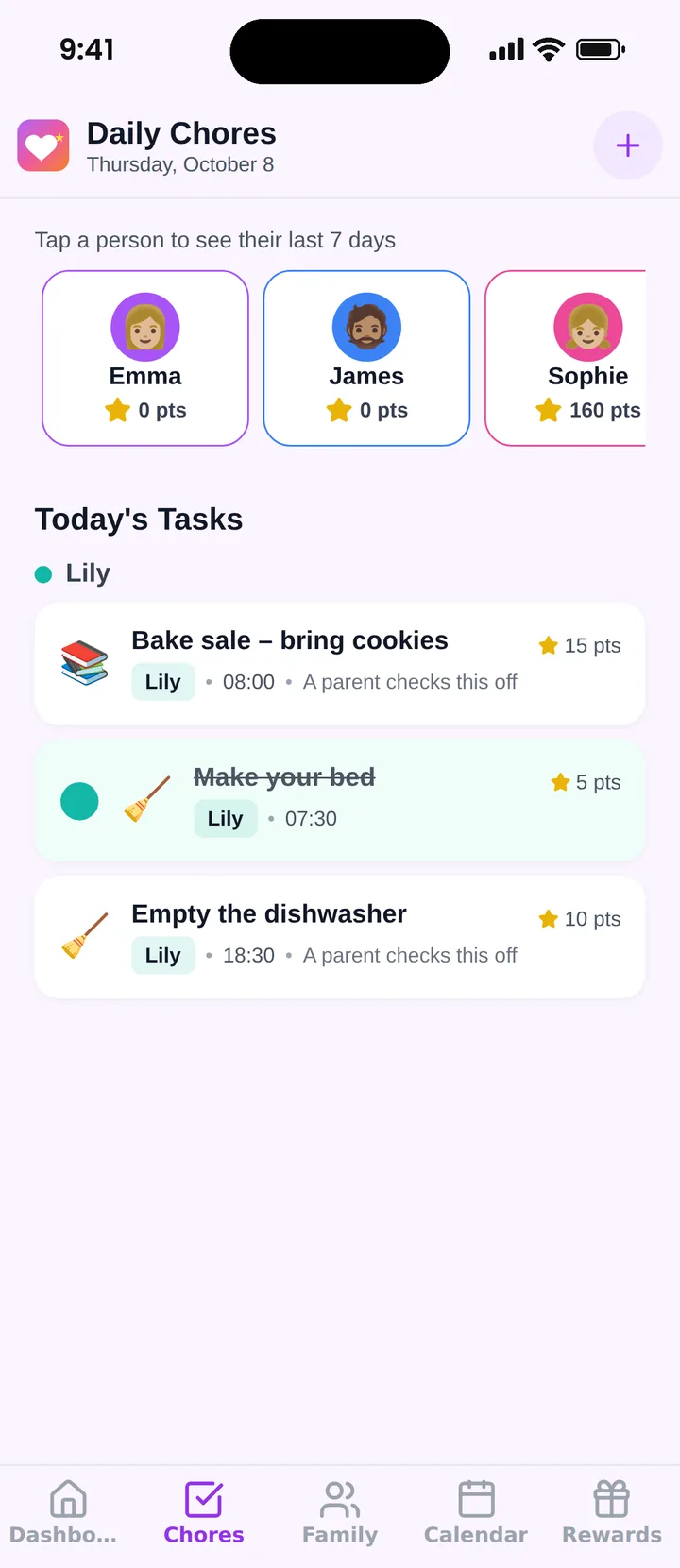
The free plan covers up to 3 family members. For other options, see our list of the best chore apps for kids.
Tonight, do the 15-minute audit and pick the first two jobs to swap. That's enough for this week.
Frequently asked questions
What are good chores for boys?
The same ones that are good for girls of the same age: making the bed and tidying toys at 4 or 5, sorting laundry and sweeping at 6 or 7, loading the dishwasher and folding clothes at 8 or 9, cleaning the bathroom and cooking a simple meal by 10 to 12. Pick by age and skill, not by gender.
Should boys and girls get paid the same for chores?
Yes. The same task done to the same standard should earn the same points or money, regardless of who does it. If one child gets paid for mowing and another does dishes for free, kids notice quickly, and the unpaid job starts to look like it doesn't count.
What do I say if my child says a chore is a girl job?
Keep it short and calm: "In our house, every job is everybody's job. You'll need to know how to do this when you live on your own." Then hand them the job anyway. Arguing at length gives the idea more weight than it deserves.
How do I split chores fairly between a son and a daughter?
Write down every job, note who did it last week, and look for patterns like one child always doing the kitchen and the other the trash. Then rotate shared jobs weekly so both kids do every kind of work, with versions adjusted to each child's age.
Try Famiyo With Your Family
Chores with points, a rewards shop for kids and one shared family calendar. Set it up in a couple of minutes.



Free to download • No credit card required • Available on iOS & Android