Chore Charts That Actually Work: 9 Rules
Most chore charts fade by week three. These 9 rules fix the usual causes: too many chores, vague jobs, nagging, slow rewards and the midweek collapse.
By Famiyo Editorial Team6 min read
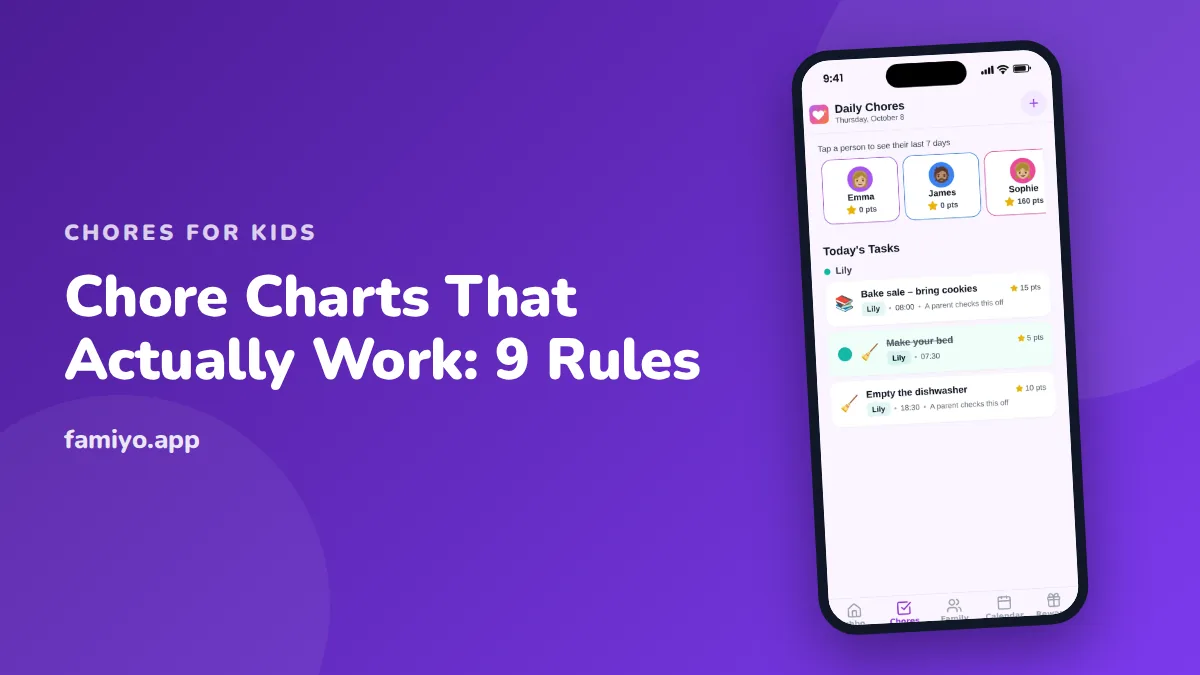
Here's how most chore charts go. Big launch on Sunday, markers out, everyone excited. By Wednesday of week two the chart has a coffee ring on it and you're back to asking "Did you feed the cat?" four times a night. The nine rules below go after the specific reasons charts die, so yours makes it past week three.
Why most chore charts quietly die
The chart itself is rarely the problem. A chore chart is a promise: the system will do the reminding, so you don't have to. Most charts break that promise in a few predictable ways.
They ask for too much. They list chores nobody can check ("be helpful"). The reward is a month away, which for a 6-year-old might as well be never. And when the chart stops working, a parent steps in as the backup reminder, which quietly teaches everyone that the chart is optional and the parent is the real system.
Each rule below closes one of those gaps. You don't need all nine on day one. But if your chart is already dying, one of them is almost certainly the cause.
Rules for building the chart
1. Start with three chores, not twelve
Ambitious charts die first. If a 7-year-old faces eleven boxes a day, they'll fall behind by Tuesday, and falling behind is not motivating for anyone.
A workable starting point is 2 to 3 daily chores for preschoolers and 3 to 4 for school-age kids, plus one weekly bigger job from around age 8. Add another chore only when the current ones have run without reminders for about two weeks. A short chart that gets done beats a long one that gets ignored.
2. Write the finish line
"Clean your room" means nothing to a kid. Or rather, it means "push everything under the bed." Write each chore so the finish line is something you could check with a photo.
| Vague chore | Finish line a kid can check |
|---|---|
| Clean your room | Floor clear, clothes in the hamper, books on the shelf |
| Help with dinner | Set 4 places: plate, fork, knife, napkin |
| Feed the dog | One full scoop of food, water bowl filled to the line |
| Tidy the bathroom | Towel on the hook, toothpaste capped, sink wiped |
| Do the dishes | Dishwasher loaded, counter wiped, sink empty |
| Pack your bag | Homework folder, water bottle, library book on Thursdays |
This one rule ends a surprising number of arguments. You're no longer debating whether the room is "clean." You're checking three things.
3. Give every chore a when
"Today" is not a time. A chore without a when gets done at 8:55 p.m., with tears, or not at all.
Attach each chore to something that already happens. Bed before breakfast. Lunchbox in the sink right after school. Dishwasher after dinner, before anyone touches a screen. Kids don't need to watch a clock; they just need to know what comes before what.
4. Build it with them, not for them
A chart that appears on the fridge overnight feels like a new rule handed down. A chart a child helped make feels like theirs.
You still decide what the house needs. They get real choices inside that. Try: "Here are six jobs the house needs every day. Pick three." Let them choose the order, the colors, the layout. With a teenager, let them draft the chart and you edit it. If you lean toward a lower-pressure approach overall, our piece on gentle parenting and chores goes deeper on cooperation without coercion.
Rules for the daily part
5. Put yourself on the chart
Kids are excellent fairness detectors. If the chart lists only their jobs, it reads as a punishment board. Put the adults on it too: "Mom: laundry, Tuesday and Friday. Dad: dinner and kitchen, weeknights."
You don't have to give yourself stickers. The point is that everyone in the house can see the work is shared.
6. Say it once, then point at the chart
This is the rule that saves your voice. One reminder per chore, phrased the same way every time, and then you stop talking.
Something like: "Check your chart." Or: "What's left on your chart before screens?" No lecture, no list of everything they forgot this week. If the deadline passes and the box is empty, it stays empty. That's the consequence, and it's enough.
It feels uncomfortable for about a week, because the old habit is to remind again. Hold the line. Our guide on getting kids to do chores without nagging has more scripts for the moments when one reminder doesn't feel like enough.
7. Pay out fast
A reward that takes a month to earn is invisible to a young child. Aim for something small every 2 to 3 days and something bigger every 3 to 4 weeks.
With points, the math is simple. Give small chores (2 to 5 minutes) 5 points, medium chores (10 to 15 minutes) 10 points and big chores 20 points. Price small rewards, like 15 extra minutes of screen time or choosing dessert, at 30 to 50 points. A child doing three small chores a day earns 15 points, so a 40-point reward lands every 2 to 3 days. That's close enough that they can feel it coming.
A +2 bonus for chores done without a reminder is a nice touch. It rewards exactly the behavior you're after.
Rules for keeping it alive
8. Survive Wednesday
Every family has a Wednesday. Swim practice runs late, a sibling is sick, someone melts down over socks. The chart falls apart for a day.
That's fine, as long as the chart is built to survive it. A missed day doesn't reset anything. No streak drops back to zero, no earned points get taken away. Tomorrow starts fresh. Taking back points turns the chart into a punishment tool, and kids stop trusting it fast.
It also helps to agree on a "minimum day" in advance: on chaotic days, only one chore counts, usually the one that keeps something alive, like feeding the pet.
9. Rebuild it every few weeks
Kids get bored of everything, including charts that work. Every 3 weeks or so, take 10 minutes on a weekend to ask three questions: What's easy now? What's annoying? What should we swap?
Move easy chores off the chart once they've become automatic. Swap in a harder one as kids grow. Rotate jobs between siblings so nobody is stuck with the trash forever. A chart that changes a little every few weeks lasts much longer than one that stays frozen until everyone quits.
When the chart still isn't working
If you've got a chart and it's sputtering, match what you're seeing to the rule that probably broke.
| What you see | Rule that likely broke | What to try this week |
|---|---|---|
| Chart ignored after the first few days | 1 or 7 | Cut to 3 chores, make the first reward reachable in 2 days |
| Chores "done" but done badly | 2 | Rewrite the finish lines, show the chore once more |
| Everything happens at bedtime | 3 | Tie each chore to a moment earlier in the day |
| Siblings arguing about who got the easy jobs | 4 or 9 | Let them choose, rotate jobs every week |
| You're still reminding all evening | 6 | One reminder, then point at the chart |
| Child gives up after one bad day | 8 | Remove streaks and point deductions |
Some kids need a different setup entirely. A child with ADHD or autism may do better with picture steps, very short chores and immediate small rewards. Our article on chores for autistic kids covers visual, predictable charts in detail, and your child's therapist or pediatrician can help tailor them.
Letting the phone do the reminding
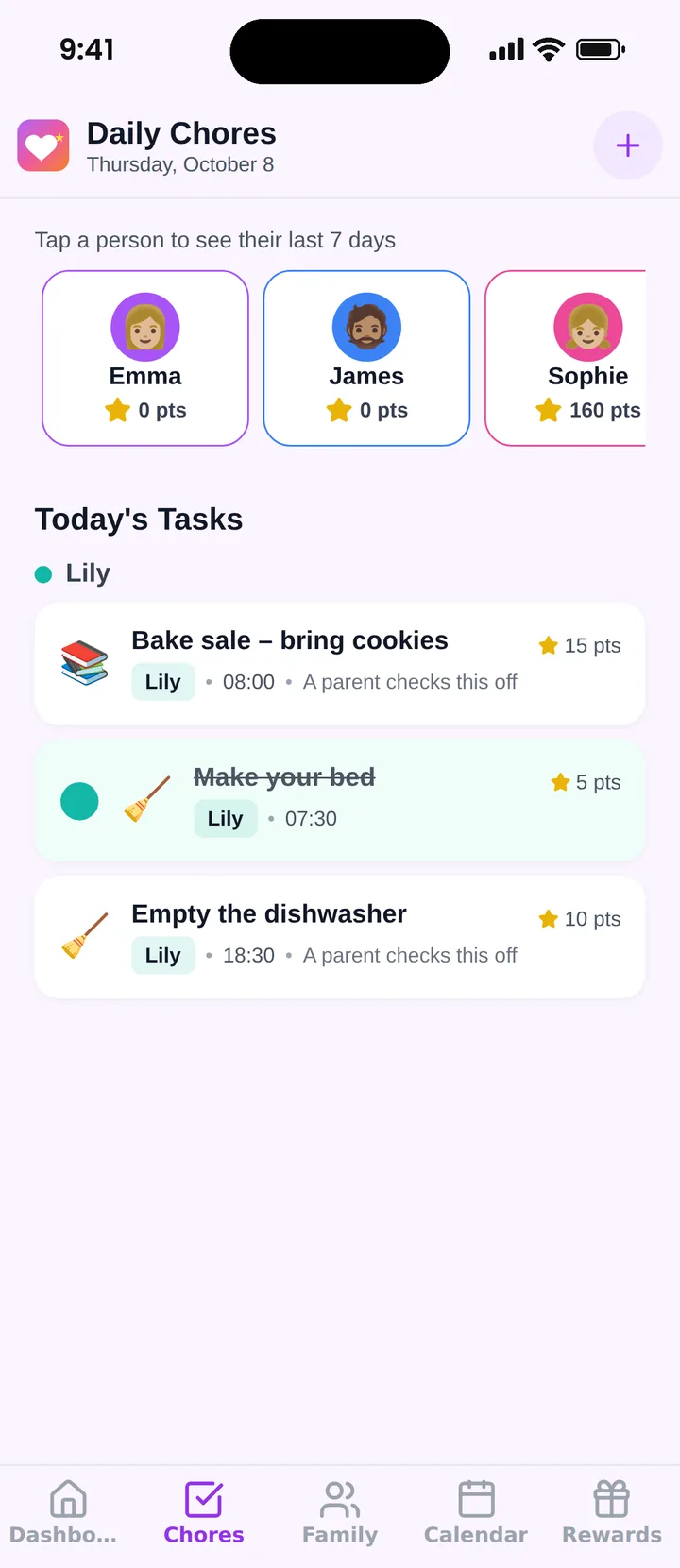
Famiyo is a free family app for iPhone and Android that combines a shared family calendar, chores with points and a rewards shop; kids join with a code, no email needed. Each child sees their own chores and points on their own phone, and gets a notification when you add a new task. When they tick a chore off, you get a notification, so the checking happens without a conversation. You choose whether kids can mark chores done themselves or whether you approve them first. Points go straight toward rewards you set in the family shop, which takes care of rule 7.
For a wider comparison, see our list of the best chore apps for kids.
Pick the one rule your current chart breaks most and fix only that this week. Most of the time, it's rule 1.
Frequently asked questions
Why do chore charts stop working?
Usually because the chart asks for too much, the chores are vague, or the rewards are too far away to matter. The parent then becomes the real reminder system and the chart turns into wallpaper. Cutting the list, defining what done looks like and paying out small rewards more often fixes most of it.
How long should you try a chore chart before changing it?
Give it 2 to 3 weeks of consistent use. The first days often run on novelty, and the real picture shows up once that wears off. If something isn't working, change one thing at a time, such as the number of chores or the reward timing, so you can tell which change helped.
Should parents be on the family chore chart?
It helps. When the adults' jobs sit on the same chart, chores read as how the household runs rather than something done to kids. You don't need points for yourself, but seeing 'Dad: clean the kitchen' next to 'Sam: feed the cat' changes the tone of the whole thing.
Is a paper chore chart or an app better?
Paper works well for kids under 7, who like stickers and need to see the chart on the fridge. Older kids often respond better to a chart on their own phone, because it shows what's left without a parent saying a word. Plenty of families use paper for the youngest and an app for everyone else.
Try Famiyo With Your Family
Chores with points, a rewards shop for kids and one shared family calendar. Set it up in a couple of minutes.



Free to download • No credit card required • Available on iOS & Android