Gentle Parenting and Chores: Cooperation Without Coercion
How gentle parenting works with chores: firm expectations without threats or bribes, what to say when kids refuse, and where points and charts still fit.
By Famiyo Editorial Team6 min read
Somewhere along the way, gentle parenting got a reputation for meaning "never ask kids to do anything they don't feel like." So if you're trying to parent gently and the living room is buried under Lego, you might wonder if you're even allowed to ask for help. You are. Here's how gentle parenting and chores actually fit together, what to say instead of threats, what to do when your kid flat-out refuses, and where points and charts belong.
Gentle doesn't mean optional
Gentle parenting has two halves, and people tend to forget the second one. The first is warmth: you respect your child's feelings, you don't shout or shame, you assume they want to do well. The second is a firm limit. The expectation doesn't disappear because your child is upset about it.
For chores, that means the job is still happening. Your 6-year-old still clears their plate. Your 11-year-old still empties the dishwasher. What changes is how you get there. You're aiming for cooperation, which is slower than compliance on day one and much faster by month three.
It also helps to change how chores are framed. They're not a favor kids do for you, and they're not a punishment for being messy. They're what people who live together do. "In this family, everybody helps" is a sentence you'll say a hundred times, and that's fine.
What to say instead of threats and bribes
Most parents don't plan to threaten. It just comes out at 6:45 pm when dinner is burning. Having replacement sentences ready is half the battle.
| Instead of | Try |
|---|---|
| "If you don't clean your room, no tablet for a week." | "Tablet time starts when your floor is clear. Want me to set a 10-minute timer?" |
| "I'll give you a cookie if you pick up your toys." | "Let's race. You do the cars, I'll do the blocks." |
| "Why do I always have to ask you five times?" | "I'm going to ask once, then I'll come and help you start." |
| "You're so lazy." | "You look wiped out. Snack first, then the dishwasher?" |
| "Fine, I'll do it myself!" | "I'll do the pots. You do the plates. Ten minutes and we're both free." |
| "Your sister already did hers." | "What's the first thing you'll put away?" |
| "Do it now!" | "Do you want to feed the dog before or after you change out of your school clothes?" |
None of these are magic. They work because they keep the limit in place while taking away the fight. The child still feeds the dog. They just get to decide whether it's before or after changing clothes, and that small bit of control is often enough.
When your kid says no
They will. Probably on a Wednesday, when everyone's tired and the week has stopped being fun. Here's a sequence that works more often than it fails:
- Check the basics. Hungry, tired, overstimulated or overwhelmed kids don't cooperate, gently parented or not. Fix that first.
- Name the feeling. "You really don't want to stop playing. I get it, that game looks fun."
- Keep the limit anyway. "And the table still needs setting before dinner."
- Offer a real choice. Both options have to be fine with you: now or after one more level, forks or plates, by yourself or with me.
- Make it smaller. "Just the forks" is a lot easier to start than "set the table." Starting is the hard part.
- Use when-then. "When the table's set, we eat." Say it once, calmly, and then stop talking.
What if they still don't do it? Then the next thing they want waits. Dinner, screen time, going outside, whatever naturally comes next. That's not a punishment you invented. It's just the order things happen in.
And sometimes, honestly, you'll do it yourself because it's 8 pm and everyone needs to go to bed. That's not failure. One skipped chore doesn't undo anything. What undoes things is giving up on the expectation altogether.
Doing chores alongside kids also counts as gentle parenting, not giving in. Younger children especially learn by working next to you, and older ones are more willing when the job isn't a solo exile to the bathroom.
What gentle looks like at different ages
The principle stays the same from toddler to teen. The tactics don't. A choice that works with a 4-year-old will insult a 14-year-old.
| Age | What the chore looks like | The gentle part |
|---|---|---|
| 2 to 3 | Toys in the bin, clothes in the hamper, wiping a spill | You do it together, every time. Sing, race, make it silly. |
| 4 to 7 | Setting their place, feeding the pet, tidying their room | Picture lists, two-option choices, a timer instead of your voice |
| 8 to 12 | Loading the dishwasher, vacuuming a room, cleaning the bathroom sink | They own the job and choose when it happens, within a deadline |
| 13 and up | Their own laundry, cooking a family meal, shopping from a list | They help decide the list, and you respect their schedule like an adult's |
With teens, the biggest shift is that you negotiate the when and the how, but not the whether. "The kitchen needs to be clean by 9. You pick when" treats them like the near-adult they are. Then you let them pick, even if it's 8:52.
Do points and chore charts break gentle parenting?
This is where gentle parenting communities argue the most. Our honest take: it depends entirely on how you use them.
A chart or a points system works with gentle parenting when it's a shared tally of what got done, a visual reminder so you don't have to nag, and a way to notice effort out loud. Kids like seeing their progress. That's not manipulation.
It works against gentle parenting when points are taken away as punishment, when the chart becomes a threat ("Keep that up and you lose your stars"), or when it's used to rank siblings in front of each other. At that point, it's just yelling with stickers.
A good test: if your child messed up today, does the chart look any different tomorrow? If the answer is yes, because something was removed, rethink it. Our guide to chore charts that actually work covers the setup rules in more detail.
Set chores up so you don't have to push
The most gentle thing you can do is build a system that needs fewer reminders in the first place. That means a short list, a fixed time and jobs that match your child's age.
Keep the daily list small: 2 to 3 tasks for preschoolers, 3 to 4 for school-age kids. Attach each chore to something that already happens, like clearing plates right after dinner. Put the list somewhere kids can see it, so the list does the reminding instead of you. And pick jobs your child can actually do well; frustration looks a lot like defiance from the outside. For ideas on what belongs on the daily list, see chores kids should do every day, and for more ways to cut the reminders, read how to get kids to do chores without nagging.
Letting Famiyo do the reminding
Famiyo is a free family app for iPhone and Android that combines a shared family calendar, chores with points and a rewards shop; kids join with a code, no email needed. For gentle parenting, its main job is to take the reminding off your plate. Your child gets a notification when a chore is assigned and sees their own list on their own phone, so the prompt comes from the app instead of from you at the bottom of the stairs.
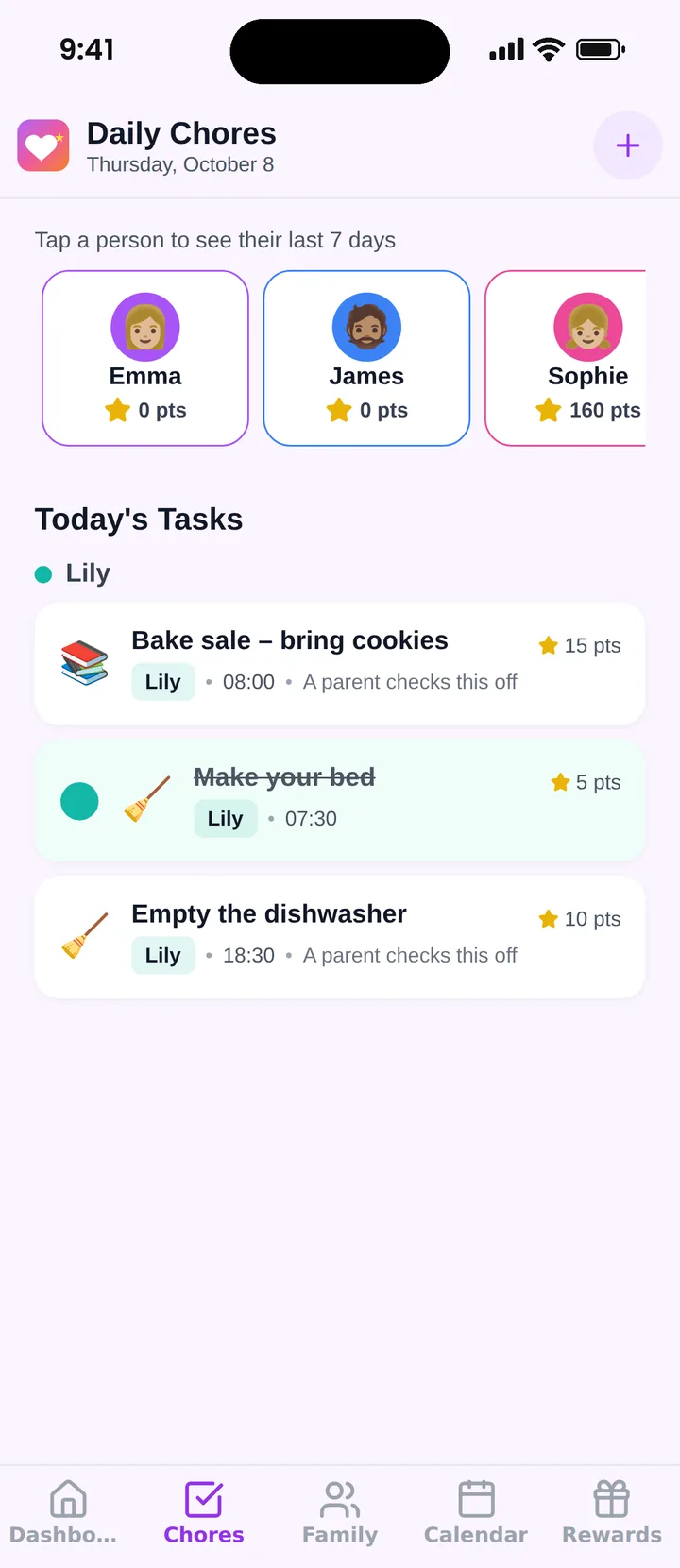
You can let kids check off their own tasks, which is a quiet way of saying you trust them. Points simply add up as jobs get done and can be spent in a rewards shop you set up together. For more options, see our list of the best chore apps for kids.
Tonight, pick one sentence from the table above and use it the next time a chore stalls. Just one. It gets easier from there.
Frequently asked questions
Do gentle parents make kids do chores?
Yes. Gentle parenting is not permissive parenting. The expectation that everyone helps stays firm. What changes is the delivery: no yelling, threats or shaming, and more choices, teamwork and patience. The chore still gets done, sometimes later or with help.
What do I do when my child refuses to do a chore?
Check whether they're hungry, tired or overwhelmed, name the feeling, then hold the limit with a choice: 'Do you want to do it now or after your snack?' If they still refuse, use a when-then: the next fun thing starts when the job is done.
Are chore charts and rewards against gentle parenting?
Not necessarily. A chart or points that track what got done are a visual reminder and a way to notice effort. They clash with gentle parenting when used as threats, when points are taken away as punishment, or when siblings are compared publicly.
What age can gentle parenting chores start?
As soon as a child can help, usually around 2. Toddlers can put toys in a bin, put clothes in the hamper and help feed a pet for 5 to 10 minutes a day. Doing it with them is the gentle part, and it's also how they learn.
Try Famiyo With Your Family
Chores with points, a rewards shop for kids and one shared family calendar. Set it up in a couple of minutes.



Free to download • No credit card required • Available on iOS & Android