Chore Rotation: How to Rotate Chores Fairly
How to set up a chore rotation that feels fair to every kid: four rotation methods, how to balance jobs across ages, a sample 3-week chart and swap rules.
By Famiyo Editorial Team7 min read

When one child always gets the dishes and another always gets the two-minute job of feeding the cat, somebody notices, usually at dinner. A chore rotation settles it by moving shared jobs around on a schedule everyone can see. Below you'll find four ways to rotate, a simple way to balance jobs when your kids are years apart, a sample three-week chart for three kids, and the house rules that keep a rotation alive past week two.
When a rotation works better than fixed jobs
Fixed jobs have real advantages. A child who empties the dishwasher every day for a year gets fast at it, and nobody has to remember whose turn it is. A rotation earns its place when:
- kids argue about who got the "worse" job,
- there are jobs nobody wants, like the bathroom or the trash,
- you want every child to learn every basic skill before they leave home,
- the same child keeps ending up with the jobs that take longest.
Most families do best with a mix. Personal jobs stay fixed: making your own bed, packing your own school bag, putting away your own clean clothes. Shared household jobs rotate. That split is a good default, because nobody should ever rotate out of looking after their own things.
Four ways to rotate chores
Round-robin
List the shared jobs, one per child. On rotation day, everyone moves one job down the list and the last child wraps around to the top. With three kids and three jobs, each child is back on their first job in week four. It's the easiest system to explain to a 5-year-old, and it works well when the jobs are roughly the same size.
Zone rotation
Instead of single tasks, each child owns an area for the week: the kitchen, the living spaces, or laundry and pets. Zones work because each one has a clear finish line. "Help in the kitchen" is vague. "The table is wiped, the dishwasher is running and the counters are clear" is something a child can check for themselves.
Tiered zones for different ages
Everyone rotates through the same zones, but each zone comes in versions. The 6-year-old's kitchen week is setting and wiping the table. The 13-year-old's kitchen week is loading and running the dishwasher and wiping the counters and stove. Same zone name on the chart, a job that fits the child. This is the method most families with a wide age gap end up using, and it's the one the sample chart below is built on.
Rotating pick order
Write each job on a card with its point value. On rotation day, kids take turns choosing jobs, and the pick order rotates too: whoever chose last this week chooses first next week. Older kids like the control. It works best from about age 8, once a child can weigh one 20-point job against two 10-point ones.
How to make a rotation fair when kids are different ages
Fair doesn't mean identical. A 6-year-old and a 13-year-old shouldn't scrub the same toilet. The test of a fair rotation is simpler than that: for each child, no zone should be the bad week. If Ava's laundry week is twice the work of her kitchen week, she'll dread it, and she'll be right.
Points make this easy to check. Give every task a value by size:
| Task size | Example | Points |
|---|---|---|
| Small (2 to 5 minutes) | Feed the pet, set the table | 5 |
| Medium (10 to 15 minutes) | Empty the dishwasher, tidy the living room | 10 |
| Big (30 minutes or more) | Clean the bathroom, mow the lawn | 20 |
| Bonus | Done without a reminder | +2 |
Then build each child's version of every zone to the same daily total. Older kids will earn more points per day than younger ones, which is fine, because they're doing bigger jobs. What matters is that the total stays steady for each child from week to week.
Keep an eye on time as well. Typical daily chore time is 15 to 20 minutes at ages 6 to 7, 20 to 30 minutes at 8 to 9, about 30 minutes at 10 to 12 and 30 to 45 minutes from 13. That includes their fixed personal jobs, so a rotation zone should take up only part of it. For what an older child's zones can include, see these chores for 11-year-olds.
A sample chore rotation for three kids
Here is a hypothetical family with kids aged 6, 9 and 13 and three zones. Each child's version of a zone is worth the same points every day: 10 for the 6-year-old, 15 for the 9-year-old, 20 for the 13-year-old.
| Zone | Age 6 version | Age 9 version | Age 13 version |
|---|---|---|---|
| Kitchen | Set the table, wipe the table after dinner | Load the dishwasher, wipe the counters | Load and run the dishwasher, wipe counters and stove |
| Living spaces | Put cushions and toys back, sweep the entry | Tidy the living room, take out the trash | Tidy the living room, trash and recycling out, quick sweep of the hall |
| Laundry and pets | Feed the pet, match socks from the clean basket | Feed and water the pet, fold one basket | Walk the dog or clean the litter box, fold and put away one basket |
And here is how the zones move:
| Week | 13-year-old | 9-year-old | 6-year-old |
|---|---|---|---|
| 1 | Kitchen | Living spaces | Laundry and pets |
| 2 | Living spaces | Laundry and pets | Kitchen |
| 3 | Laundry and pets | Kitchen | Living spaces |
Week 4 starts the cycle again. The two older kids also get one weekly big job worth 20 points, which rotates on its own track: vacuuming one room for the 9-year-old, cleaning the bathroom or mowing the lawn for the 13-year-old. Notice that every zone gets done by every child. Nobody is "the dishes kid" and the same chart works for sons and daughters alike, which matters more than it seems (our piece on chores for boys and girls explains why).
How often to rotate chores
Weekly is the right default. Pick a fixed rotation day, such as Sunday evening, and move everyone at once. A week gives kids six or seven tries at a job, which is enough to get competent without getting bored.
A few exceptions are worth making:
- Skill jobs like cooking a meal or doing laundry start to finish can stay with one child for a month. One week isn't enough to learn them, and a teen who has just figured out the washer shouldn't have to hand it over.
- Kids under 6 do better with fewer changes. Keep their zone version tiny and use a picture on the chart so they can find their own job.
- Don't rotate mid-week because someone complained. A rotation that moves under pressure stops feeling fair to everyone else.
Give any new rotation 2 to 3 weeks of steady use before you judge it. The first rotation day is always a bit bumpy.
Rules for swaps, sick days and missed jobs
Most rotations fail on the exceptions, not the plan. Agree on these before the first week and write them under the chart:
- Swaps are allowed when both kids agree and tell a parent before the day starts. A swap covers a whole day, not half a job.
- When a child is sick, whoever covers their zone gets the points for it. That makes covering feel like a favor that pays rather than a punishment.
- A missed job waits. It gets done that day before screens, and it doesn't carry over as double work next week.
- When a child is away (a weekend at the other parent's house, a school trip), a parent covers the zone and the rotation doesn't shift. Write the rotation by week number so absences don't scramble the order.
- Complaints go to a short monthly family check-in, not the kitchen at 7 p.m. That's when you trim a zone that's too big or add a task as a child grows.
Post the chart and these rules where everyone walks past them every day, like the fridge or the back of the front door. If paper charts tend to vanish in your house, our guide to a kids chore tracker covers keeping track on phones instead.
Running the rotation in Famiyo
Famiyo is a free family app for iPhone and Android that combines a shared family calendar, chores with points and a rewards shop; kids join with a code, no email needed. Each zone becomes a set of repeating chores, and each participant can get their own number of points for the same task. On rotation day you change who each chore is assigned to, and kids get a push notification about their new tasks. You get one when a job is checked off, and everything syncs live between phones.
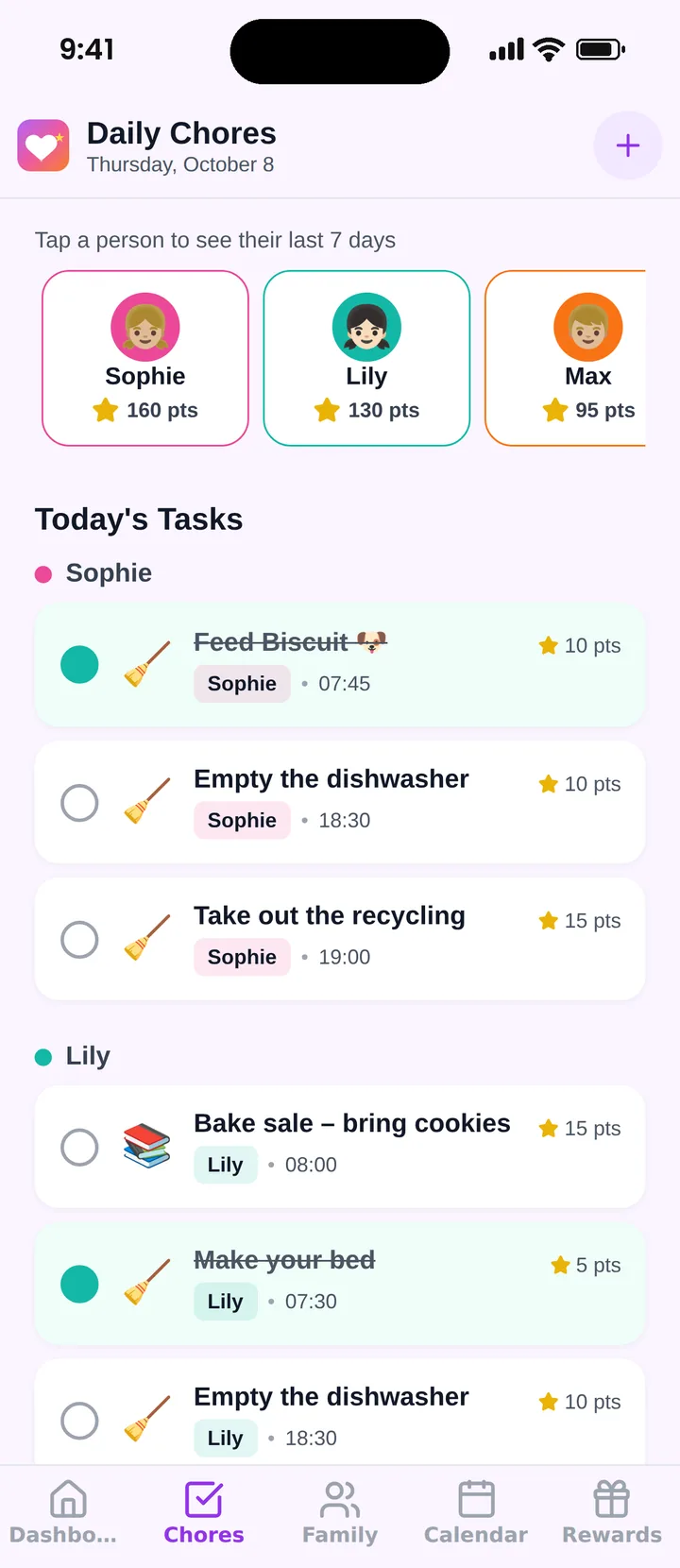
The free plan covers up to 3 family members and 1 repeating task; Premium removes the limits. For other options, see our list of the best chore chart apps.
Pick your zones tonight, write each child's version on one sheet, and make this Sunday your first rotation day.
Frequently asked questions
How often should you rotate chores?
Weekly suits most families. A week gives kids enough repetitions to get decent at a job without getting bored of it. Rotating every day tends to confuse younger kids about whose turn it is, and skill-heavy jobs such as laundry or cooking are better left with one child for a month so they actually learn them.
How do you rotate chores between kids of different ages?
Rotate the zone, not the exact task. When the youngest child has kitchen week, they set and wipe the table, while an older child on kitchen week loads the dishwasher and wipes the counters. Each child's zones should be worth about the same points to them, so no week is the bad week.
What if a child refuses their rotation job?
Keep the rotation as it is and let the job wait until it's done, before screens or other extras, instead of handing it to a sibling. If refusals keep happening with one zone, check whether that version of the zone is too big for the child's age and trim it at the monthly review.
Should parents be part of the chore rotation?
Adults can take a slot in some zones, such as cooking dinner or cleaning the bathroom. It shows kids the rotation is how the household runs, not a job list for the youngest people, and it keeps the adults' share of the work visible on the same chart.
Try Famiyo With Your Family
Chores with points, a rewards shop for kids and one shared family calendar. Set it up in a couple of minutes.



Free to download • No credit card required • Available on iOS & Android