How to Motivate a Teenager With Anxiety
What looks like laziness in an anxious teen is often avoidance. Here is how to lower the pressure, shrink the first step and reward effort instead of results.
By Famiyo Editorial Team4 min read
You ask your 15-year-old to start their homework and nothing happens. You ask again, and they snap or disappear into their room. It is easy to read this as a bad attitude. With an anxious teenager, it is often something else: the task feels bigger and riskier than it looks, so the brain steers away from it. This page covers how to read that pattern, and how to build motivation in small steps that a worried teen can actually take.
Why anxious teens look unmotivated
Anxiety and low motivation share outward signs: putting things off, irritability, long stretches on a phone, "I don't care." The reasons differ. An unmotivated teen may find the task pointless. An anxious teen often cares a great deal and fears doing it badly, being judged, or not knowing where to begin.
Avoidance gives quick relief, and that relief teaches the brain to repeat the habit. The American Academy of Pediatrics and the CDC both describe avoidance as a common feature of anxiety in young people, and recommend professional support when it interferes with school, sleep or friendships. You can't fix that with a better sticker chart. What you can do is stop adding fuel and make starting easier.
If you suspect ADHD rather than anxiety, or both, see our guide on motivating a teenager with ADHD. The two overlap more than many parents expect.
What to stop doing first
Some well-meant habits raise the temperature:
- Repeating the request several times in a row.
- Announcing a deadline at the last minute.
- Taking away points or privileges when the teen freezes.
- Saying "just do it" or "there's nothing to be scared of."
- Comparing them with a sibling.
None of these make the worry smaller. They add a second threat on top of the first one. Start by agreeing on one calm time of day to talk about what is coming up, and drop the running commentary the rest of the time.
A stepwise way to get started
This sequence works for chores, homework, a driving lesson or a job application. Use it for one task at a time.
- Ask what feels hardest about it. Listen without fixing. "The hardest part is not knowing if it's right" tells you more than "I don't want to."
- Shrink the first step until it takes about five minutes or less. "Open the laptop and write the title" is a step. "Do the essay" is not.
- Agree on when and where the step happens, and say it out loud so it is not a surprise.
- Offer to sit nearby, not to hover. Some teens do better with a parent in the room; others need privacy. Ask which.
- Praise the attempt, in specific words: "You started even though it felt bad."
- Decide the next step together, and stop for the day if the effort was real.
If a teen only manages the first step on a hard day, that still counts. Progress for an anxious teen is rarely a straight line.
Reward the attempt, not the result
Evidence on reinforcement is consistent: small, timely rewards tied to behavior the child controls tend to help. For anxiety, the details matter.
| Do | Skip |
|---|---|
| Reward the step ("started the task") | Reward only the finished, perfect result |
| Keep the points and prices fixed and visible | Change the rules mid-week |
| Let the teen choose from a menu | Surprise them with a prize they didn't choose |
| Let points accumulate with no penalties | Deduct points when they freeze or cancel |
| Tie rewards to what they control | Tie rewards to grades, test results or how they feel |
Rewards will not treat anxiety, and they should never be the main plan. Used lightly, they give a teen a reason to try the thing they dread, and a visible record that they did. For a bigger picture of how to set values, see how to reward kids for chores.
Choices and predictability
Anxious teens tend to dislike surprises. A few habits keep the household steady:
- Write the week on a shared calendar so nothing arrives as a shock.
- Give notice before a change: "Thursday we're seeing your grandmother, so homework moves to Wednesday."
- Offer two ways to do a task, not an open question: "Dishes now or after your show?"
- Give them one job they own completely, so they have a place where they are the expert.
A sense of control is one of the main things they are missing. Small choices give some of it back.
Using a rewards shop as a menu
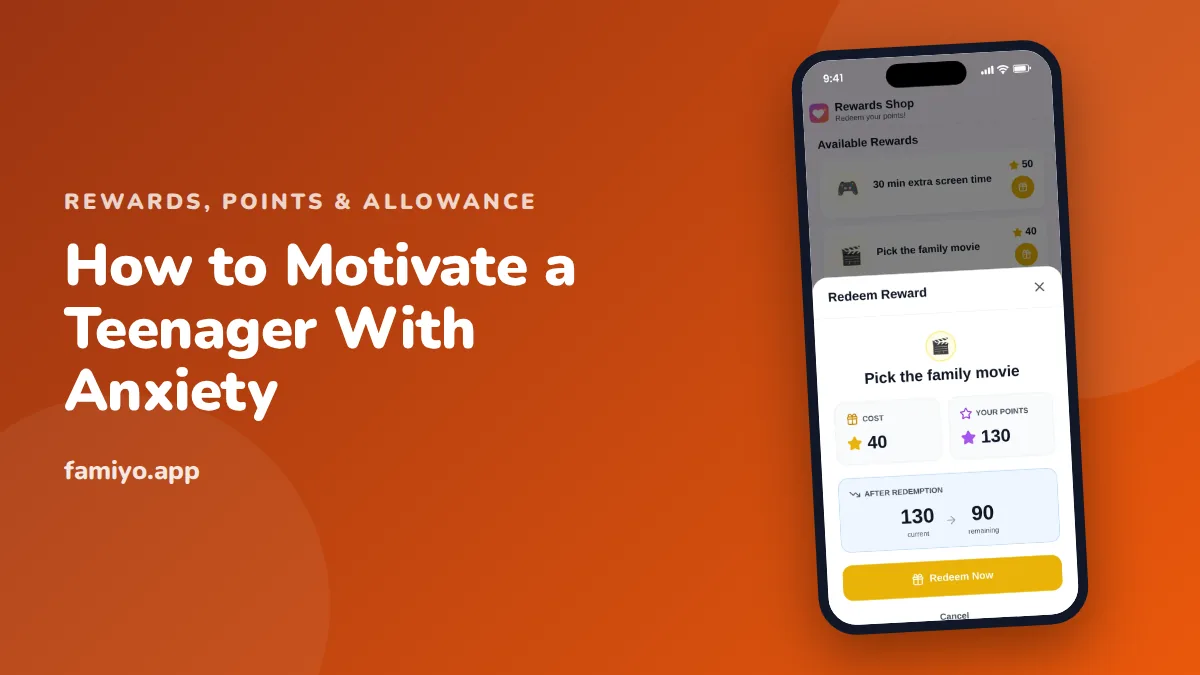
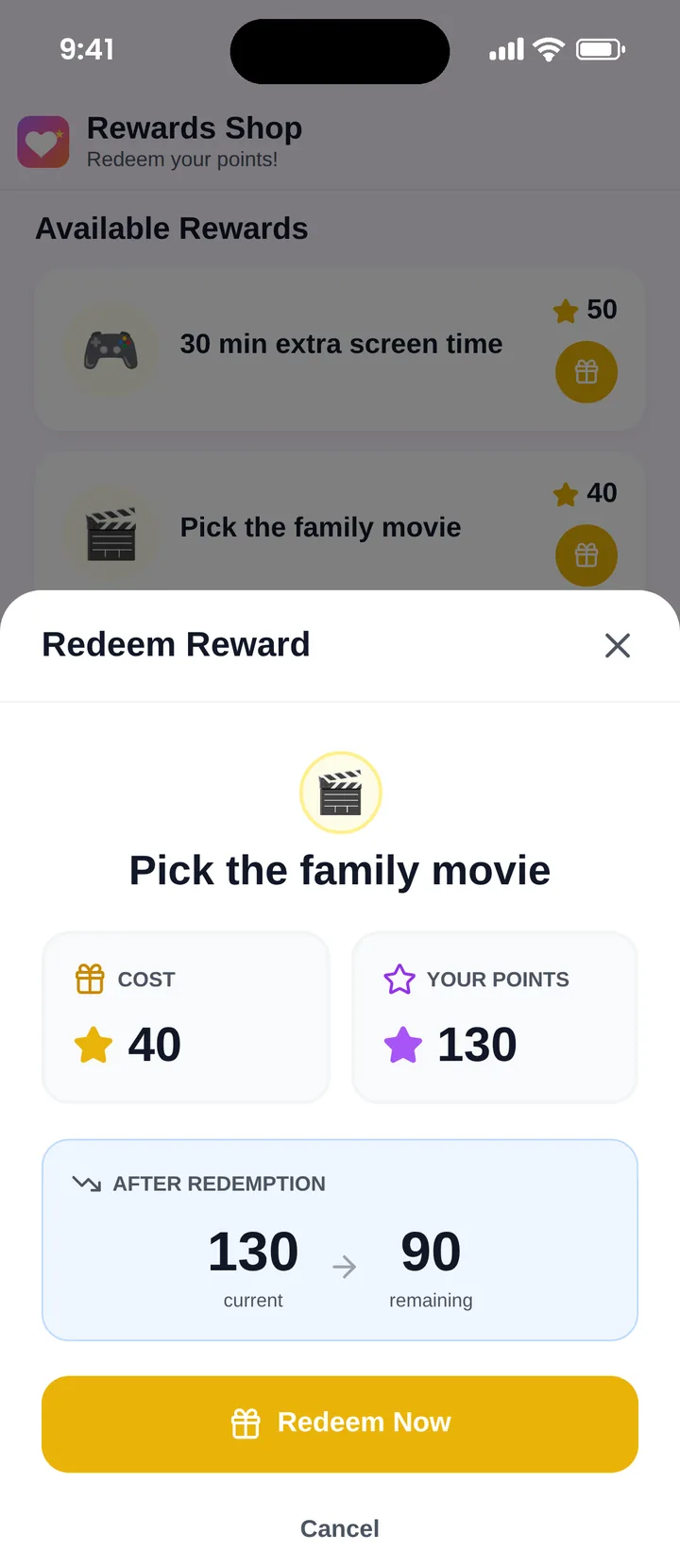
Famiyo is a free family app for iPhone and Android that combines a shared family calendar, chores with points and a rewards shop; kids join with a code, no email needed. For an anxious teen, the useful part is how predictable it is. You create rewards in advance with a price in points, how many are available and when, and your teen sees exactly what a task earns and what a reward costs. They redeem from their own phone and see how many points they will have left, so nothing is a surprise and nobody has to ask. You hear about the redemption through a push notification. There is no need to take points away: set the prices once and let them build up. See our list of the best reward chart apps for kids.
When to bring in a professional
Motivation tactics help with everyday stuckness. They do not replace care. Call your teen's pediatrician or a therapist if worry lasts for weeks, keeps your teen from school or friends, disrupts sleep or appetite, or comes with panic attacks or talk of self-harm. If your teen mentions wanting to hurt themselves, treat it as urgent and call 988 in the US.
Your teen's school counselor can also help adjust workload while you get support in place. For a teen who is stuck on school in particular, see how to motivate a teenager who hates school.
This week, pick one task that keeps causing a standoff and cut it to a five-minute first step. Tell your teen the plan ahead of time, and notice the attempt when it happens.
Frequently asked questions
Why does my anxious teenager seem unmotivated?
Often the teen wants to do the task but dreads it, so they avoid it. Avoidance brings short-term relief, which strengthens the habit. From the outside it looks like laziness, but the fear is usually the engine.
Do rewards work for teens with anxiety?
They can, if they are predictable and tied to effort. Rewards for steps taken, not perfect results, lower the stakes. Taking points away or making rewards depend on performance can add pressure and backfire.
Should I push my anxious teen or give them space?
Aim for a middle path: stay warm, agree on a small step together and check in once. Constant pushing raises stress, but accepting full avoidance tends to make the fear bigger over time.
When should I get professional help?
Talk to your teen's pediatrician or a therapist if worry stops them from going to school, seeing friends, sleeping or eating, or if it lasts for weeks. Motivation tactics at home support treatment but do not replace it.
Try Famiyo With Your Family
Chores with points, a rewards shop for kids and one shared family calendar. Set it up in a couple of minutes.



Free to download • No credit card required • Available on iOS & Android