Teaching Kids About Money and Investing, Age by Age
How to teach kids about money and investing by age: what to cover from 5 to 17, simple compound growth examples, and how to practice with real choices.
By Famiyo Editorial Team6 min read

Most kids hear "invest" the way they hear "mortgage": something adults do, somewhere else. But the ideas underneath, like waiting for a bigger payoff, ownership and growth over time, are things a 7-year-old can start to feel with a jar of coins. This guide walks through what to teach at each age, how to explain compound growth without jargon, when real accounts make sense, and how to give kids practice with money they actually control.
Learn to handle money before learning to invest
Investing is saving with a long time horizon and some risk. A child who has never held back from spending $5 will not benefit from a lesson on index funds. So the order matters:
- Earn: money comes from effort.
- Spend: every choice costs something else.
- Save: waiting can buy a bigger thing.
- Give: money can help someone else.
- Invest: money can grow, and can also shrink.
A simple split for younger kids is spend, save, give, for example 50%, 40%, 10%. Once the saving jar becomes routine, investing is a natural next step, not a leap.
What to teach at each age
| Age | Core idea | A concrete activity |
|---|---|---|
| 5 to 7 | Money is earned and choices cost something | Three jars: spend, save, give. Let them see a saved amount grow over weeks |
| 8 to 10 | Saving toward a goal, and waiting pays off | A savings goal with a picture and a price. Offer a small bonus if they wait a month |
| 9 to 11 | Money can grow over time | Walk through compound interest with a simple table (see below) |
| 11 to 13 | What a stock and a fund are | Pick a company they use and look up what it does and how it makes money |
| 13 to 15 | Risk, diversification and fees | Compare a single stock with a broad fund over a long chart |
| 15 to 17 | Real accounts, taxes and long-term goals | Open a custodial account together, talk about retirement accounts and earned income |
These ages are loose. A curious 9-year-old may be ready for the ownership idea, and an anxious 13-year-old may need more time with saving. Follow the child.
Explaining compound growth in one minute
Kids understand "your money makes babies" better than any formula. Use the rule of 72: divide 72 by the yearly growth rate to estimate how many years it takes money to double. At 7%, it is about 10 years.
An illustration, not a promise: if $100 grew at a steady 7% a year, it would be about $197 after 10 years and about $387 after 20, without adding anything. Real markets do not move in a straight line, and some years go down.
Make it physical. Have your child fill in a table on paper:
| Year | Start | Growth at 7% | End |
|---|---|---|---|
| 1 | $100 | $7 | $107 |
| 2 | $107 | $7.49 | $114.49 |
| 3 | $114.49 | $8.01 | $122.50 |
Then ask: "What happens in year 4?" The point they should notice is that the growth itself starts growing. That is the lesson, and the numbers are just a way to see it.
Make a small, real investment together
Simulations are fine, but real money, even a small amount, changes how a child pays attention. Some practical points for parents:
- Minors generally cannot open a brokerage account alone. Custodial accounts let an adult manage investments for a child. Rules, taxes and options differ by country and state, so check with a financial professional or the provider before you start.
- A retirement account for a teen generally requires that the teen has earned income. A first job or paid work can open that door.
- Education savings accounts exist in some places and have their own rules.
- Many families start with a broad, low-cost fund rather than single stocks, because it spreads risk. That is a common approach, not advice for your situation.
Decide ahead of time how much you are comfortable losing, and tell your child the truth: the value can go down, and that is part of what investing is. A small dip on a small amount is an honest classroom.
If your child earns money from jobs at home, our page on chores for 9-year-olds to earn money lists realistic jobs and pay. For where the whole question of paying for chores sits, see should kids get paid for chores, and for the saving and budgeting habits that come before any investing, teaching kids money management.
Practice with a points economy first
A points system can be a safe rehearsal for money: kids earn for effort, face a price list and decide whether to spend now or save for something bigger. It does not need real dollars to teach the habits.
Some useful ways to stretch the idea:
- Set a larger reward, like a day out at 400 points, so a child has to save across weeks.
- Offer a "saver's bonus": if they leave points untouched for a month, they get 10% more. That is compound growth in miniature.
- Let them choose between a small reward now and a bigger one later, and discuss which they would pick if it was real money.
- Use the conversion of 100 points to $1 when you want to talk about prices in dollars.
A saver's bonus is a family rule you track yourselves, and the point is the pattern, not the maths.
Talking about risk without scaring them
Kids pick up money feelings from you. If markets make you anxious, they will hear it. Keep the conversation calm and concrete.
- Show a long chart of a broad fund. Point to the dips and ask, "What would you have done here?" Most children say they would sell, which opens a good talk about patience.
- Explain that nobody can predict next month, so people spread money across many companies instead of betting on one.
- Mention fees in plain words: a fee is a small slice that goes to whoever runs the fund, every year, whether the fund goes up or down.
- Separate goals by time. Money for a bike next spring belongs in a savings jar. Money for college or retirement, many years away, is where investing can make sense.
Then ask them to explain it back to you in their own words. If they can teach it to a younger sibling, they understand it.
Giving kids money decisions, not just money
The most effective lesson is a decision with a consequence. Examples to try:
- A teen gets a monthly clothing budget and keeps the unspent part.
- A tween chooses between a $20 toy now and doubling the savings jar to $40 in two months.
- A child earns $2 to $5 for a big extra job, such as washing the car, and decides what to do with the money.
Keep basic family chores unpaid, as part of belonging to the household, and pay for extra jobs. Typical weekly allowance ranges are $3 to $7 at ages 5 to 7, $7 to $10 at 8 to 10, $10 to $15 at 11 to 13, and $15 to $25 from 14. It is a starting point, not a standard.
When your child makes a poor choice with a small amount, resist fixing it. The regret over a $6 purchase is cheap tuition.
Doing the points-for-rewards part in Famiyo
If you want the points rehearsal without building a spreadsheet, an app can run it.
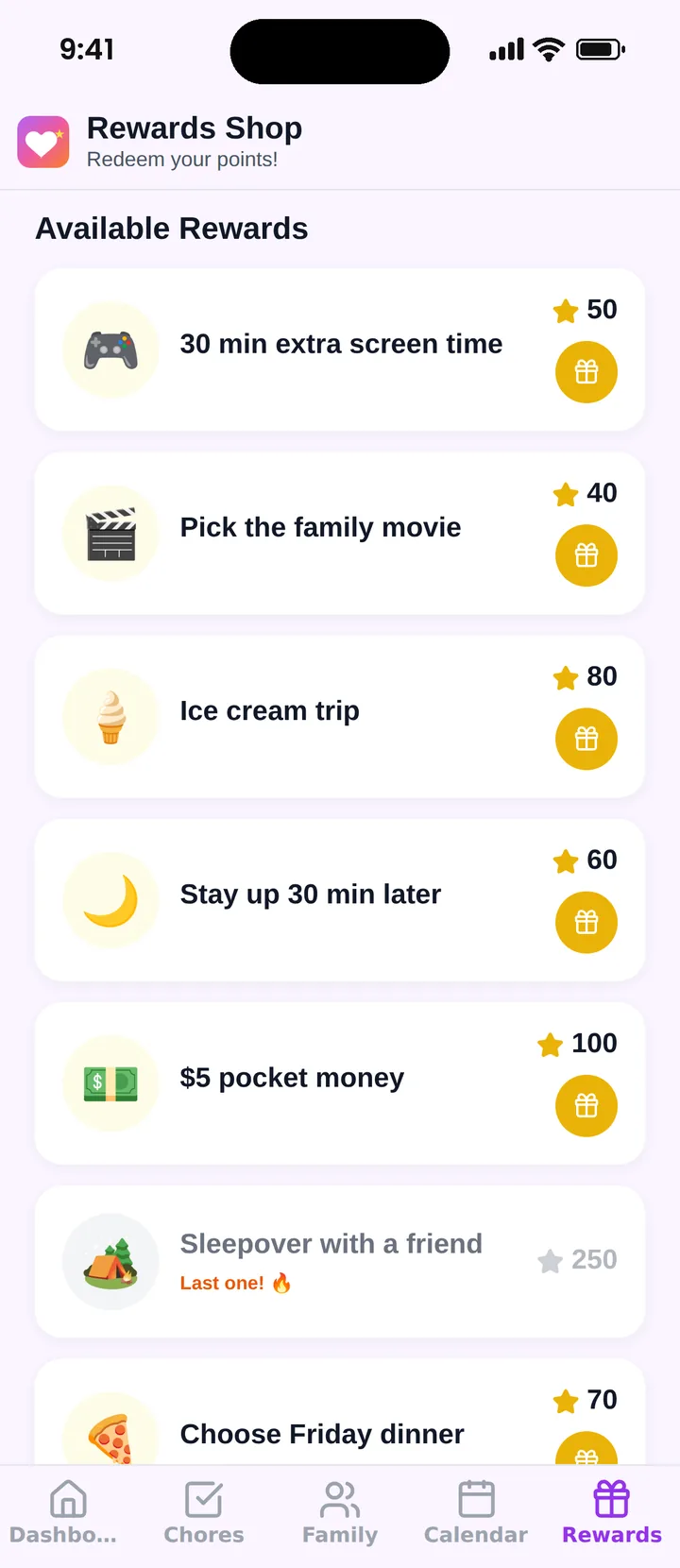
Famiyo is a free family app for iPhone and Android that combines a shared family calendar, chores with points and a rewards shop; kids join with a code, no email needed. You create rewards with a price in points, including pocket money as a reward, set how many are available and when, and kids redeem from their own phone, seeing how many points they will have left. Famiyo does not hold or move real money, so any cash is handed over by you outside the app. The statistics screens show points this week and in total, which helps when talking about saving.
For a look at your choices, see our list of the best allowance apps for kids.
A good next step this week: sit down with your child, pick one saving goal with a price, and write it on paper where you can both see it.
Frequently asked questions
At what age should I start teaching my child about investing?
Start money basics around 5, when kids can count and understand trade-offs. Introduce the idea of growth and compound interest around 9 to 11, and real investing concepts around 12 to 14, with a parent controlling any account.
How do I explain the stock market to a child?
Say that a stock is a tiny slice of ownership in a company. If the company does well, the slice can become more valuable, and if not, it can lose value. Use companies they know, such as a favorite shoe or game brand.
Can a child own investments?
Not directly in most places. Minors usually invest through an account an adult manages, such as a custodial account, and some families use education savings accounts. Rules and tax treatment vary, so check with a financial professional.
Should I give my child real money to invest?
A small amount of real money teaches more than a simulation, as long as you can accept losing it. Many families use a portion of savings or gifts, and let the child help choose within limits you set.
How do I teach kids that investing involves risk?
Be plain about it. Show a chart of a fund over a long period, including the dips, and talk about why people invest for years, not weeks. A small, real loss on a small amount is a safe way to learn it.
Try Famiyo With Your Family
Chores with points, a rewards shop for kids and one shared family calendar. Set it up in a couple of minutes.



Free to download • No credit card required • Available on iOS & Android