Chores for 15 Year Olds to Earn Money at Home
Paid chores for 15 year olds that build real skills: bigger projects, fair pay of $2 to $5 per job, a monthly job board and ways to pay by app or points.
By Famiyo Editorial Team5 min read

At 15, most teens are done with sticker charts and want to know what their time is worth. They are also close to wanting a phone upgrade, concert tickets or money toward a first car. That makes this a good year to build a job board at home: real projects, clear pay and the same expectations you would have of someone outside the family. Below you will find the jobs that suit this age, the pay for each, a monthly structure and how to keep it fair for siblings.
What is different about paid chores at 15?
Two things changed since 14. The first is capability. A 15-year-old can use power tools with supervision, cook a full meal, handle a hose and ladder safely and lift most of what an adult lifts. The second is attitude. They notice when something looks like busywork, and they will do a job well if the job is real.
If you are starting from scratch, our guide to chores for 14 year olds to earn money covers the basic split between unpaid chores and paid jobs. The same rules apply here: anything that comes with living in the house is free, and anything that goes beyond it can be paid. What moves up at 15 is the size and length of the projects.
Which skill-based jobs fit a 15 year old?
Think in terms of projects rather than chores. A project has a defined result, takes more than one session or more than an hour and teaches something. The table pairs each with the skill it builds and a fair rate in the usual ranges.
| Project | What it teaches | Rough time | Suggested pay |
|---|---|---|---|
| Detail the car inside and out | Care for expensive things, sequence | 60 to 90 minutes | $5 |
| Organize the garage or basement | Sorting, deciding what to keep | 2 hours, over two days | $5 |
| Paint a fence or shed with supplies provided | Prep work, patience | 3 hours, over a weekend | $5 |
| Cook a full dinner on a set night each week | Planning, shopping from a list, timing | 90 minutes | $4 |
| Weed and mulch one garden bed | Physical work, finishing | 60 minutes | $3 |
| Help a younger sibling with a school project | Teaching, patience | 45 minutes | $2 |
| Set up and tidy the home printer, router cables or media shelf | Troubleshooting | 30 minutes | $1 |
| Clean gutters or sweep the porch and steps | Safety, working at height with a spotter | 60 minutes | $4 |
Pay stays within the range for a big job even when the work is long, because the point is to teach, not to replace an adult wage. If a project runs three hours and you want to pay more, split it into stages and pay at each one.
A job that needs a ladder or a power tool needs an adult nearby the first time. After that, it depends on your teen and your own judgment.
How do you organize the jobs so it does not become a nag?
Post the jobs rather than assigning them. A simple monthly board works.
- On the first of the month, list five to eight paid jobs with the pay and a deadline for each.
- Let your teen pick the ones they want. They do not have to take any.
- Each job gets a one-line description of done: "Garage floor swept, tools on the pegboard, boxes labeled."
- When the job is finished, a parent checks it against that line. If it passes, they are paid on the next Saturday. If it does not, they fix it first.
- Unclaimed jobs on the 20th are either done by a parent or offered to a sibling.
This takes ten minutes a month. It also removes the "can I do something for money?" conversation at 9 p.m. on a school night, because the answer is already on the board.
How do you keep the money from disappearing?
Most 15-year-olds are better at earning than at keeping. A one-line rule makes a difference: a third goes to a goal, a third is spend and a third is saved for later. It does not need to be exact. What matters is that your teen decides what the goal is, whether that is a pair of shoes or the first month of insurance when they start driving.
If you pay by phone transfer, the money is already in an account and the split can be a small step: they move a third into savings as soon as it lands. If you pay in cash, a labeled envelope for each third does the same job.
Our guide to earn screen time ideas is useful for the other side of the coin. Some 15-year-olds care more about extra time online than extra money, and you can offer both as a choice.
Should siblings get the same jobs?
Not necessarily. A 15-year-old and a 10-year-old are not interchangeable, and treating them the same only causes friction. Give the older teen the bigger jobs and a higher rate, and give the younger one smaller jobs in the $0.25 to $1 range. Say out loud that the pay follows the size of the job and not the age of the child.
Do not let paid work replace the shared jobs everyone does. If the 15-year-old does the dinner dishes for money while the 10-year-old does them free, you have created a very quick argument. Keep the baseline identical in kind (everyone clears their own plate, everyone keeps their room) even when the amounts differ.
Paying in points with Famiyo
Famiyo is a free family app for iPhone and Android that combines a shared family calendar, chores with points and a rewards shop; kids join with a code, no email needed. For a 15-year-old, you can add each paid project as a chore with its own points, and a different number of points for each child if the job differs. Then you create rewards in the shop, such as pocket money, a night out or extra screen time, each with a price in points, and your teen chooses what to redeem from their own phone. In the default suggestion, 100 points equal $1. The money itself changes hands outside the app. Our list of the best allowance apps for kids compares other ways to run this.
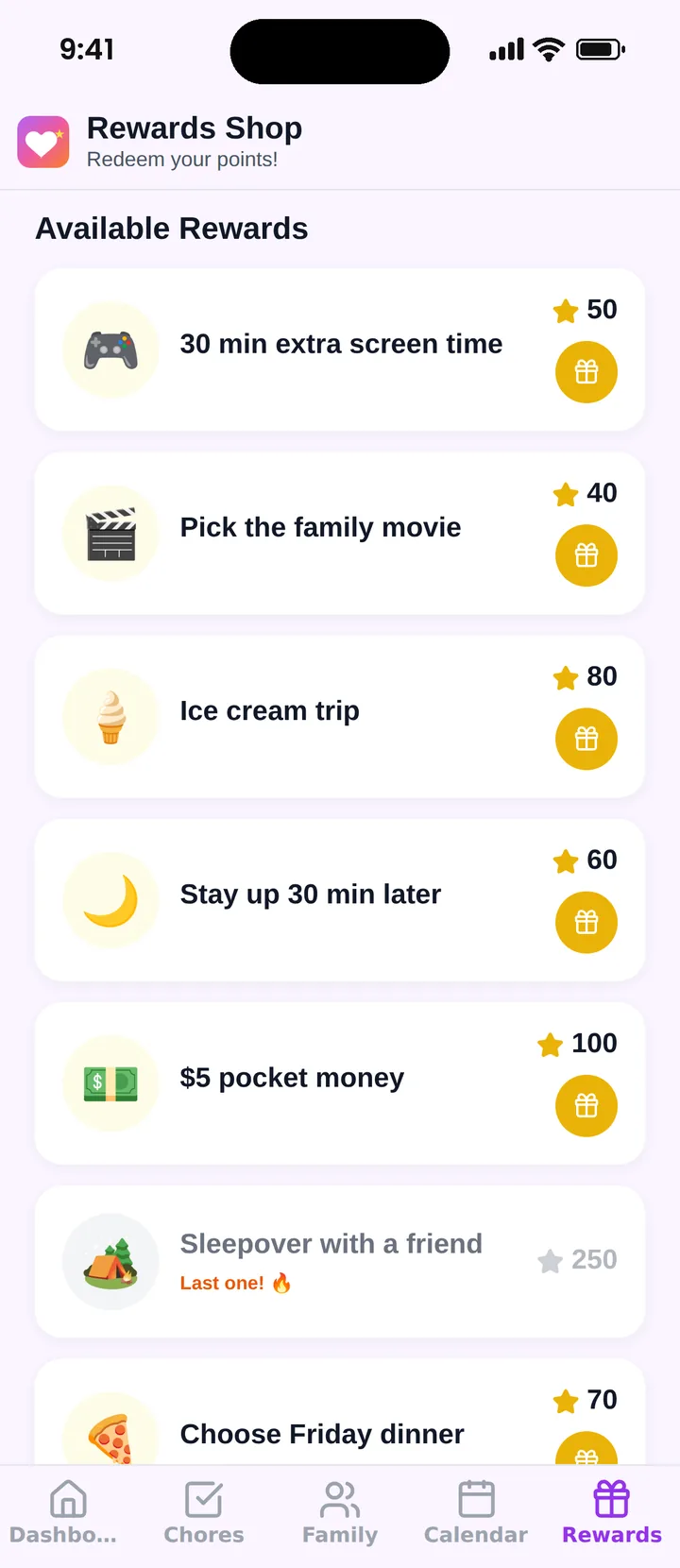
Parents can require approval before points are added, which suits bigger jobs that need a quick look at the result.
What if your teen says no thanks?
Sometimes a 15-year-old will turn down every job on the board. That is allowed. It teaches the other half of the lesson: money is available, but no one hands it over for free. The unpaid baseline continues.
If your teen ignores the board for several months and then asks for money, point to the board. Do not hand out cash on request because it is easier. And if they come to you with a project idea of their own, such as cleaning out the attic for $15, listen. A teen who makes an offer is already thinking like an adult. The next step in that direction is covered in our guide to chores for 16 year olds to earn money.
Print or write out five jobs with pay and deadlines tonight, and let your teen choose first.
Frequently asked questions
How much should a 15 year old get paid for chores?
Pay $0.25 to $1 for a small extra job and $2 to $5 for a big one. A typical allowance for a teen is $15 to $25 a week, so paid jobs work best as an extra on top, or as a replacement if you want pay tied to effort.
What chores can a 15 year old do to make money at home?
Mowing, raking, washing and detailing the car, deep-cleaning a bathroom or the fridge, cooking a family dinner, organizing the garage, helping a younger sibling with homework and doing outdoor jobs like painting or weeding. These are tasks you would otherwise do or hire out.
Should a 15 year old be paid for basic chores?
No. Their room, their laundry, their dishes and a share of the household jobs are part of living in the house. Paying for basics makes it harder to get them done for free later. Pay only for work that goes beyond the baseline.
How do I stop my teen from only doing chores for money?
Keep the baseline list unpaid and short, and write it down. Paid jobs are optional extras. If your teen declines them, nothing changes except that they do not earn that money. The unpaid list does not depend on how they feel about the cash.
Is it better to give a 15 year old an allowance or pay per chore?
Many families do both: a modest allowance to practice budgeting, plus paid jobs for extra income. If you only want one, an allowance teaches planning while pay-per-job teaches that effort turns into money. At 15, the mix is up to you.
Try Famiyo With Your Family
Chores with points, a rewards shop for kids and one shared family calendar. Set it up in a couple of minutes.



Free to download • No credit card required • Available on iOS & Android