How to Reward Kids for Good Behavior (What Works and What Backfires)
How to reward good behavior so it lasts: praise first, small rewards second, clear rules, fast timing, and a step-by-step plan with examples by age.
By Famiyo Editorial Team5 min read
Parents ask this question for two reasons. Either a child is already doing well and deserves recognition, or a behavior needs to change and punishment hasn't helped. Rewards can work in both cases, but how you give them decides whether they build good habits or a child who asks "what do I get?" for everything. This page walks through what the research-informed guidance says, a reward ladder from free to costly, a five-step plan, and examples by age.
Why rewarding behavior works, and when it does not
Behavior that gets noticed tends to repeat. That is the basic idea behind positive reinforcement, and it is what pediatric guidance such as the American Academy of Pediatrics describes when it recommends catching children being good and responding to it. Attention and praise do the most work, and they cost nothing.
Material rewards are a tool, not the foundation. They help most when a behavior is new, hard or not naturally rewarding: staying in bed at night, sharing a toy, getting dressed without a fight. They help least when a child already enjoys the activity, such as drawing or reading. In those cases, a prize can make the activity feel like work. It depends on the child, and on how long the reward system runs.
Two practical rules fall out of this. Reward the behavior you want, not the absence of the one you don't. And plan to fade the reward once the habit is steady.
The reward ladder: start at the top
Work down this list and stop at the first rung that does the job.
| Rung | Examples | Cost |
|---|---|---|
| 1. Specific praise | "You waited your turn even though you were upset. That was hard." | Free |
| 2. Attention and time | A game together, ten minutes of your full focus, choosing dinner | Free |
| 3. Small privileges | 15 extra minutes of screen time, picking the family movie, staying up 30 minutes later | Free |
| 4. Points or tokens | Points toward a bigger reward | Free |
| 5. Prizes or outings | A day out, a toy around $20 | Money |
Most everyday good behavior needs rungs 1 to 3. Save the lower rungs for the hard habits you are actively working on.
How to reward good behavior in 5 steps
- Pick one or two behaviors. "Be good" is too vague. "Hang up your coat when you come in" is something a child can do and you can see.
- Say the rule and the reward ahead of time. Calmly, before the moment arrives. "If you get dressed by 7:30, you get ten minutes of the tablet before school."
- Reward it fast and name it. "You hung up your coat without me asking. Thank you." The praise matters more than the prize.
- Keep rewards small. Large prizes make small behaviors feel pointless afterward. Aim for a small reward within a day or two, and a bigger one every few weeks.
- Fade it. Once the behavior is routine, keep the praise and drop the prize, or move to a surprise reward now and then.
What to say in the moment
Words matter because they teach the child what they did right.
- Instead of "Good job!" try "You cleaned up without a reminder."
- Instead of "You're so good!" try "You shared your snack with your sister. That was kind."
- For a repeat of a hard habit: "That's three nights in a row you stayed in your bed. How does that feel?"
Praise the effort and the choice, not the child's character. Calling a child "so good" sets up a standard they may feel they have failed when they have a bad day.
Reward ideas by age
| Age | Good rewards for good behavior |
|---|---|
| 2 to 4 | Stickers, a high five, a song, an extra story, choosing a snack |
| 5 to 7 | A game with a parent, a trip to the park, choosing dessert, a points chart toward a small prize |
| 8 to 12 | Extra screen time, a friend over, choosing the family movie, points toward a bigger reward |
| 13+ | Later curfew, more say in plans, money for an extra, time with a car or a friend |
Be ready for a dip. When rewards start, behavior often improves quickly, then slips after a week or two as the novelty fades. That is normal. Keep the rule the same, keep the praise coming and give it a full two to three weeks before you decide it has failed or change anything.
Mistakes that make rewards backfire
- Bribing mid-meltdown. The reward needs to be agreed on before the behavior starts.
- Taking rewards back. If a child earned it, they keep it. Pair the behavior system with a separate consequence for rule breaking.
- Rewarding everything. If every small act gets a prize, the prizes lose meaning.
- Switching rules daily. Consistency for two to three weeks tells you whether it works.
- Only rewarding perfection. Reward progress. A child who goes from five time-outs to three deserves credit.
If your child has ADHD or autism, or if behavior is intense or sudden, talk with your pediatrician or therapist, who can help tailor rewards and timing to your child.
For ideas tied to specific situations, see our guides on how to reward kids for chores, how to reward kids for good grades and how to reward your child without spoiling them.
Running the rewards in Famiyo
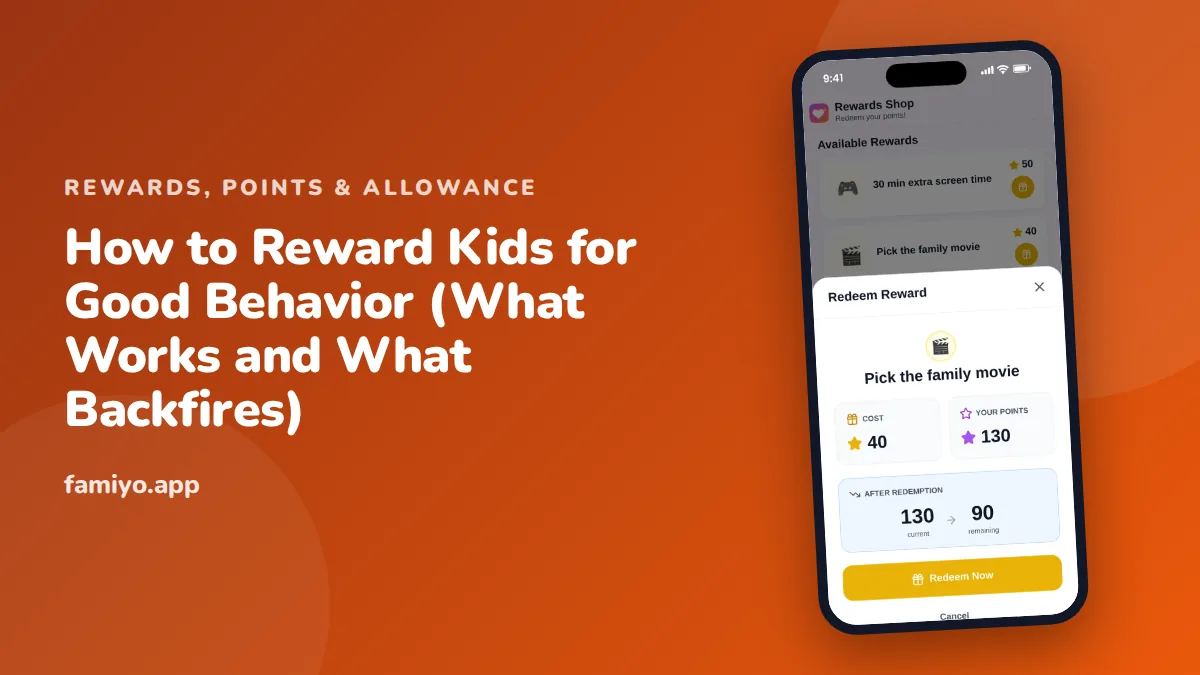
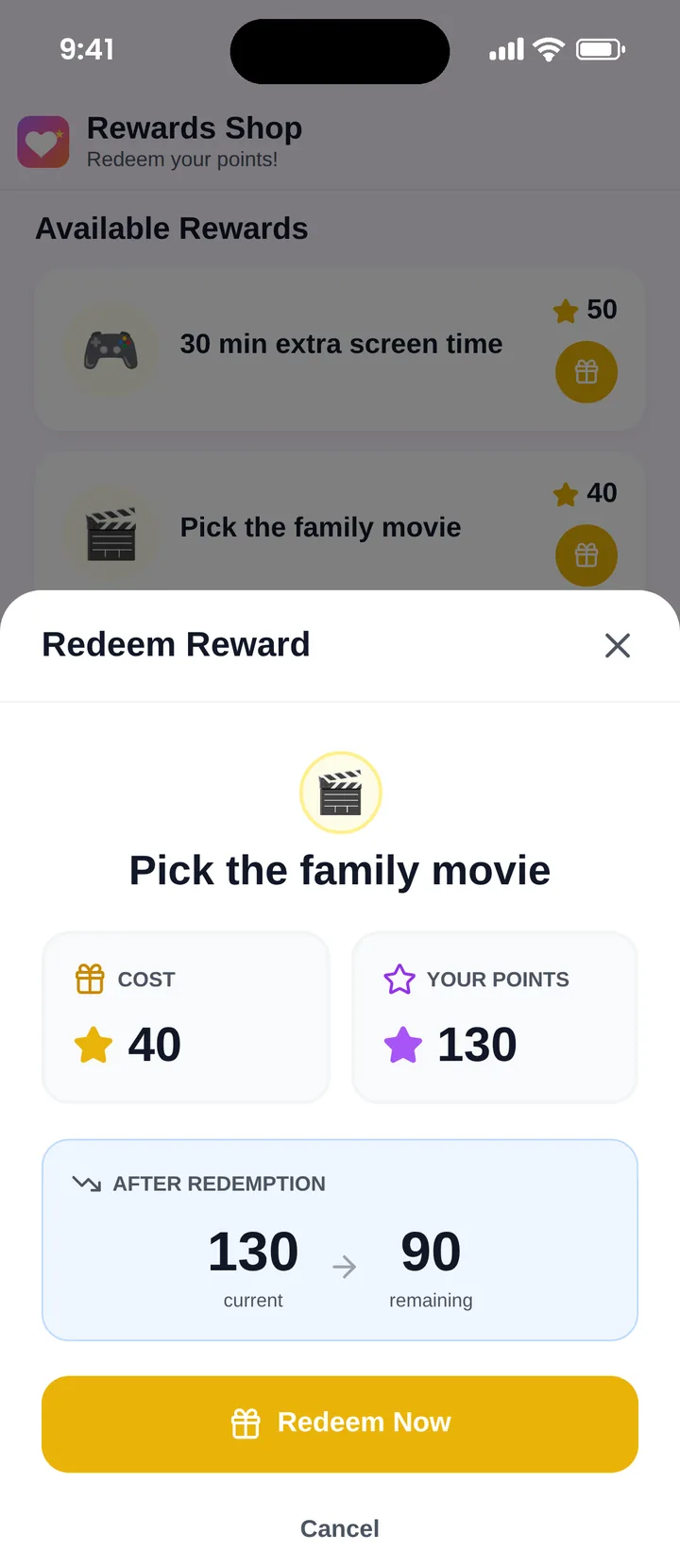
Famiyo is a free family app for iPhone and Android that combines a shared family calendar, chores with points and a rewards shop; kids join with a code, no email needed. The rewards shop covers rungs 3 to 5 of the ladder. You create rewards, set a price in points, choose how many are available and when. A child sees the list on their own phone, redeems what they can afford and sees how many points they will have left. You get a notification when a reward is redeemed. Behaviors such as getting ready on time can be set up as tasks with points. Compare tools in our list of the best reward chart apps for kids.
A simple way to begin
Choose one behavior this week, say the rule out loud, and give praise within seconds of it happening. Hold off on prizes until you see whether attention alone works.
Frequently asked questions
Should I reward kids for good behavior at all?
Yes, thoughtfully. Child development guidance, including from the AAP, favors positive attention and praise for behavior you want to see. Material rewards help most with new or difficult habits. They work worst for things a child already enjoys, where they can crowd out interest.
What is the best reward for good behavior?
Specific praise and your attention, delivered right away. Free or low-cost rewards come next, like choosing the music in the car, a game together or 15 extra minutes of screen time. Costly prizes should be rare.
How soon after the behavior should I reward it?
As soon as possible. For young children, within seconds to minutes. Older kids can wait for a point or token to be exchanged later, but the praise still needs to happen right then so they connect it to what they did.
How do I stop rewards from turning into bribes?
Set the deal before the behavior, not during a meltdown. A reward you announce calmly in advance is a plan. A reward you offer mid-tantrum to make it stop is a bribe, and children learn quickly that noise gets prizes.
Try Famiyo With Your Family
Chores with points, a rewards shop for kids and one shared family calendar. Set it up in a couple of minutes.



Free to download • No credit card required • Available on iOS & Android