How Much Allowance for a 6 Year Old?
A 6-year-old usually gets $3 to $7 a week. Here is how to pick your number, split it into spend, save and give, and keep payday simple.
By Famiyo Editorial Team3 min read
Six is when money starts to make sense. A first grader can count coins, compare a price tag with what is in their hand, and understand that spending it on one thing means not having it for another. This page gives you the number, a way to split it, and a payday routine a 6-year-old can follow without help.
What is a typical allowance for a 6-year-old?
Between $3 and $7 a week. The rule of thumb of $1 per year of age points to $6, and that is a perfectly good choice. If you are unsure, start low at $3 to $5. You can raise it later, and a child almost never complains about a raise. Lowering it is the hard direction.
| Weekly amount | What it looks like in practice |
|---|---|
| $3 | Three bills. Easy to count, easy to split. |
| $5 | One bill, or a bill and coins to make three jars. |
| $7 | Good if your child is asked to save toward bigger goals. |
None of these is the right answer for every family. Pick one you can pay every week without strain.
How should a 6-year-old split allowance?
A simple three-way split fits this age well. A common split is 50% spend, 40% save, 10% give. On $5 that is $2.50, $2 and 50 cents.
- Use three clear jars or envelopes, labeled with a drawing: a toy, a piggy bank, a heart.
- On payday, your child splits the money into the jars themselves.
- The spend jar is theirs to use freely, even on something you find silly.
- The save jar waits for one named goal.
- The give jar goes to something your child picks, like a coin for a shelter collection.
Seeing the save jar fill up is what makes the habit stick. Our chore jar ideas for kids show other ways to make progress visible.
Should it be tied to chores?
Not the base amount. At 6, a child is still learning that families share the work, and basic jobs belong to that. Tidying their room, sorting laundry by color and packing the school bag are part of the deal.
Paid extras can sit on top: 25 cents to $1 for a small job, like helping wash the car or sweeping the porch. Keep these rare so the lesson does not shrink to "no pay, no help."
If screen time is the thing your child really wants, see how families handle earning screen time with chores. Some prefer that to cash at this age.
How do you run payday with a 6-year-old?
Same day, same time, every week. Saturday morning works because nobody is rushing. Do it at the kitchen table, pay in a mix of small bills and coins, and let your child count it before they split it. If you forget a payday, pay the next day and say sorry. Consistency matters more than the amount.
Expect mistakes. Some 6-year-olds will blow all of their spend jar on one thing they regret by Wednesday. That is a cheap lesson at $2.50, and it is why the amounts are small.
Doing this with points in Famiyo
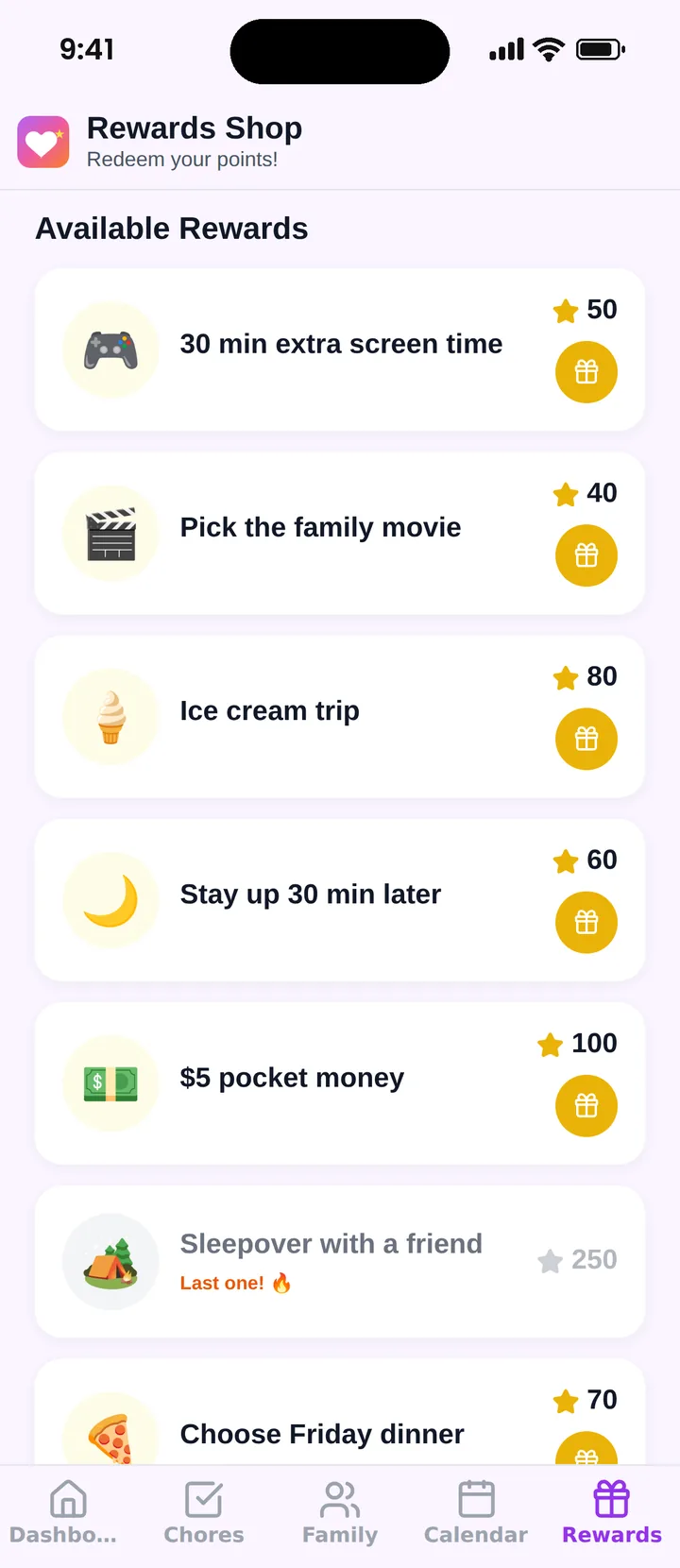
Famiyo is a free family app for iPhone and Android that combines a shared family calendar, chores with points and a rewards shop; kids join with a code, no email needed. A 6-year-old can use it as a stand-in for the jars. Chores they do earn points, and you add pocket money as a reward in the rewards shop, say $1 for 100 points (100 points = $1). Your child sees the prices, picks one, and redeems it from their own phone; the app shows how many points they will have left. The cash still comes from your wallet.
Our list of the best allowance apps for kids compares other options.
When should the amount go up?
Treat the first number as a trial. After a couple of months, ask whether your child can name what they are saving for and whether the spend jar still feels meaningful. If the answer is yes to both, hold steady until the next birthday. A small raise then, even 50 cents, feels like a promotion and ties growing up to growing responsibility. Do not raise it because they asked loudly on a Tuesday.
Before you start
Pick the amount, buy three jars, and set payday. If a younger or older sibling is in the picture, our pages on what to give a 5-year-old and a 4-year-old show how the numbers change.
Frequently asked questions
Is $5 a week a good allowance for a 6-year-old?
Yes. $5 is inside the usual $3 to $7 range and easy to divide: $2.50 to spend, $2 to save and 50 cents to give. If $5 feels like a lot for your budget, $3 works just as well at this age.
Should a 6-year-old earn allowance by doing chores?
Keep everyday jobs like tidying their room and packing the school bag unpaid, because they are part of being in the family. Offer a few small extras that earn 25 cents to $1, such as washing the car with you.
How do I help a 6-year-old understand money?
Use physical money. Coins and bills in three clear jars let your child see saving grow. A 6-year-old is still learning to count and compare amounts, so keep prices and goals small.
What if my 6-year-old loses interest in saving?
Make the goal concrete and close. A small toy that costs two weeks of saving feels real. Put a picture of it on the jar and count the coins together each payday.
Try Famiyo With Your Family
Chores with points, a rewards shop for kids and one shared family calendar. Set it up in a couple of minutes.



Free to download • No credit card required • Available on iOS & Android