Thanksgiving Break Routine for Kids: A Simple Schedule
A Thanksgiving break schedule for kids: what to keep, what to loosen, sample days for a 3-day or 5-day break, travel tips and a Sunday reset.
By Famiyo Editorial Team6 min read
Thanksgiving break is short enough that a full overhaul would be silly, but long enough to unravel a school-night routine. Bedtimes drift, meals shift around the big dinner, and by Wednesday somebody has been in pajamas for two days. This guide shows what to hold steady, what to let go, and a few sample days, plus how to get everyone back on track before Monday.
What to keep and what to loosen
Not everything in a school routine matters equally. Sort it into two piles and you get a break that feels like a break without a rough Monday.
Keep these three:
- Wake-up within about an hour of the school-day time. Sleeping until 10 on a Tuesday is fine. Sleeping until noon every day is not.
- Meals at regular times, with a real breakfast. Meals are the easiest way to give a loose day a skeleton.
- A bedtime that moves by no more than an hour. For ages 6 to 12, sleep needs stay at 9 to 12 hours, and teens still need 8 to 10, according to AAP and AASM recommendations.
Loosen these:
- Homework blocks, unless a project is genuinely due
- Strict morning checklists
- Screen windows (keep the rule of screens off about an hour before bed)
- The order of the afternoon
Tell the kids the plan on the first day, and say it plainly: "We're keeping breakfast and bedtime. Everything else is flexible."
A sample day for a long Thanksgiving break
Say school is out Monday through Friday. A quiet, middle-of-the-week day might look like this.
| Time | Plan |
|---|---|
| 8:00 | Wake up, get dressed, breakfast |
| 9:00 | Chores, 20 to 30 minutes (beds, room, one helper job) |
| 9:30 | Free play or a project |
| 11:00 | Outing, errand or outdoor time |
| 12:30 | Lunch |
| 1:30 | Quiet hour: reading, audio books, drawing, a puzzle |
| 2:30 | Cooking or baking with a parent, or a game |
| 4:00 | Outside, or screen time if the day was active |
| 6:00 | Dinner |
| 7:00 | Family time, bath and pajamas |
| 8:00 | Lights out, adjusted by age |
Not every day needs the full table. Three fixed points (breakfast, lunch, dinner) and one planned activity is a good day.
Thanksgiving week, day by day
A break that starts the weekend before runs a little differently from a Wednesday-to-Sunday one. Here is a way to think about the shape of the week.
- The weekend before: keep Saturday and Sunday ordinary, and finalize travel and guests. Put it on the calendar so kids can see what is coming.
- Monday and Tuesday: the calmest days. Use them for projects, the library, a trip to the park, and getting the house ready.
- Wednesday: prep day. Pack the bags, bake the pie, set the table with the kids. Aim for a normal bedtime, because Thursday is long.
- Thursday, Thanksgiving Day: breakfast at the usual time, a snack before the meal so nobody melts down, a walk or backyard game before dinner. Our guide to Thanksgiving chores for kids covers the jobs.
- Friday: a rest day. Leftovers, a movie, a long outdoor stretch.
- Saturday: outing or visit, and the start of the reset.
- Sunday: early bath, packed bags, an earlier-than-usual night.
Sample schedules by age
Ages change what a day needs. A toddler will want a nap whether or not it is a holiday, while a teenager will want to sleep until noon.
| Age | What to protect | Fun anchor |
|---|---|---|
| 2-3 | Nap and bedtime, meals, an hour outdoors | A short outing, then a long quiet play session |
| 4-5 | Meals, rest time, 10 to 15 minutes of helping | A craft or baking project |
| 6-8 | Wake-up, meals, bedtime close to usual | A game afternoon, bike ride or library trip |
| 9-12 | Sleep window, one chore, one active hour | A movie night or sleepover day with a friend |
| 13+ | Sleep (8 to 10 hours), one shared task | Plans with friends, driving or cooking practice |
For little ones, our daily routine for a 2-year-old is a good model for the days you stay home. If you have a school-age child, the shape of after-school routine for 5- to 7-year-olds also carries over: snack, move, quiet, dinner.
Cold-weather ideas for the quiet hours
Late November often means short days and cold air, so the question is usually what to do after lunch. Keep a short list on the fridge so nobody has to invent something at 2 p.m.
- Bake the pie crust or cookies for guests, and let kids measure and stir
- Make place cards, a thankful jar or a paper chain of things they are grateful for
- Sort out outgrown clothes and toys for donation before the holiday season
- Build a fort, run an obstacle course in the hall, or have a dance party
- Read aloud for 20 minutes, or play an audio book while everyone draws
- Walk or bike before dinner, even for 20 minutes, to burn off energy
Pair every screen block with something active before or after it. A movie at 4 p.m. goes down better after an hour outside, and bedtime is easier too.
Travel days and houses full of guests
Travel is the real disruptor. If you drive or fly, expect sleep to fall apart for a night or two, and plan around it.
Pack a small routine kit: the bedtime book, the nightlight, the stuffed animal, the same pajamas. Keep the bedtime steps in the same order even if the bed is a different one. For a crowded house, choose one quiet spot where children can retreat for an hour, and tell hosts in advance.
On long drives, give each child a job or a game that fits the clock. Our list of games to teach kids time management has some that work well in a car, like estimating how long until the next exit.
Meals matter more than usual on travel days. Eat something real before the big dinner and keep snacks around. A hungry child at 4 p.m. is the usual cause of the Thanksgiving meltdown, not the turkey.
The Sunday reset before school
The goal is to make Monday morning normal, and that starts on Saturday. A gentle plan:
- Saturday: wake-up 30 minutes earlier than the break average. Get outside in the morning.
- Sunday: wake-up at close to the school-day time, breakfast at the table, a long walk or active play.
- Sunday afternoon: backpacks, lunch ideas, any homework left over.
- Sunday evening: early bath, dinner on time, screens off about an hour before bed, and the same bedtime routine as a school night.
Allow a few days of grumbling. A routine that has slipped needs 2 to 3 weeks to feel solid again, so do not judge it in the first morning.
Doing the break routine in Famiyo
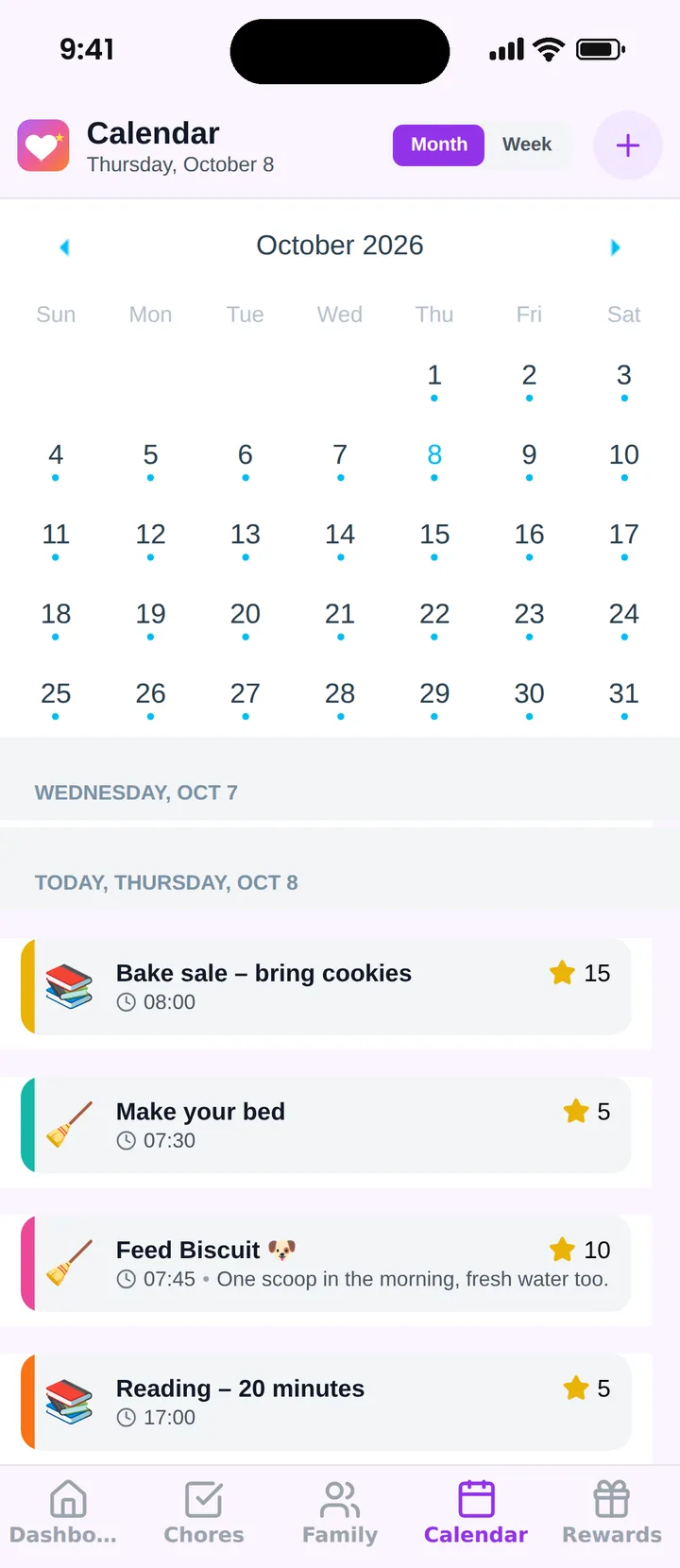
Famiyo is a free family app for iPhone and Android that combines a shared family calendar, chores with points and a rewards shop; kids join with a code, no email needed. For break week, put travel, dinner and visits on the shared calendar with a color for each person, then add repeating events for things like the daily walk or quiet hour. Each child can have their own daily tasks with points, such as make your bed or help set the table.
The free plan includes up to 3 family members and 1 repeating task. See our list of the best family organizer apps to compare options.
Before the break starts, write the three anchors on a sticky note and put it on the fridge: wake-up, meals, bedtime.
Frequently asked questions
Should kids keep a normal schedule over Thanksgiving break?
Keep the anchors, not the whole timetable. Wake-up within about an hour of normal, regular meals and a bedtime close to usual protect sleep. Homework, strict screen windows and tight morning routines can relax. A looser day is the point of a break.
What should a kid's Thanksgiving break day look like?
A simple shape works: a slow morning, one planned activity or errand, lunch, a quiet hour, outdoor time, a few chores, then dinner and an early wind-down. Three or four fixed points are enough. Leave the rest open for play.
How do I get kids back on schedule after Thanksgiving break?
Start on Saturday, not Sunday night. Move wake-up earlier by 15 to 30 minutes, keep meals regular, get outside, and turn screens off about an hour before bed. By Sunday evening a normal bedtime should come much more easily.
How much should kids sleep during a long break?
The usual recommendations still apply: 9 to 12 hours for ages 6 to 12 and 8 to 10 hours for teens, 10 to 13 hours including naps for ages 3 to 5. A late night here and there is fine. A whole week of drift makes Monday harder.
What can kids do at home during Thanksgiving break?
Cook with you, bake something for guests, sort through toys for donation, make place cards, write thank-you notes, build a fort, do a puzzle or play board games. Pair every screen block with something active or hands-on.
Try Famiyo With Your Family
Chores with points, a rewards shop for kids and one shared family calendar. Set it up in a couple of minutes.



Free to download • No credit card required • Available on iOS & Android