How to Reduce Morning Chaos: Work Backward From Leaving Time
Fix chaotic school mornings by working backward from the door, finding your real bottleneck and moving three jobs to the night before.
By Famiyo Editorial TeamUpdated 5 min read
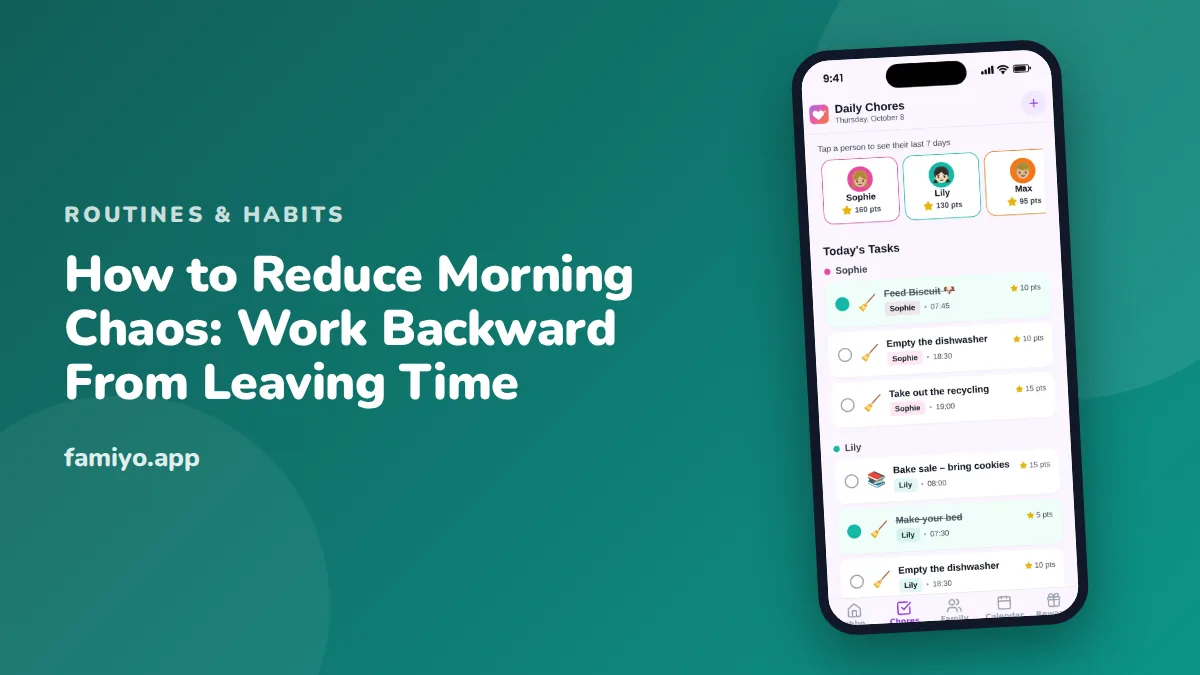
You say "shoes" four times, someone discovers the gym kit is in the wash, and the car pulls out of the driveway six minutes late with everyone annoyed. Chaotic mornings usually come from one or two weak spots, not from the whole morning being broken. This page shows how to work backward from the door, find the weak spot, and move the right jobs to the night before.
Start from the door, not the alarm
Most families build a morning forward: wake up, then see what happens. Build it backward instead. Take the time you must leave and subtract.
- Leave time, say 7:50.
- Subtract 5 minutes of slack for the missing shoe. That puts "done" at 7:45.
- Shoes, coat and bag by the door: 5 minutes, so start at 7:40.
- Breakfast and teeth: 15 to 20 minutes, so start at about 7:20.
- Dressed and hair done: 10 minutes, so start at 7:10.
- Wake-up: 7:00.
For a school-age child, 30 to 45 minutes from wake-up to leaving is normal, so a 50-minute window like this one has a little room built in. If your alarm currently goes off 20 minutes later than the numbers say, you have found part of the problem already.
Find your bottleneck first
Do not redesign everything. Spend three mornings watching where time actually leaks, and write it down. It is nearly always one of these.
| Where it leaks | What it looks like | The fix |
|---|---|---|
| Searching | Shoes, glasses, homework, the permission slip | One landing spot by the door for bags and shoes. Everything goes there at night |
| Deciding | Nobody can pick an outfit, breakfast takes a negotiation | Clothes chosen the night before. Two breakfast options, not a menu |
| The bathroom | One bathroom, three people, one hairbrush | Stagger the order. Toothbrushing happens right after breakfast, not in the queue |
| Dawdling | A child who gets sidetracked by a book or a toy | A visible list and a timer, not repeated reminders |
| Screens | "Just one more minute" on a tablet | Screens stay off until the bag is by the door |
| Your own pace | Parent still dressing, still packing lunches | Get yourself ready first, then get everyone else |
Fix one row for two weeks. Changing six things at once makes it impossible to tell what helped.
Move three jobs to the night before
The most reliable way to cut morning stress is to do the thinking in the evening, when nobody is rushing. Three jobs do most of the work.
Pack the bag and put it by the door. Lay out tomorrow's clothes, including shoes and socks. Look at tomorrow's calendar together for anything unusual: gym day, a trip, early pickup, a test. Lunch prep is a bonus. The whole thing takes about 5 to 10 minutes, and it removes the decisions that eat the most morning minutes.
Evenings are also where sleep gets protected. School-age children aged 6 to 12 need 9 to 12 hours, and teenagers 8 to 10, according to the American Academy of Pediatrics and the AASM recommendations. If wake-up is a daily fight, check bedtime before you change anything else. Our guide to getting teens to wake up in the morning goes deeper on that age.
Give the morning a visible order
Kids who are asked "what's next?" every minute are not being difficult. They just cannot see the sequence. Put it where they can: a short list on the fridge, or on their own phone. For children under 7, 4 to 6 steps works best, with pictures if they cannot read. For older kids, a plain checklist is enough. Our school morning routine checklist has a ready one, and the morning routine for kids page explains how to build one with your child.
Put the steps in a fixed order and say them once at the start: "Dress, breakfast, teeth, bag, shoes." After that, point to the list. You stop being the reminder and the list takes over.
Run a three-morning test
Before you change anything, collect a little evidence. For three school mornings, note the time each step actually starts and finishes, and the time the car leaves. A scrap of paper on the fridge is enough. Do not tell anyone off while you are measuring, because you want the normal morning, not the best behavior.
Then compare it with your backward plan. If breakfast runs 12 minutes over every day, that is your bottleneck. If the delay moves around, it is probably searching, and a landing spot by the door will fix most of it. This also settles arguments. "We are always late" becomes "Teeth are taking 11 minutes," which is something you can solve.
What to say, and what to skip
Mornings go better when the adult is short and specific. Try these.
- Instead of "Hurry up": "It's 7:25. You have until 7:40 to finish breakfast."
- Instead of "Why are you not dressed?": "Clothes first, then you can play until breakfast is ready."
- Instead of repeating: "Check your list." Then walk away.
Skip lectures before school. Anything that needs a conversation can wait until the afternoon. If a child is regularly the last one out, try ending the morning with a small, specific job, so they have a reason to move, as covered in how to get kids out the door in the morning.
Setting up the morning in Famiyo
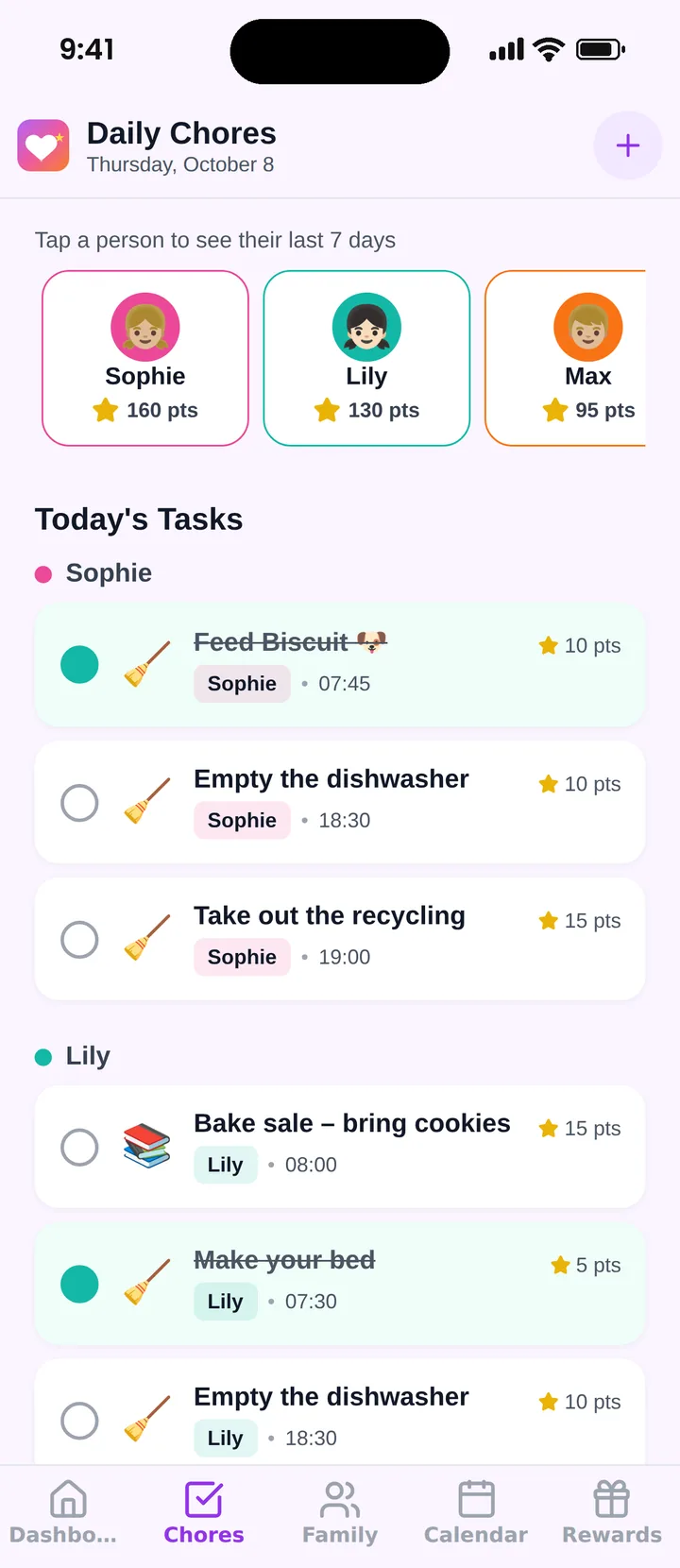
Famiyo is a free family app for iPhone and Android that combines a shared family calendar, chores with points and a rewards shop; kids join with a code, no email needed. For mornings, you can add the steps as chores that repeat every day, so each child sees today's list on their own phone and ticks things off, or you approve them. Chores can carry points, for example 5 for a small job and +2 if it is done without a reminder. The free plan includes one repeating task, so a single "morning checklist" works there; Premium removes the limit.
See our list of the best family organizer apps if you are choosing a tool.
Pick tonight's three jobs, do them, and write down what time you walk out the door tomorrow. That is your baseline.
Frequently asked questions
Why are mornings with kids so chaotic?
Usually because too many decisions and searches are packed into a short window: what to wear, where the shoe is, what is today. Move those to the evening and mornings become a sequence of simple steps instead of a string of small emergencies.
How long should a school morning routine take?
For school-age kids, 30 to 45 minutes from wake-up to leaving is typical. Younger or slower-waking children may need the upper end. Count backward from the time you leave and add 5 minutes of slack for the unexpected.
What should I do the night before to make mornings easier?
Three things cover most of it: pack the school bag and put it by the door, choose tomorrow's clothes, and glance at tomorrow's calendar for anything unusual like gym kit or a field trip. Lunch prep is a bonus if you have time.
How long before a new morning routine works?
Give it 2 to 3 weeks of consistent use before you judge it. The first week is usually messy. If one step still causes most of the delay after three weeks, change that step rather than the whole routine.
Try Famiyo With Your Family
Chores with points, a rewards shop for kids and one shared family calendar. Set it up in a couple of minutes.



Free to download • No credit card required • Available on iOS & Android