Family Habit Tracker: Build Habits Together, Parents Too
How to run a family habit tracker where parents track habits too: which habits to pick, a sample week, how long to stick with it and what to do when it stalls.
By Famiyo Editorial TeamUpdated 5 min read
Get everybody moving in the same direction and the house runs differently. A family habit tracker is the simplest way to get there: one visible place where everyone, kids and adults, marks the small things they are working on. This guide shows how to pick habits, set up a tracker you will still use in March, and keep it from turning into a scoreboard for who is failing.
What a family habit tracker is for
A chore list tells people what the house needs. A habit tracker is about what each person is building: reading before bed, drinking water, going outside, getting the bag ready. The two overlap, but habits are about repeating something until it takes no effort, and that changes how you handle them.
Three things set a family tracker apart from a personal one. Everyone's progress is visible to everyone. The habits are small enough for a child to manage. And parents are in it too, which matters more than most adults expect. Kids copy what they see. If you are asking for a 15 minute reading habit while scrolling on the sofa, they will notice.
Habits worth tracking, by age
Pick habits that are small, daily and clearly done or not done. "Be healthier" is not a habit. "Walk for 10 minutes after dinner" is.
| Who | Good first habits | Time |
|---|---|---|
| Ages 4-5 | Put pajamas on without a reminder, brush teeth, put shoes by the door | A few minutes each |
| Ages 6-8 | Pack the school bag the night before, read for 15 minutes, make the bed | 5 to 15 minutes |
| Ages 9-12 | Start homework at a set time, tidy the desk, 20 minutes of active play, lights out on time | 15 to 30 minutes |
| Teens | Sleep schedule, a short daily walk, phone off an hour before bed, one household task done without asking | 10 to 30 minutes |
| Parents | A 10 minute walk, phone-free dinner, reading before bed, one planned fun thing with the kids | 10 to 20 minutes |
Sleep is a good one to put on the list for everyone. The American Academy of Pediatrics and the AASM recommend 9 to 12 hours for ages 6 to 12 and 8 to 10 hours for ages 13 to 18, so a lights-out habit pays back in mood and mornings. Our guide on how to build good habits in kids goes deeper on picking and stacking habits.
How to set it up so it lasts
- Hold a short family meeting, ten minutes, no screens. Explain that everyone including you is picking one habit to build.
- Let each person choose their own habit from a short list. Choice matters. A habit a child picked is a habit a child defends.
- Make the habit specific and small enough to do on a bad day. "Read 15 minutes" survives a busy evening. "Read a chapter" does not.
- Attach it to something that already happens. After brushing teeth, read. After dinner, walk. Existing routines carry new habits.
- Choose one place for tracking and keep it there. A shared app or a single chart, never both.
- Mark it daily. Kids check off their own. Parents check their own too, in front of the kids.
- Look at the week together every Sunday for five minutes. Say what worked first, then what to change.
A small reward helps at the start. Not for every day, but for hitting a mark such as five days out of seven. Keep the reward small, like picking the movie or choosing dessert.
A sample week for a family of four
Here is what a first week might look like for two parents and two kids, aged 7 and 11.
| Mon | Tue | Wed | Thu | Fri | Sat | Sun | |
|---|---|---|---|---|---|---|---|
| Mom: 10 min walk | done | done | skipped | done | done | done | done |
| Dad: phone-free dinner | done | done | done | skipped | done | done | done |
| Age 11: lights out 9:30 | done | done | done | done | skipped | done | done |
| Age 7: bag packed at night | done | skipped | done | done | done | done | done |
Notice the skipped days. Nobody hit 100 percent, and that is the point. A tracker with perfect marks is usually one nobody is honest about. Five of seven is a good start.
What to do when someone misses days
This is where trackers die. Somebody misses Wednesday, then Thursday, and the chart turns into a record of failure. A few rules help.
- Never miss twice. One missed day is normal. Two in a row is a signal to ask what is in the way.
- Make the habit smaller, not the child guiltier. If 15 minutes of reading keeps slipping, try 5.
- Ask, do not scold. "What made last night hard?" gets better answers than "Why didn't you read?"
- Do not take away the tracker as a punishment. It stops being a tool and turns into a threat.
- Let a parent miss in public too. "I skipped my walk Wednesday, it rained and I gave up" shows kids that missing is survivable.
If your child is the one who loses interest every time, our piece on why kids don't want to do chores covers the common causes and what helps.
Shared habits that everyone does together
Not every habit has to be individual. Some of the easiest ones to keep are the ones you do side by side, because the other person is the reminder. Try one or two of these as a single line on the tracker for the whole family.
- A 10 to 15 minute walk after dinner, kids on scooters if they like.
- Cooking one meal together on Saturday, with a child picking the recipe.
- A weekly outdoor hour, whatever the weather: park, trail, backyard.
- Ten minutes of tidying before bed, with music, everybody in motion.
Shared habits are where a tracker feels like fun instead of homework. They also take the pressure off the kid who is struggling, since nobody is singled out.
Habits, responsibility and independence
Habits are the quiet engine behind a child's growing independence. A 9 year old who packs their own bag without being asked has taken over a piece of their own life. Each habit like that is a small handoff from you to them, and the tracker is how you both see it happen. For the bigger picture, see independence for kids.
Keep expectations grounded. Habits for young children are as much about parents' routines as the kids' own discipline. A 5 year old will not remember bedtime reading unprompted. They will remember it if it happens at the same time every night.
Doing this in Famiyo
Famiyo is a free family app for iPhone and Android that combines a shared family calendar, chores with points and a rewards shop; kids join with a code, no email needed.
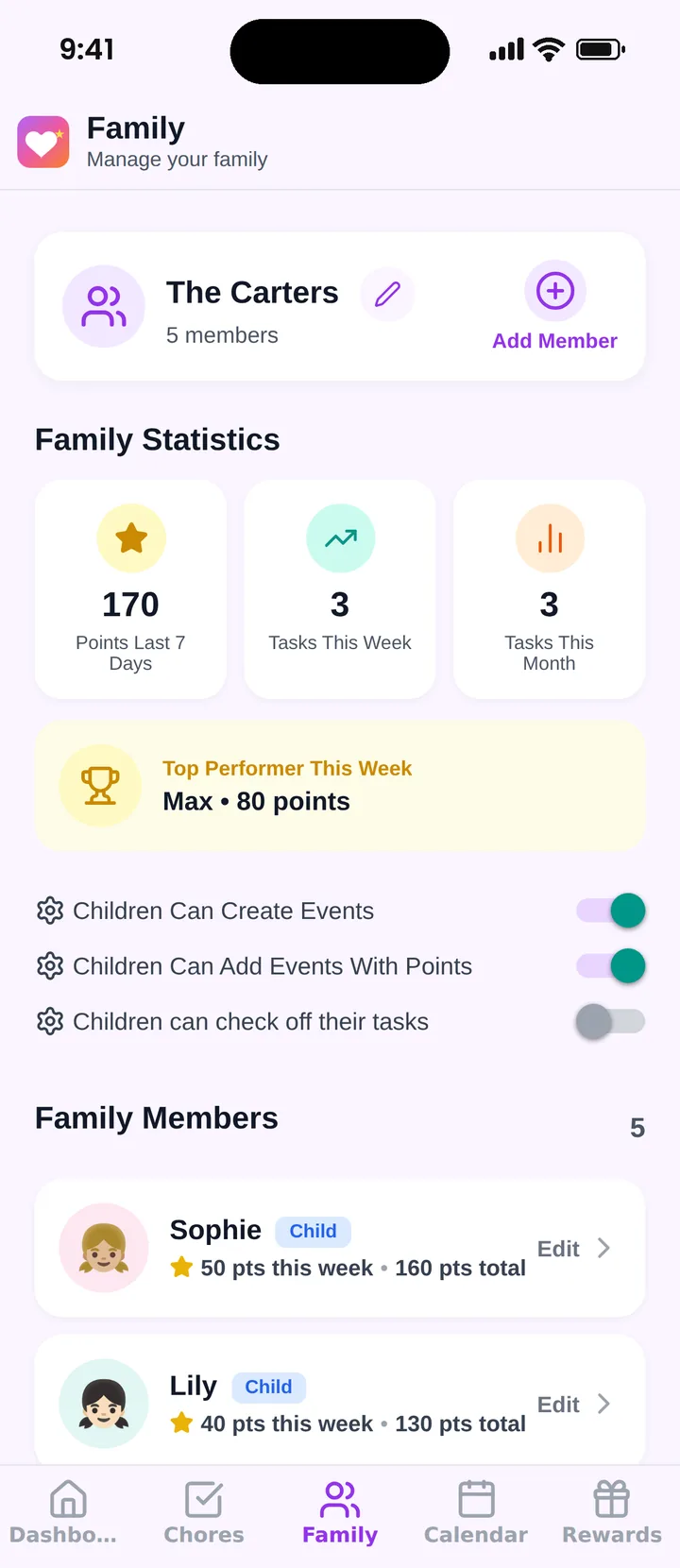
Famiyo is not a dedicated habit tracker, but a repeating task works the same way. Add a daily habit as a task, assign it to the person and give it points, then they check it off each day. The statistics show points this week and in total for each family member, the last 7 days per child, and a top performer of the week, so the Sunday check-in is a glance. The free plan includes 1 repeating task, and Premium removes that limit. Compare it with other tools in our best family organizer apps.
Pick one habit tonight
Do not wait for the perfect system. Choose one habit for yourself and one for each child, write them down where everyone passes, and start tomorrow.
Frequently asked questions
What habits should a family track?
Start with small, daily, visible ones: making the bed, reading for 15 minutes, packing the school bag the night before, a family walk, lights-out on time. Choose one per person and add more only after the first habit feels automatic.
How many habits should each person track?
One to start, three at most. Kids under 7 do best with a single habit and a picture to match. Adding more before the first one sticks is the most common reason habit trackers collapse after week two.
Should parents track habits too?
Yes. Kids notice when the tracker is something done to them. When a parent logs a 10 minute walk or phone-free dinner next to the kids' habits, the whole thing feels like a shared project instead of a test.
How long does it take to build a habit?
Give a new routine two to three weeks of steady use before judging it. Some habits click sooner and some take longer, so look for the task getting easier, not for a magic number of days.
Try Famiyo With Your Family
Chores with points, a rewards shop for kids and one shared family calendar. Set it up in a couple of minutes.



Free to download • No credit card required • Available on iOS & Android