How to Teach Kids a Daily Schedule They Follow on Their Own
A six-week plan to teach kids a daily schedule: start with one anchor, add a visible list, fade your reminders and let them take over.
By Famiyo Editorial TeamUpdated 5 min read
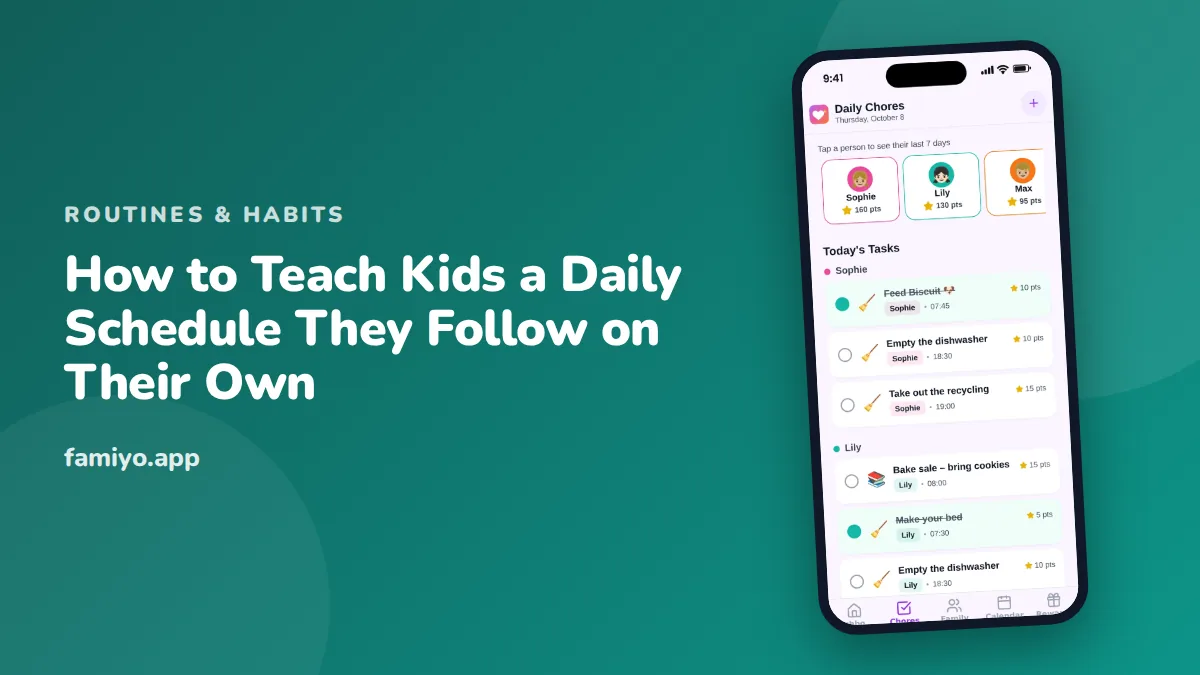
Kids are not born knowing what comes next. Following a daily schedule is a skill, and like any skill it is learned in stages, with the adult doing less each time. This page gives you a six-week plan, what to say at each stage, an age table, and what to do when a child pushes back.
Why a schedule is a skill, not a rule
A child who "never does what I ask" often cannot yet hold a sequence in mind, or sees no reason for the order. A schedule gives the sequence a place to live outside their head. That is why a list works better than a reminder: a reminder runs out when you do, but a list is still there.
The aim is not an hour-by-hour life. It is for a child to know what happens next, to do it without being told, and to feel a bit of pride when they do. That is independence in practice.
The six-week plan
Each stage lasts about two weeks. If your child needs longer, stay longer. New habits need 2 to 3 weeks of consistent use before you can judge them.
- Weeks 1 and 2: pick one anchor. Choose a single moment that already happens at the same time every day, such as breakfast or bedtime. Make that one routine predictable: same order, same time. Do nothing else yet.
- Weeks 3 and 4: add a visible list. Write the anchor routine as a short list. For a child under 7, use 4 to 6 steps, with pictures if they cannot read. Put it where they will see it. Say the list aloud together once at the start of the routine, then point to it instead of repeating yourself.
- Weeks 5 and 6: fade your reminders. Replace "What's next?" with "Check your list." Then walk away and stay close enough to help. Tell them you will check at the end, not during.
- After week 6: add a second routine. Repeat the same stages with another anchor, such as after school or bedtime. Because your child already knows how a list works, this goes faster.
If a stage is not working, go back one stage instead of adding pressure. For toddlers, our sample toddler schedule shows what a full day can look like, and for ages 3 to 5 see the daily schedule for preschoolers.
What each age can handle
| Age | What the schedule looks like | Who runs it |
|---|---|---|
| 2-3 | One or two anchors. Three steps with photos, such as shoes, coat, car | You, together, every time |
| 4-5 | A picture list of 4 to 6 steps for morning and bedtime | The child follows it, you stay close |
| 6-7 | A written or picture list for morning, after school and bedtime | The child checks it, you check at the end |
| 8-9 | A short written list, a clock or timer, one weekly job | The child runs the routine, you review it |
| 10-12 | Their own list and a weekly planning chat | The child, with a weekly check-in |
| 13+ | Their own calendar and deadlines | The teen, with a check-in when asked |
Our guide to the visual schedule for kids covers how to build the picture list for the younger rows.
Make it theirs
Children follow a plan more readily when they helped make it. Give them real choices, within limits. They can pick the order of two steps, choose the picture or colour for each, or decide which of two breakfasts they want. Do not offer a choice you will not honour.
Involve them in the wording as well. A step called "Get dressed" is boring. A step they have named, even something silly, is theirs. Dressing is often the first step children can learn to do alone, and teaching kids to get dressed by themselves breaks it down.
What to say
Short, specific, and always the same.
- Starting: "It's breakfast time. Look at your list."
- Prompting: "Check your list. What's next?"
- Praising: "You did every step before I said anything. That's it."
- When a step is skipped: "Look at the list. Is there a step you can do now?"
- When there is pushback: "I hear you. The list is the same. I'll be here if you want help."
Avoid comparisons to siblings, and avoid threats. Praise the specific thing, not "good boy" or "good girl." And do not turn every missed step into a lecture. One calm sentence is enough.
When it does not work
Most failures come from one of four causes.
The list is too long. Cut it down to 4 to 6 steps for a young child.
The time does not fit. A morning routine for school-age kids usually takes 30 to 45 minutes from wake-up to leaving, and a bedtime routine 20 to 30 minutes. If your plan needs 20, a child will fall behind every day.
You are still the reminder. If you keep saying the next step, the child never needs to look. Point to the list instead.
The child needs a different format. Some children respond better to a timer, a song, or a countdown than to a list. Try one change, hold it for two weeks, and see.
If a child has trouble following steps even after these changes, it is worth a conversation with their pediatrician or teacher.
Using Famiyo for a child's daily schedule
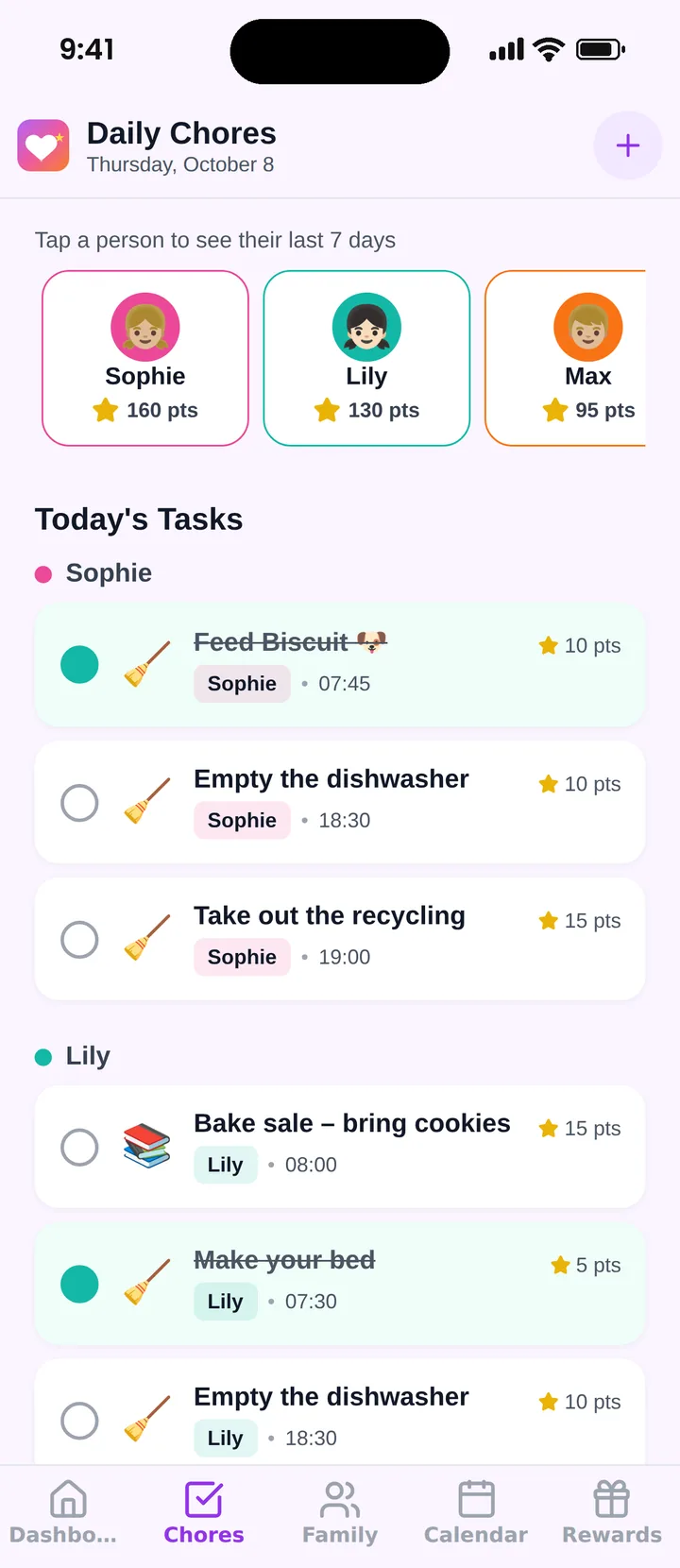
Famiyo is a free family app for iPhone and Android that combines a shared family calendar, chores with points and a rewards shop; kids join with a code, no email needed. For a daily schedule, add each step as a chore that repeats every day. Your child opens the app on their own phone, sees today's tasks, and ticks them off themselves, or you approve them if you prefer. Points make the habit visible, and a child gets a new-task notification so they do not need a reminder from you. You can see what each child has done so far today.
Our list of the best chore chart apps compares the options.
Choose one anchor routine this week, write it as four steps, and put the list where your child can see it.
Frequently asked questions
At what age can kids follow a daily schedule?
Toddlers can follow a simple sequence like breakfast, play, nap, with an adult. By 4 or 5 they can follow a short picture list. School-age kids can follow a written one, and by about 10 many can manage their own.
How many steps should a kids' schedule have?
For a child under 7, 4 to 6 steps in a visual routine works best. Older children can handle more, but the same principle holds: shorter is easier. If a child keeps skipping a step, the list is probably too long.
How long does it take for kids to learn a routine?
Give a new routine 2 to 3 weeks of consistent use before you judge it. The first week usually involves a lot of reminders. By week three you should be reminding less. If not, shorten the list rather than adding rewards.
What if my child refuses to follow the schedule?
Check the steps and the timing first: too many steps, a time that does not suit them, or a step they find hard. Let them help redesign the list. Stay calm, point to the list rather than repeating yourself, and keep it the same for a week.
Try Famiyo With Your Family
Chores with points, a rewards shop for kids and one shared family calendar. Set it up in a couple of minutes.



Free to download • No credit card required • Available on iOS & Android