How to Get Kids to Do Chores Without Asking
Kids wait to be asked because you are the reminder. Move the cue to a time, place or list, then fade yourself out with this 4-week handoff plan and scripts.
By Famiyo Editorial Team5 min read
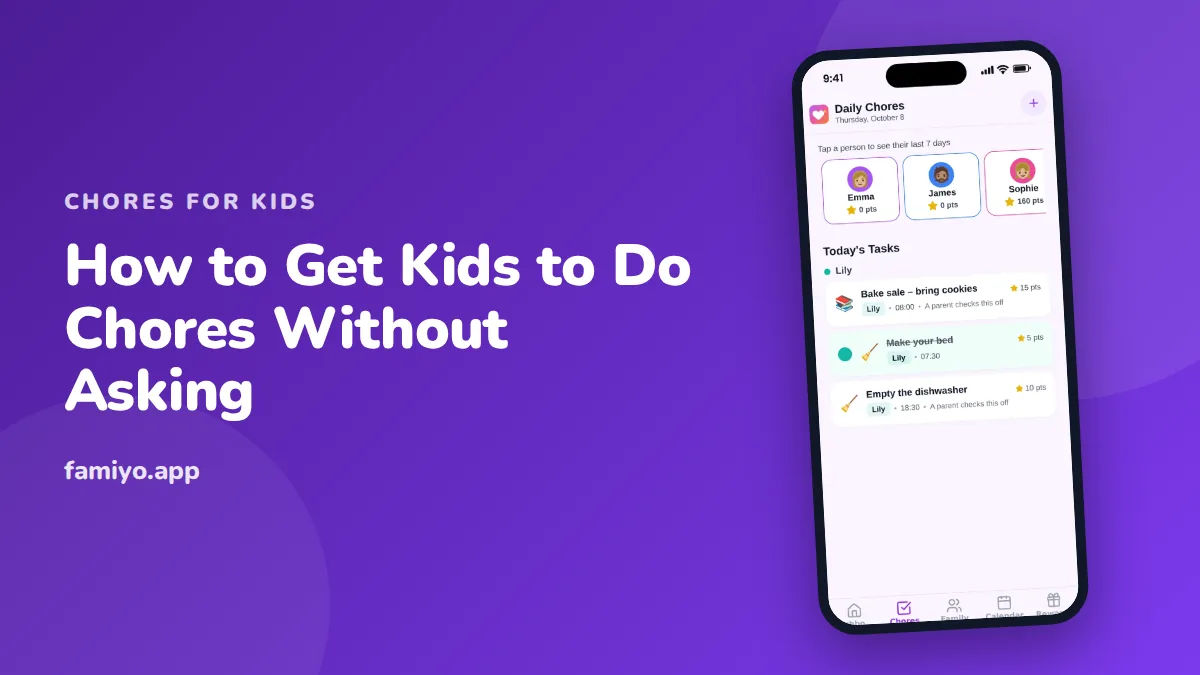
You've asked for the dishwasher to be emptied every evening for a year. It gets emptied every evening, right after you ask. The chore is learned. What isn't learned is when to start it, because in your house the start signal is you. Here's how to change the signal, a four-week plan to step out of the reminder job, and the exact words to use along the way.
Why kids wait to be asked
Honestly, it's not laziness. Waiting is the efficient move. If a parent always says "go feed the cat" at 6:15, a kid has zero reason to keep 6:15 in their head. You'll handle it. You always do.
There's also a skill gap. Starting something on your own needs a kid to notice the moment, remember the job and choose it over whatever they're doing. Those are planning skills, and they develop slowly all the way through the teen years. Adults with full calendars forget things too. We just use phones and sticky notes to cover it.
So "without asking" never really means "with no reminder at all." It means the reminder comes from somewhere other than your voice: a time, a place, a list or a notification. Once you see it that way, the problem gets a lot more solvable.
What "without asking" looks like at each age
Be realistic about the target. A 6-year-old who clears their plate after dinner without a word from you is doing the real thing. A 6-year-old who remembers to water plants on Thursdays is a myth.
| Age | Realistic self-start | Cue that replaces you |
|---|---|---|
| 4-5 | One job tied to a moment that never changes, like plate to the counter after meals | The moment itself, plus a picture card |
| 6-8 | Two or three jobs tied to daily anchors (wake-up, after school, dinner) | A checklist at eye level or on their own device |
| 9-12 | A short daily list done within a time window, like before 7 p.m. | A list plus a deadline, checked by the child |
| 13+ | Daily jobs and one weekly job, scheduled around their own plans | Their own phone, calendar or notifications |
If you're not sure which jobs belong on the daily list, our guide to chores kids should do every day helps sort them from the ones that can wait.
Move the cue from your voice to a trigger
Every chore you want done unprompted needs a trigger that happens no matter what. Vague timing ("sometime after school") is the main reason kids wait for you. Pick a moment that already exists and attach the job right after it.
| Chore | Weak trigger | Strong trigger |
|---|---|---|
| Make the bed | In the morning | Before coming down for breakfast |
| Feed the dog | When the dog is hungry | Right after you put your own breakfast bowl in the sink |
| Empty the dishwasher | After school | Before any screen goes on |
| Pack the school bag | Before bed | Right after brushing teeth |
| Put away laundry | When it's folded | Before dinner on the day the basket lands on their bed |
"Before screens" is the most powerful trigger in most houses. It isn't a punishment. It's an order of events: job, then tablet. Kids figure out the sequence fast, and the tablet ends up doing the reminding.
Then make the list visible. A checklist taped to the bedroom door, a chart in the kitchen or a list on their own device all work. What matters is that the child can check it without asking you. Our chore chart for kids guide covers how to build one they'll actually look at.
The four-week handoff plan
You can't go from full reminders to zero overnight. Kids notice the gap, the chore gets skipped, you get annoyed and everyone's back to nagging by Friday. Fade yourself out instead, one step a week.
- Week 1, direct but tied to the trigger. "Breakfast bowl's in the sink, so it's dog time." You're still the reminder, but you're naming the trigger every time so they hear the link.
- Week 2, ask a question instead of giving the answer. "What happens after your bowl goes in the sink?" Let them say "feed the dog." Saying it themselves is how it moves into their head.
- Week 3, point to the list. "Check your list." Or say nothing and just point. Keep your tone flat and boring.
- Week 4, say nothing. If the job doesn't happen, let the sequence do its work: screens wait until the list is done. No lecture.
When a week goes badly, go back one step, not to the start. And plan for the Wednesday that falls apart. Soccer runs late, someone's crying about a spelling test, the dog gets fed at 8 p.m. by whoever notices. That's a normal week, not a failed system.
What to say instead of asking
The words matter more than they seem. Instructions keep you as the boss of the chore. Questions and short cues hand it back.
- Instead of "Go empty the dishwasher," try "What's left on your list?"
- Instead of "Did you feed the cat?," try "Cat's looking at me."
- Instead of "How many times do I have to tell you?," try "Screens are ready when your list is."
- Instead of "Thank you for finally doing it," try "You did the whole list before I got home."
Notice the last one. When they do start on their own, say so, specifically and right away. "You packed your bag without anyone saying a word" is the kind of feedback that makes a kid want to do it again tomorrow.
A small bonus helps too. A common points setup gives 5 points for a small job like feeding the pet and 10 for a medium one like emptying the dishwasher, plus 2 extra points when it's done without a reminder. Two points sounds tiny. Kids still care, because it turns "nobody asked me" into something visible.
Letting the app do the reminding
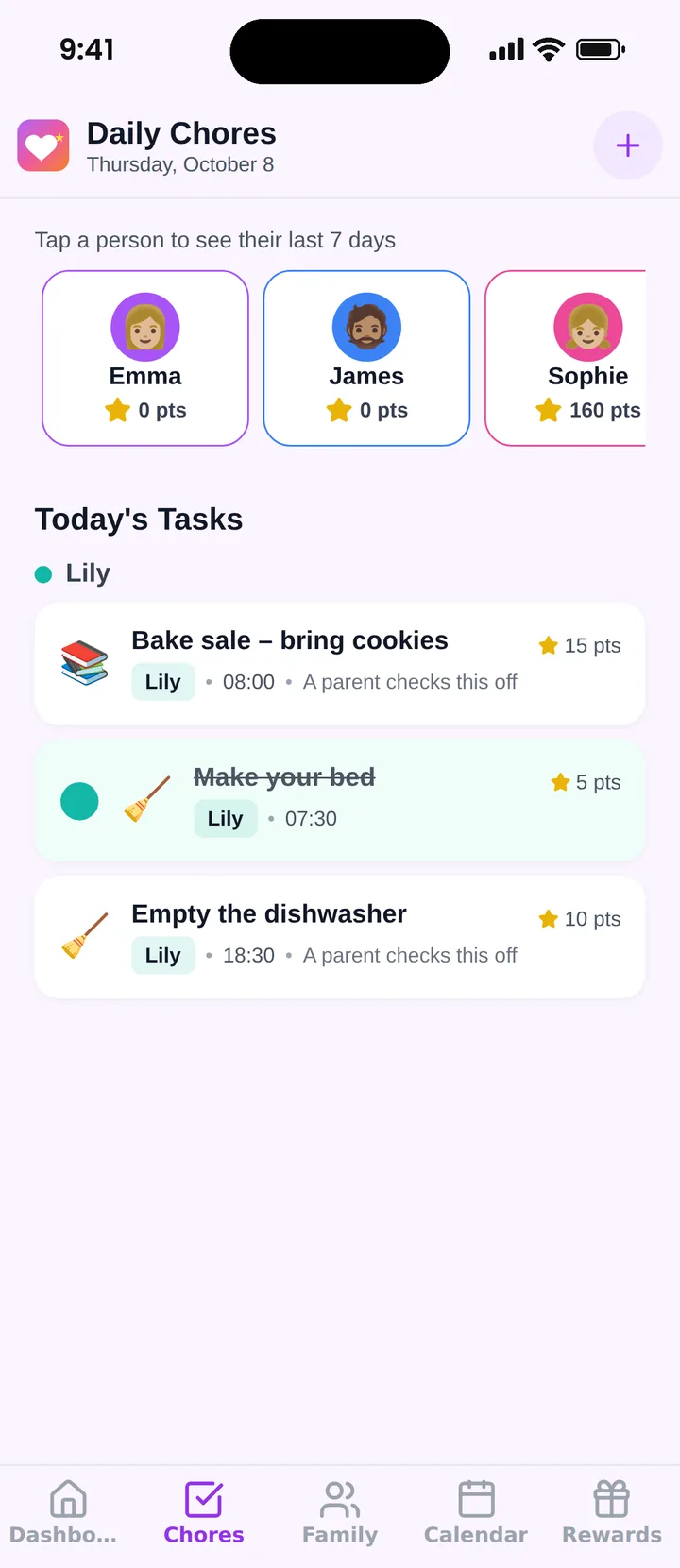
Famiyo is a free family app for iPhone and Android that combines a shared family calendar, chores with points and a rewards shop; kids join with a code, no email needed. Set each chore to repeat at its trigger time, such as "Feed the dog, daily" or "Pack school bag, weekdays," and give it points. Your child sees their own list on their phone and gets a notification when a new task is added, so the nudge comes from the app instead of you. When they check it off, you get a notification, which means no more "did you do it?" from across the house. Add 2 points by hand when a job was done unprompted. For other options, see our list of the best chore apps for kids.
Pick one chore tonight and give it a trigger that never changes. Run the four-week fade on that one before you touch the rest, and if you want to plan who does what across the household, our chore schedule for the family is a good next step.
Frequently asked questions
At what age can kids do chores without being asked?
Most kids can start a familiar chore at a fixed trigger, like clearing their plate after dinner, from about age 5 or 6, as long as the trigger never changes. Remembering jobs across a whole day without a list usually comes later, around 10 to 12, and even teenagers still miss things on busy days.
Should I reward kids for doing chores without being asked?
A small bonus works well while the habit forms. A common setup is a regular point value for the chore plus 2 extra points when it's done without a reminder. That makes the unprompted version worth more without punishing the child who still needs a nudge.
What do I do when my child stops doing chores without reminders?
Expect it, especially during busy weeks or after holidays. Go back one step in the handoff for a few days, for example from silence to a one-word cue, rather than starting over with full instructions. Check whether a trigger has changed, such as a new after-school activity.
Is it normal for kids to need reminders for chores?
Yes. Planning and remembering are skills that develop slowly through childhood and into the teen years. Needing a cue is normal. The goal is for the cue to come from a routine, a list or a notification instead of from a parent's voice.
Try Famiyo With Your Family
Chores with points, a rewards shop for kids and one shared family calendar. Set it up in a couple of minutes.



Free to download • No credit card required • Available on iOS & Android