Chore Chart for a 4-Year-Old: Ideas That Actually Get Done
A chore chart for a 4-year-old with 10 jobs preschoolers can really do, what done looks like, points per job, rewards, and a free printable weekly chart.
By Famiyo Editorial Team5 min read
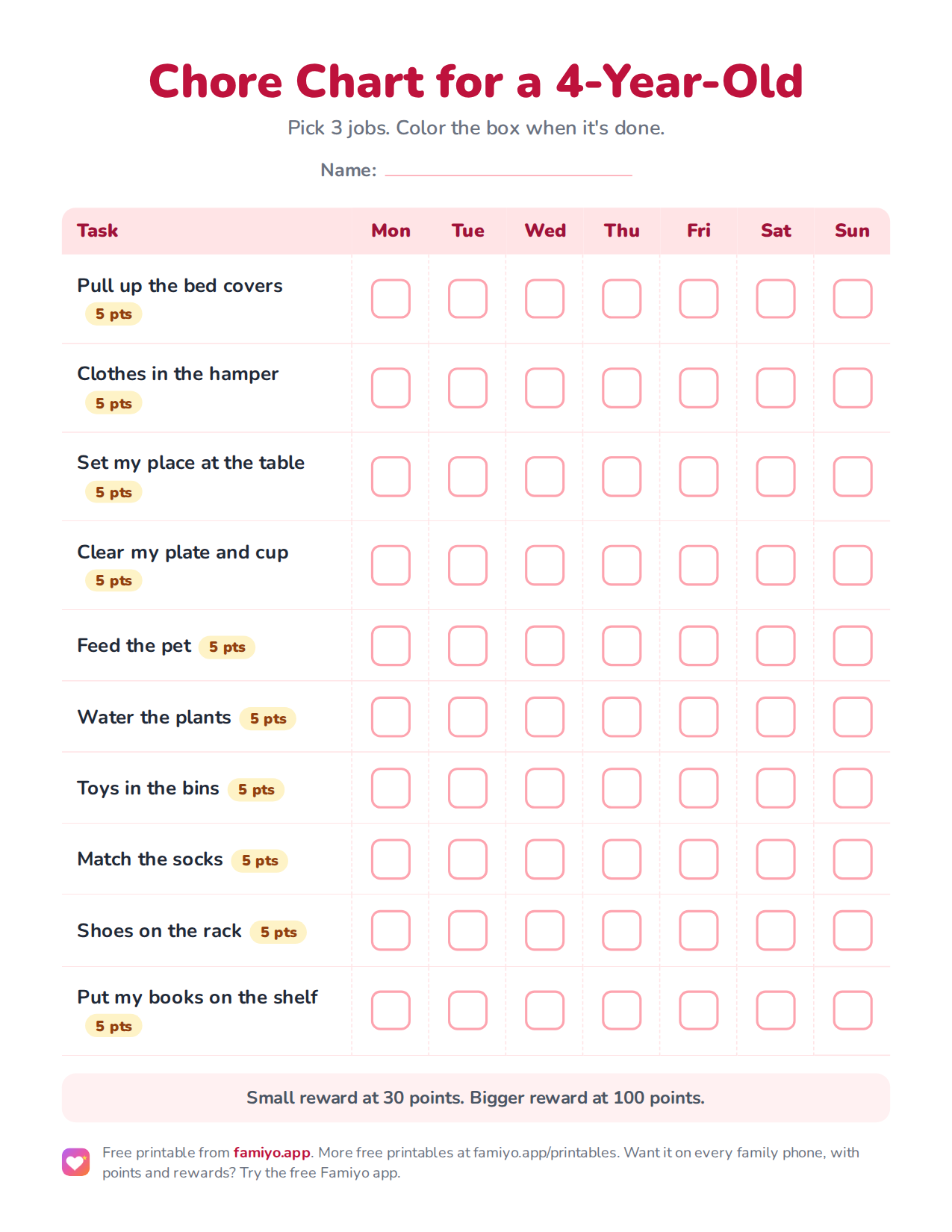
Free printable
Chore Chart for a 4-Year-Old
A weekly chart on one US Letter page. Download the PDF to print it, or save the image to use it on a tablet or in a document.
Free for home, classroom and nonprofit use, see the license. More free printables.
Four-year-olds want to help. They also want to do it their way, right now, and then stop. A chore chart for this age has to catch that eagerness without asking for more focus than a preschooler has. Below you'll find which jobs fit, what finished looks like for each one, how to reward them and a printable weekly chart.
What a 4-year-old can really do
At four, most children can follow a two- or three-step instruction ("take your plate, carry it to the counter, come back for your cup"). They can concentrate on a simple job for a few minutes, and they love visible proof that they did something. What they can't do yet is plan ahead or remember a job that isn't in front of them.
That shapes the chart. Jobs need to be short, physical and tied to a moment in the day. A typical 4- or 5-year-old can roughly make the bed, set and clear their own place, match socks, water plants and feed a pet, for about 10 to 15 minutes of work a day in total. Start with two or three of these, not ten.
Expect the results to look like a preschooler did them. A bed with the duvet pulled up and slightly crooked is a made bed at four. Redoing it in front of them teaches that their work doesn't count.
10 chore chart ideas for a 4-year-old
Each job below is something most 4-year-olds can do on their own after you've shown them a few times. The "done" column is what you can point to on the chart.
| Job | When | What done looks like | Minutes | Points |
|---|---|---|---|---|
| Pull up the bed covers | After getting dressed | Duvet up, pillow at the top | 2 | 5 |
| Clothes in the hamper | Bath time | Floor clear of dirty clothes | 1 | 5 |
| Set my place at the table | Before dinner | Plate, cup, fork and napkin at their seat | 2 | 5 |
| Clear my plate and cup | After meals | Both on the counter by the sink | 1 | 5 |
| Feed the pet | Morning | One scoop in the bowl | 2 | 5 |
| Water the plants | Saturday | Small can, each plant gets a drink | 3 | 5 |
| Toys in the bins | Before dinner | Floor clear, toys in labeled bins | 5 | 5 |
| Match the socks | Laundry day | Pairs folded together in a pile | 5 | 5 |
| Shoes on the rack | Coming home | Both shoes side by side on the rack | 1 | 5 |
| Books on the shelf | Before bed | Books spine out on a low shelf | 2 | 5 |
Every job is worth 5 points because every job is small. That keeps the math simple and stops a 4-year-old from feeling that one job "counts more" than another. Once your child is five, our chore chart ideas for 7-year-olds show how charts grow with bigger jobs and different point values.
How to teach a job so it sticks
Show, do it together, then step back. With a 4-year-old, each stage might take three or four days.
- Do the job while your child watches, and say each step out loud. "One scoop. Into the bowl. Lid back on."
- Do it together. You hold the bag, they scoop. Hand over a bit more each day.
- Let them do it alone while you stay nearby. Name what they did: "You fed Biscuit all by yourself. The lid is back on too."
- Add it to the chart only now. A job on the chart should be one your child can already do.
Make the house help. A low hook for the towel, a step stool by the sink, toy bins with a picture on the front, a small watering can kept where they can reach it. Most "won't" at four is really "can't reach".
Using the printable chart
The printable below has ten jobs down the side and a box for each day, Monday to Sunday, with 5 points per job. Choose three rows with your child and cross out the rest, or cut them off. Stick it at their eye level near where the jobs happen, often the kitchen.
It suits a 4-year-old who is just starting chores, and also works for a young five. Let your child color the box or add a sticker the moment a job is done, not at bedtime. At this age the reward is partly the coloring.
Keep this chart for jobs only. If you're also working on behaviors like gentle hands or listening, they belong on a separate chart, as our behavior chart for a 5-year-old explains. Mixing the two makes it unclear what earns a box.
Rewards a 4-year-old will work for
With three jobs a day at 5 points each, your child earns about 15 points a day. Set a small reward at 30 points, so something good happens every two days, and a bigger reward at 100 points, roughly once a week.
Small rewards that work at four: choosing the bedtime story, picking dessert, an extra 10 minutes at the playground, choosing the music in the car. Bigger ones: baking cookies together, a trip to the library, a picnic in the backyard. Show the rewards as pictures next to the chart so your child can see what they're working toward.
Screen time is a tricky prize at this age. The American Academy of Pediatrics suggests about 1 hour a day of high-quality programming for ages 2 to 5, so extra screens can add up quickly.
A digital chore chart with Famiyo
If paper keeps getting lost, or both parents want to keep track, a digital chart can do the same job. Famiyo is a free family app for iPhone and Android that combines a shared family calendar, chores with points and a rewards shop; kids join with a code, no email needed. Each job becomes a repeating chore worth 5 points. At four, set it so a parent approves each job rather than letting your child check it off alone. Your child can look at their own tasks and points on a family tablet, and the rewards shop holds the prizes you've chosen, each with a price in points, so they can see how close they are.
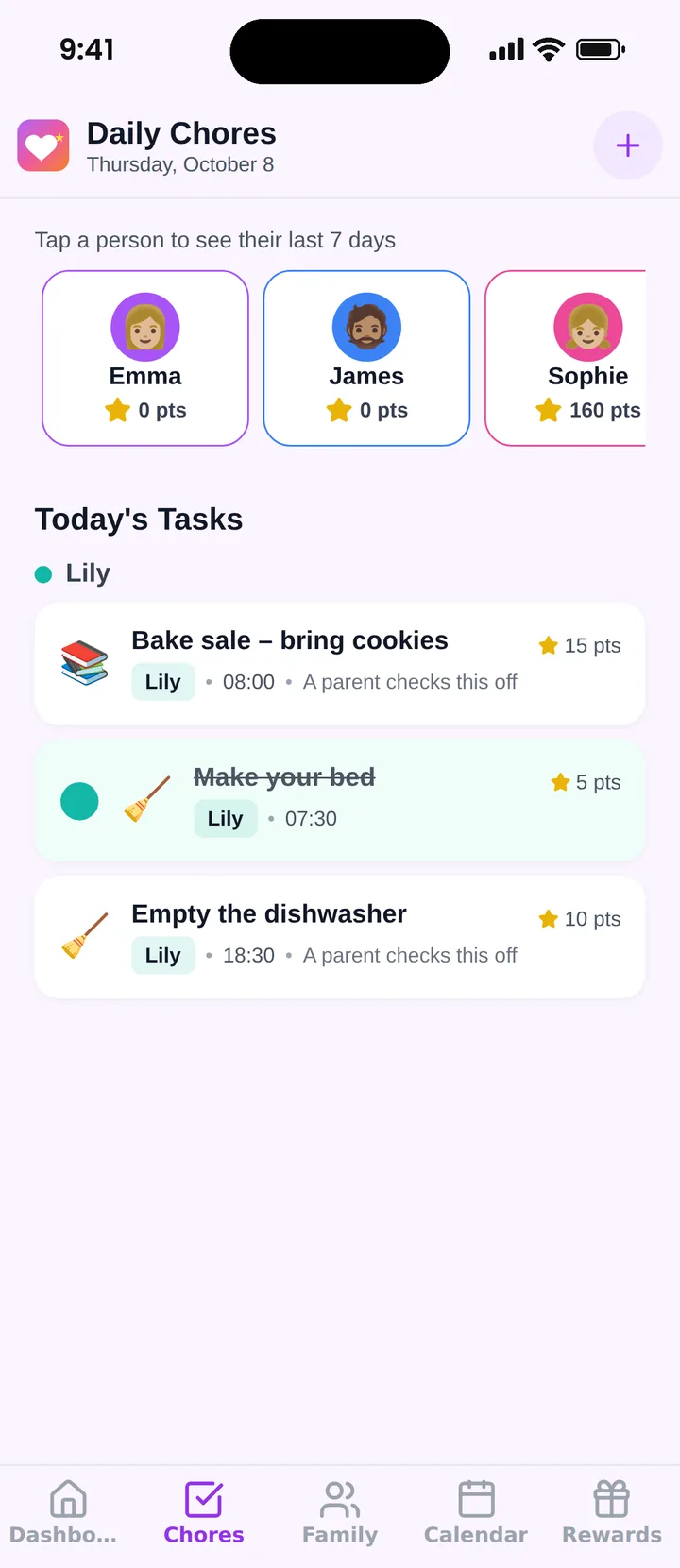
The free plan includes 1 repeating task; Premium removes that limit. Compare options in our list of the best chore chart apps.
Pick three jobs tonight, take a photo of your child doing each one, and tape the photos next to the rows.
Frequently asked questions
How many chores should a 4-year-old have on a chart?
Two or three daily jobs is plenty to start, adding up to about 10 to 15 minutes a day. Once those happen most days with only a pointing reminder, add one more. A chart with eight rows at four usually turns into a grid of empty boxes, which discourages both of you.
Can a 4-year-old use a chore chart if they can't read?
Yes. Put a simple picture next to every job, ideally a photo of your child doing it. Four-year-olds recognize their own photos easily and can follow a row of pictures from left to right without any words. Read the chart aloud with them for the first week.
What rewards work for a 4-year-old's chore chart?
Quick, small ones: choosing the bedtime story, picking dessert, an extra trip to the playground, or helping bake something. At 5 points per job and three jobs a day, a 30-point reward arrives every two days, which is about as long as a 4-year-old can wait.
Should a 4-year-old be paid for chores?
Most families keep everyday jobs like clearing a plate unpaid, because they are part of living in a family. At four, money is abstract anyway. Points that turn into a small treat or privilege are easier to understand than coins in a jar.
Try Famiyo With Your Family
Chores with points, a rewards shop for kids and one shared family calendar. Set it up in a couple of minutes.



Free to download • No credit card required • Available on iOS & Android