Reward Chart Ideas for 6- and 7-Year-Olds (Free Printable)
Eight reward chart ideas built for 6- and 7-year-olds, a reward menu with point prices, and a free printable weekly chart for first and second graders.
By Famiyo Editorial Team5 min read
Free printable
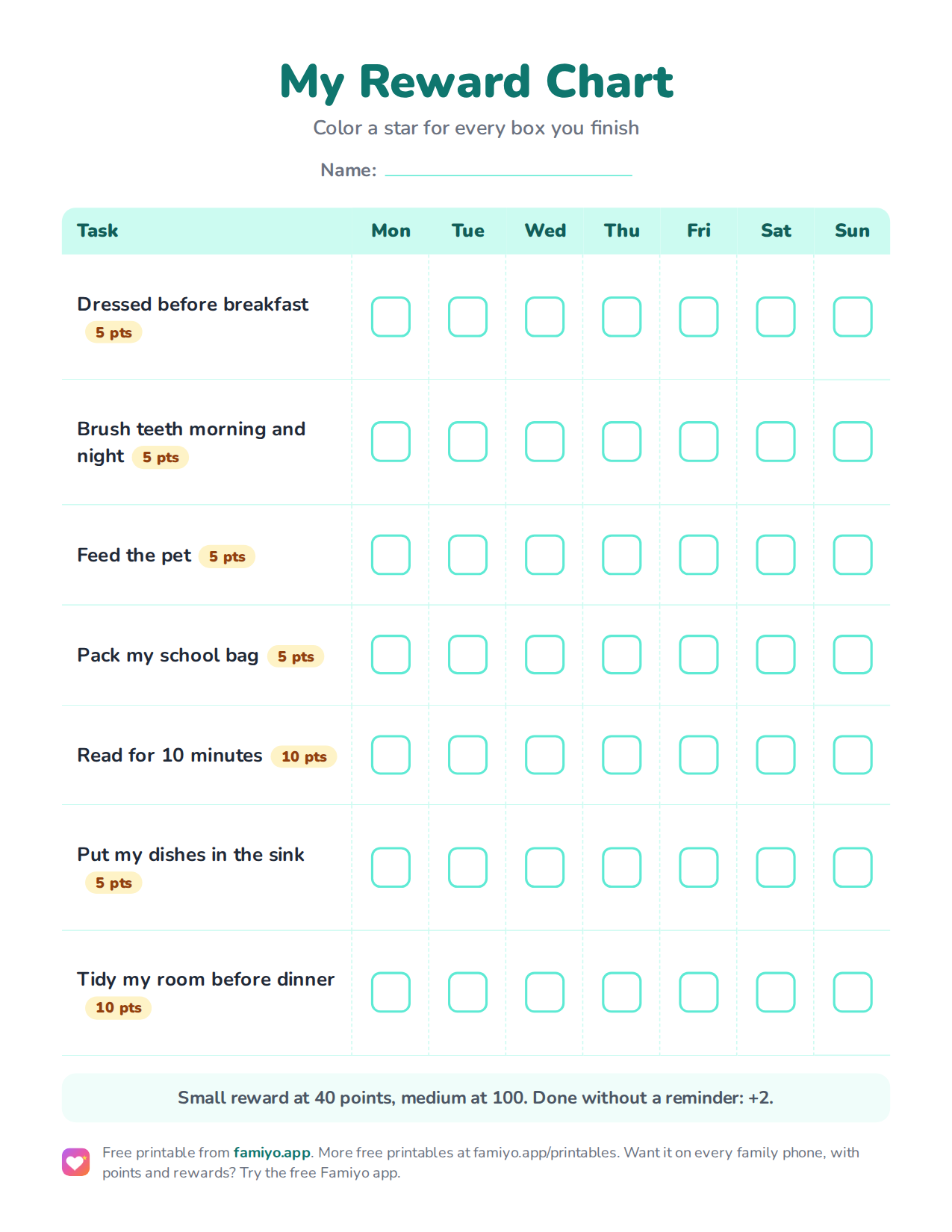
My Reward Chart
A weekly chart on one US Letter page. Download the PDF to print it, or save the image to use it on a tablet or in a document.
Free for home, classroom and nonprofit use, see the license. More free printables.
Six is when a reward chart starts to make real sense. A first grader can count past 100, remember yesterday's points, and wait a couple of days for something good, which a 4-year-old usually can't. This page gives you eight chart ideas built for 6- and 7-year-olds, a reward menu with prices, and a printable weekly chart.
What changes at 6 and 7, and what that means for the chart
Children this age are learning to read, so a chart can finally use words. Pair every word with a small picture for a 6-year-old, though. Many are still sounding things out, and a chart they can't read becomes a chart you have to read to them.
They also care a lot about fairness and rules they can see. If the chart says "Read for 10 minutes: 10 points," that is the rule, and they will hold you to it. Use that. Write each target so there's no doubt about when it counts: "Dressed before breakfast" works, "Be good in the morning" doesn't.
Their sense of time is still short. A week feels long to a 6-year-old and a month feels like forever. That's why the reward menu below leans on small and medium rewards, with one bigger goal that grows slowly in the background.
Finally, most kids this age want to feel capable. Charts that show progress ("look how many stars this week") tend to work better than charts that only show what's missing.
Eight reward chart ideas for this age
- The morning launch chart. Four boxes for the morning only: dressed, teeth, bag, shoes on by the door. Mornings are where most first-grade friction happens, and a short chart covers the hardest 30 minutes of the day.
- The road to the reward. Draw a winding road with 20 squares and a picture of the reward at the end. Every finished target moves a sticker one square. It shows "how close am I" without any math.
- Two-goal chart. One small goal this week (choose dessert on Friday) and one big goal this month (a day at the zoo). Kids see quick wins and a long-term target on the same sheet.
- Beat your record. Track how many targets they hit each day and circle the best day. The child competes with last week's self, not with a sibling.
- Reading ladder. Every 10 minutes of reading adds one rung. At 10 rungs they pick the next library book or a bedtime story from a parent. Good for a new reader who needs practice to feel easy.
- Mystery envelope. Seal three reward slips in envelopes. When the chart is full, they pick one without knowing what's inside. The surprise keeps a 6-year-old interested for longer than a fixed prize.
- Kindness catches. A separate row where you add a star when you notice them helping without being asked: holding the door, sharing a snack, helping a sibling find a shoe. Keep it to things you saw, not things they report.
- The "on my own" column. Each target has two boxes: "with help" and "on my own." Points double when they did it alone. This rewards the skill you're building, not just the result.
Pick two or three. A morning launch chart with a road to the reward on the side is plenty for a 6-year-old. A 7-year-old can add the kindness row or the "on my own" column.
A reward menu with prices
Each target on the chart is worth 5 or 10 points, and doing one without a reminder adds 2. A child who hits most of their targets earns around 30 to 45 points a day. These prices keep small rewards within reach every 2 to 3 days.
| Reward | Size | Price |
|---|---|---|
| Choose dessert | Small | 30 points |
| 15 extra minutes of screen time | Small | 40 points |
| Pick the bedtime book or story | Small | 30 points |
| Breakfast for dinner, their choice | Small | 50 points |
| Pick the family movie | Medium | 100 points |
| Stay up 30 minutes later on Friday | Medium | 100 points |
| Park or bike ride with one parent, just the two of you | Medium | 100 points |
| A day out (zoo, pool, museum) | Big | 300 points |
| A toy around $20 | Big | 400 points |
For a 6-year-old, the medium rewards matter most. Aim for one each weekend, and let the big goal build over 3 to 4 weeks. Let your child help choose the menu. A reward they picked themselves is worth more to them than one you assumed they'd like.
Mistakes that make reward charts fade
Too many targets is the most common one. Ten rows on a chart look like a wall to a first grader. Start with four, five at most.
Taking points away is the second. Once points can disappear, the chart becomes a source of worry instead of pride. Deal with behavior problems separately and keep the chart for what went well.
Third, forgetting to pay out. If your child earned "pick the movie" on Wednesday and Friday comes and goes, the chart loses its meaning fast. Write the reward day on the chart.
Last, never changing it. When a target happens on most days without help, celebrate, take it off and add a new one. If you're also handing out regular chores, our chore schedule for the family shows how a 6- or 7-year-old's jobs fit alongside everyone else's, so the reward chart and the chore list don't overlap.
The printable chart
The printable below has seven targets down the side, each with its points, and a box for every day from Monday to Sunday. It mixes self-care, a small chore and reading, which suits most first and second graders. For a 6-year-old, glue or draw a small picture beside each line and start with the first four rows; add the others once those are easy. A 7-year-old can use all seven. The note at the bottom sets the reward levels, so change it to match your own menu before you print.
Using Famiyo instead of paper
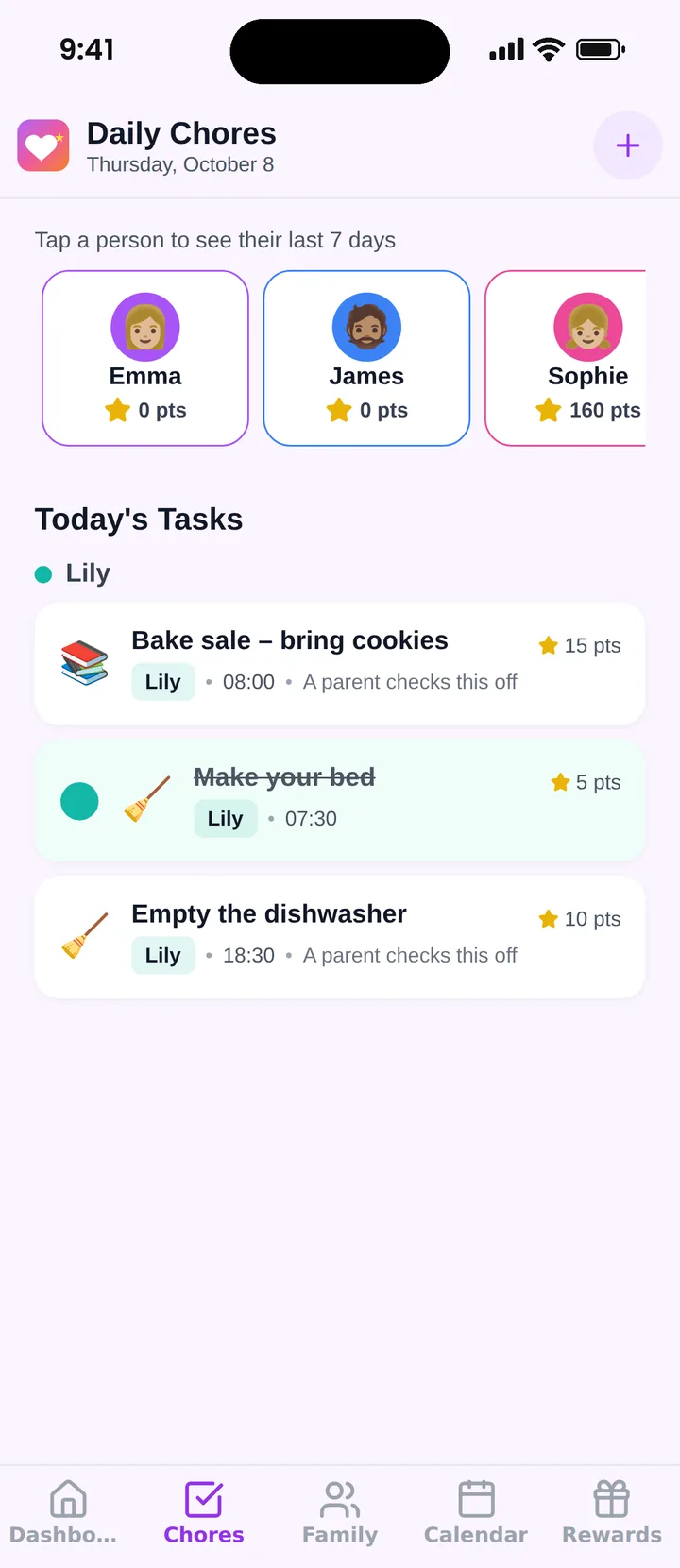
Famiyo is a free family app for iPhone and Android that combines a shared family calendar, chores with points and a rewards shop; kids join with a code, no email needed. Each target from the chart becomes a repeating task with its own points, such as "Read for 10 minutes" at 10 points every day. Your child joins on a tablet or an old phone with a 6-character code and sees only their own tasks and running total. At 6, keep parent approval on so points land once you've checked; at 7, you might let them check off their own tasks. The reward menu goes into the rewards shop with the same prices, and your child redeems from their own screen. For other options, see our list of the best chore chart apps, or read how a family chore app works for the whole household.
Sit down with your child this weekend, choose four targets and three rewards together, and put the chart up on Monday morning.
Frequently asked questions
What rewards work for a 6-year-old?
Time and choices work at least as well as things. Picking dessert, 15 extra minutes of screen time, choosing the bedtime book, a trip to the park with one parent or picking the family movie are all good rewards. Keep a toy around $20 for the big goal at the end of a few weeks.
How long should a reward chart last for a 6-year-old?
Run the same chart for 2 to 3 weeks before judging it. Once a target is happening on most days without help, take it off the chart and add a new one. Most 6- and 7-year-olds need the chart refreshed every month or so to keep it interesting.
Should a 6-year-old lose points for bad behavior?
It usually backfires at this age. A child who drops from 40 points to 25 can decide the chart is hopeless and stop trying. Handle misbehavior separately, and let the chart only count what went right. Points earned stay earned.
Is a reward chart for a 6-year-old different from one for a 7-year-old?
Slightly. A 6-year-old needs pictures next to the words, fewer targets and rewards that arrive within two or three days. A 7-year-old can usually read the labels, handle five or six targets and wait a full week for a medium reward.
Try Famiyo With Your Family
Chores with points, a rewards shop for kids and one shared family calendar. Set it up in a couple of minutes.



Free to download • No credit card required • Available on iOS & Android