Daylight Saving Time and Kids: Adjust Bedtime in 5 Days
Daylight saving time kids sleep schedule: a 5-day plan to shift bedtime in 10-minute steps before clocks fall back, with tips by age and early risers.
By Famiyo Editorial Team6 min read
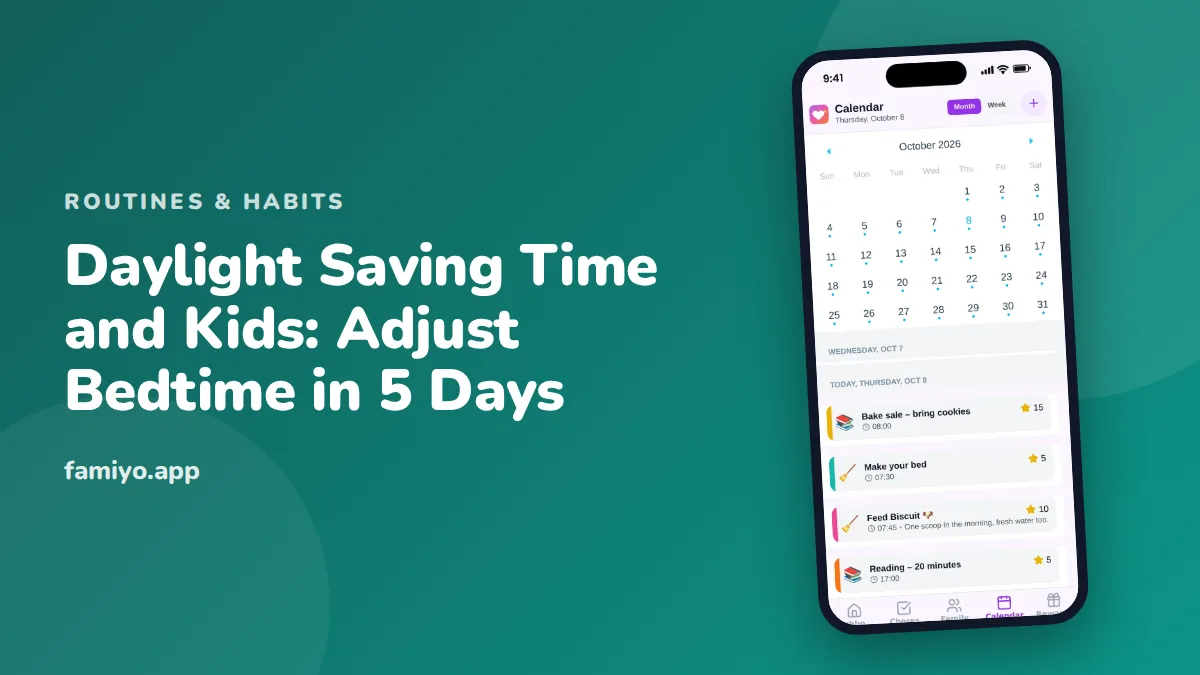
The clock moves back an hour, and your child's body does not. For a few days in early November, bedtime feels an hour early, mornings arrive an hour sooner, and a child who normally sleeps until 7 is standing at your bed at 5:45 on the new clock. This guide gives you a 5-day plan to move bedtime in small steps, what to do about early waking, and how to adjust for each age group.
What actually happens when clocks fall back
Children run on an internal rhythm that responds to light, meals and routine, not to the number on the wall. When the clock jumps back, that rhythm stays put for a while. Your child's body still thinks it is the old time.
That creates two effects. In the evening, a child who usually falls asleep at 7:30 is being put to bed at what feels like 6:30 to them, so they may stall, laugh and negotiate. In the morning, they wake at their usual internal time, which is now an hour earlier by the clock.
The change this year happens at 2 a.m. on Sunday, November 1, 2026. Most children settle within a week. The plan below is for families who would like the shift to be smooth.
The 5-day plan
The idea is to move bedtime and wake-up later in small steps of 10 minutes over four nights, so that the clock change does the last of the work. The example below uses a 7:30 p.m. bedtime and a 6:45 a.m. wake-up. Swap in your own times.
| Day | Night or morning | Bedtime | Wake-up |
|---|---|---|---|
| Wed, Oct 28 | Start | 7:40 p.m. | 6:55 a.m. |
| Thu, Oct 29 | Step 2 | 7:50 p.m. | 7:05 a.m. |
| Fri, Oct 30 | Step 3 | 8:00 p.m. | 7:15 a.m. |
| Sat, Oct 31 | Step 4 | 8:10 p.m. | 7:25 a.m. |
| Sun, Nov 1 | Clocks back | 7:30 p.m. on the new clock | 6:45 a.m. on the new clock |
Saturday night is Halloween, so you may well lose a plan for that evening. If so, hold the earlier step and carry on Sunday. A normal bedtime on Sunday matters more than a perfect Saturday.
Make each step the same way every night: same routine, same order, same book. Shift meals along with bedtime, since mealtimes help the body clock as much as sleep does. And do not forget that Saturday night's bedtime is already 8:10 on the old clock, which is only 20 minutes away from the new 7:30.
Light is the lever
Light tells the body clock what time it is, so use it on purpose.
In the morning, open the curtains, turn on bright lights and get outside as soon as you can. Even 15 to 20 minutes of daylight helps. In the evening, dim the lights from about an hour before bed and switch off screens at least an hour before, in line with the AAP's advice.
After the change, the evenings get dark early, around 5 p.m. in many places. Children can feel that it is "bedtime" at dinner. Reassure them, keep the dinner routine as usual, and put a couple of lamps on instead of the big light.
By age: what to expect and how to adjust
Sleep needs stay the same, whatever the clock says. The AAP and AASM recommend 11 to 14 hours (including naps) for ages 1 to 2, 10 to 13 hours for ages 3 to 5, 9 to 12 hours for ages 6 to 12, and 8 to 10 hours for teens.
| Age | What usually happens | What helps |
|---|---|---|
| 1-2 | Early waking, nap shifts | Move nap and bedtime in 10-minute steps, keep the room dark, a wake-up "ok to get up" light if you have one |
| 3-5 | Bedtime resistance, early waking | Use the 5-day plan, stay calm and consistent, a picture routine |
| 6-12 | Sleepy evenings, grumpy mornings | Shift 10 minutes at a time, outdoor time, steady meals |
| Teens | Late nights get later, groggy school mornings | Phones out of the bedroom, morning light, no big catch-up sleeps |
If you have a toddler and a work schedule to match, our working mom schedule with a toddler shows how to fit a shifted nap into a working day.
When your child wakes at 5 a.m.
It happens to almost every family with a young child. A few things help:
- Keep the room dark with blackout curtains or card over the window.
- Treat the early hour as nighttime: low voice, no lights, no play, a quiet return to bed.
- If your child is old enough, use a clock that changes color or a lamp on a timer. Explain it the day before: "When the light is green, you can come out."
- Do not start the day early on purpose. A child who gets breakfast and play at 5 a.m. will wake at 5 a.m. tomorrow.
- Keep the new wake-up time for at least a week before you judge the result.
Most early waking fades within a week. If it goes on past two weeks, or your child seems very tired during the day, mention it to your pediatrician.
Common mistakes that stretch the adjustment
Most families make the same few errors, and all of them are easy to fix.
- Letting the child sleep in on Sunday to "catch up". It pushes the body clock later and makes Sunday night harder.
- Skipping the shift on the weekend because plans got busy. Two uneven nights undo the progress of two good ones.
- Using screens in the dim evening hours. The light keeps the brain awake, so the earlier dark does not help.
- Changing everything at once. Move bedtime and wake-up only, and leave dinner time and the routine alone.
- Giving up after two days. Allow a full week, and up to two, before deciding the plan has failed.
A short nap can help an overtired child on the first afternoon, but for a school-age child, keep it under 30 minutes and finish it well before 3 p.m.
Routines that carry the change
A routine is an anchor when the clock moves. Keep the same three or four steps every night: bath, pajamas, one book, lights out. Predictability matters most for children who find change hard. If that sounds like your child, our guide on time management for kids with ADHD has ideas for making schedule changes visible and manageable. A visual card with the order of the evening works well.
Plan the weekend, too. A day after the change with a lot of outdoor time helps the body clock catch up, and a quiet Sunday afternoon avoids overtired kids on Sunday night. If you are heading into a holiday break, our Thanksgiving break routine for kids picks up where this plan leaves off.
Doing this with Famiyo
Famiyo is a free family app for iPhone and Android that combines a shared family calendar, chores with points and a rewards shop; kids join with a code, no email needed. For the clock change, add the 5-day plan as events on the shared calendar, one per night, with a color for each child. Set a repeating bedtime event so every phone shows the same time, and give kids a small point reward for sticking to the evening routine.
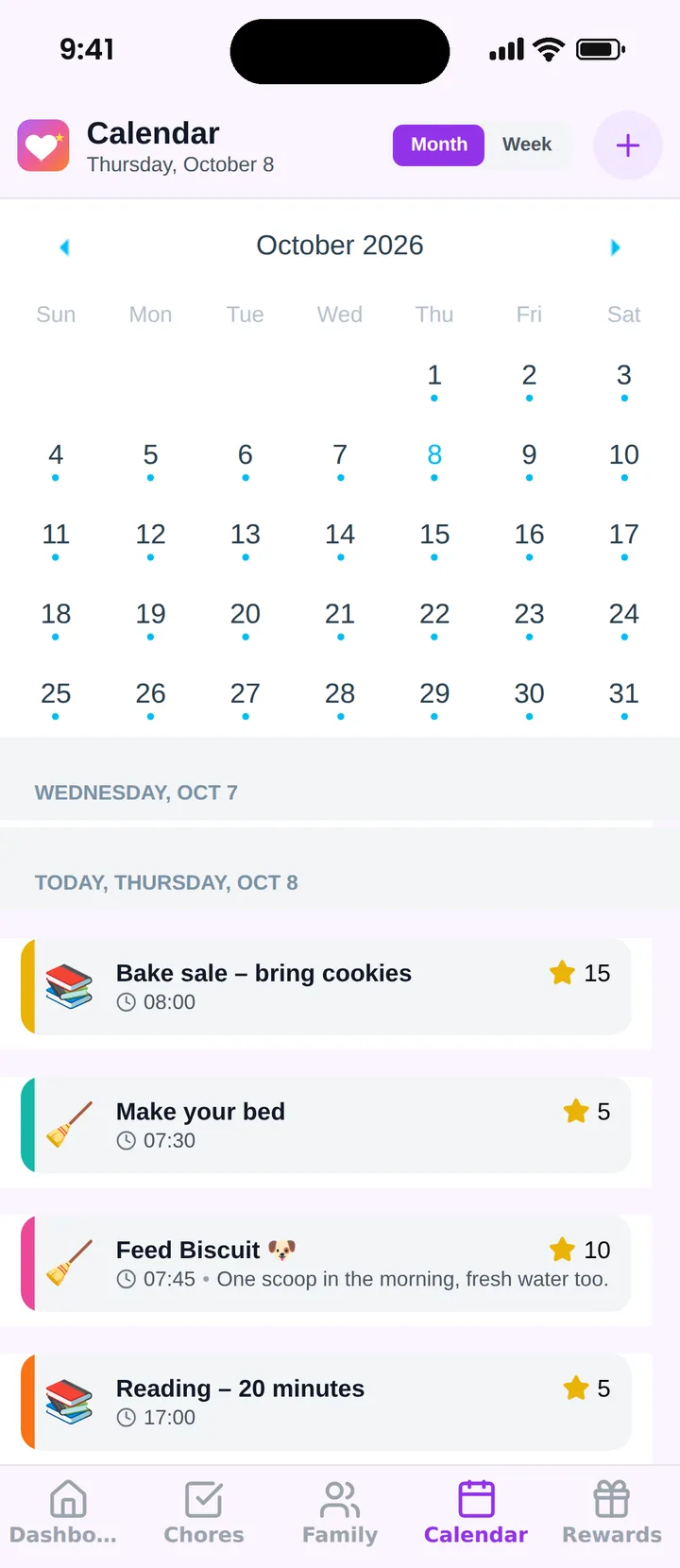
The free plan includes up to 3 family members and 1 repeating task. Our list of the best family organizer apps can help you compare tools.
Tonight, check your calendar for Wednesday, pick your child's current bedtime, and write the five times from the table on a sticky note by the bed.
Frequently asked questions
When do the clocks change in 2026?
In the United States, daylight saving time ends at 2 a.m. on Sunday, November 1, 2026. Clocks go back one hour, so 2 a.m. becomes 1 a.m. Most phones and computers update on their own, but ovens, cars and wall clocks need changing by hand.
Is falling back harder for kids than springing forward?
Falling back gives an extra hour, which many families find easier, but young children do not understand the clock. Their bodies still wake at the old time, so a 6 a.m. riser becomes a 5 a.m. riser for several days. Gradual shifts help.
How long does it take a child to adjust after the time change?
Most children settle in within a week, and some in a few days. A child who was already short on sleep, or who is very sensitive to schedule changes, may take longer. Hold the routine steady and give it up to two weeks.
My toddler wakes at 5 a.m. after fall back. What can I do?
Keep the room dark and quiet and treat 5 a.m. like night. Wait until the morning time you want to start, then go in with a bright light. Shifting bedtime by small steps for a few nights before the change makes early wakings less likely.
Should I just change the clocks and not worry about it?
For many school-age kids that works. They may be sleepy for a few evenings, then adjust. Younger children and children who are sensitive to change usually do better with a gradual shift, because it avoids an hour-long jump in one night.
Try Famiyo With Your Family
Chores with points, a rewards shop for kids and one shared family calendar. Set it up in a couple of minutes.



Free to download • No credit card required • Available on iOS & Android