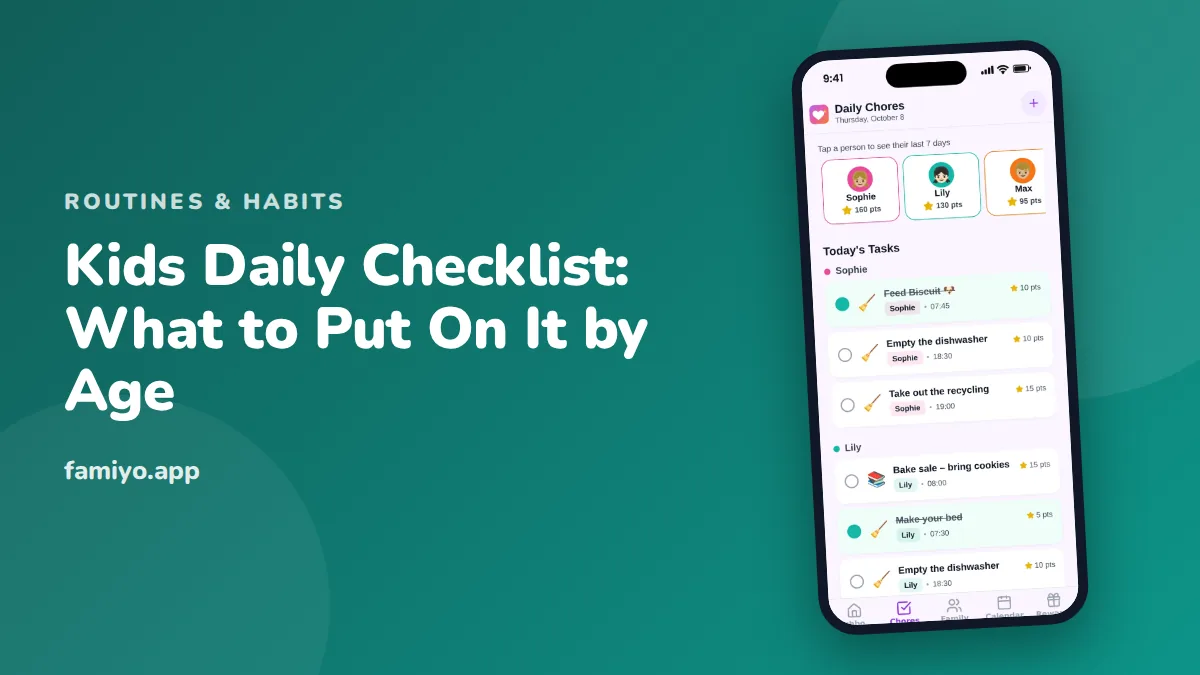
Kids Daily Checklist: What to Put On It by Age
Build a kids daily checklist your child can follow alone: how many steps by age, example checklists for ages 5, 8 and 12, and how to fade reminders.
By Famiyo Editorial TeamUpdated 6 min read
A good daily checklist does one thing: it moves the question "what do I do next?" from your mouth to a piece of paper or a screen. That is a big gain for a household. This guide shows how to write a checklist a child can actually use, with example lists for a 5-year-old, an 8-year-old and a 12-year-old, plus how to place it, how to start and how to slowly stop reminding.
What makes a daily checklist work
Three features matter more than the design.
Steps are short actions in order. "Get dressed" works. "Be ready" does not, because it hides five steps inside it. Start each step with a verb and keep it to a few words.
The list is short. A visual routine for kids under 7 works best with 4 to 6 steps. Older children can handle more, but a list that scrolls forever feels like a punishment. When a day has too much on it, split it into blocks.
The list lives where the action happens. A morning checklist on the bathroom mirror or by the shoe rack gets used. One in a drawer does not.
How many steps by age
A rough guide, based on what children can hold in mind and manage in a block of time. Your child may sit above or below their age row.
| Age | Steps per block | Format that works | Child's part |
|---|---|---|---|
| 3-4 | 3 to 4 | Pictures only, with an adult nearby | Point to the next picture |
| 5-6 | 4 to 6 | Pictures plus one or two words | Tick each step |
| 7-9 | 5 to 7 | Short written list | Run the list alone, parent glances at it |
| 10-12 | 6 to 8 | Written list or phone | Owns the list, parent checks weekly |
| 13+ | Own choice, within agreed items | Phone or notebook | Sets the order, parent sets the non-negotiables |
For tiny children, the checklist is really a prompt for you. Say it together, point at the picture, and let them do the step.
Example checklists for ages 5, 8 and 12
Copy these, then change them to match your home. Notice that the items are specific to the child's age and use time frames from typical chore ranges.
| Block | Age 5 | Age 8 | Age 12 |
|---|---|---|---|
| Morning | Get dressed, brush teeth, eat breakfast, shoes on | Get dressed, make bed, breakfast, brush teeth, pack bag check | Up on time, dressed, breakfast, bag and devices charged, out the door |
| After school | Snack, put bag away, play | Snack, homework, unpack bag, feed the dog | Snack, homework first, chore of the day, free time |
| Evening | Toys in the bin, bath, pajamas, story | Set the table, shower, pajamas, read | Clear own plate, shower, bag ready, screens off |
Morning routines for school-age kids usually take 30 to 45 minutes from wake-up to leaving the house, so count the minutes before you decide how many steps fit. If you need more detail for the morning block, our morning routine for kids and after-school routine guides break down each block with timing.
How to build the list with your child
Children follow lists they helped write. The process takes ten minutes.
- Write down everything that has to happen in one block, say mornings, in any order.
- Put the steps in the order that makes sense. Ask the child, "What comes first?" A child's logic is often fine.
- Cut it to the limit for their age. Anything beyond it moves to another block or becomes a weekly job.
- Add pictures or photos for kids who read slowly. A photo of the child's own shoes beats a clip-art shoe.
- Place it. Tape it where it is used, or open it on a phone together.
- Walk through it once together, then let the child try with you nearby.
Resist the urge to add steps over the first month. A stable list helps the habit settle, and new habits need 2 to 3 weeks of consistent use before you judge them.
Daily, weekly and monthly: where chores fit
A daily checklist is for things that happen every day. Weekly jobs such as vacuuming or changing sheets should not clutter it. Put them on a separate weekly list or add them to one day only. Our daily, weekly and monthly chore checklist shows how to sort jobs across those three layers so each day stays light.
A good rule is one chore per block at most. Mixing a chore into the daily checklist, such as "feed the dog" after school, teaches that it is part of the day, like brushing teeth.
Common checklist problems and quick fixes
Most checklists hit the same few snags in the first fortnight. None of them means the idea has failed.
The child ticks everything without doing it. Rushing to tick is normal for a 6-year-old who loves boxes. Check the first three steps together for a few days, and make the rule plain: tick after, not before. Switching to parent approval for a short stretch helps too.
The child does the list but fights one step. Usually one step is the real problem, often the one that ends something fun, like switching off a show to get dressed. Move that step to a calmer spot in the order, or put something pleasant right after it.
The list works at home and collapses on busy days. Make a short version for rushed mornings, with the three essentials only. A child who knows the short list can still finish it in ten minutes.
Siblings fight over whose list is longer. Give each child a list sized to their age and say so once: "Your list matches what you can do." Do not trade steps between kids to settle it.
The child is bored by it after a month. That is often a good sign, because boredom means the steps are automatic. Remove the steps that no longer need ticking, and keep the ones that still slip.
Weekends differ from school days, and a checklist should too. Keep two versions, a school-day list and a weekend list, with fewer time-critical steps on Saturday and Sunday. Children cope with two lists easily as long as each one stays the same every week.
Fading out the reminders
The point of a checklist is that you gradually need it less. Plan the fade from the start.
In week one, you walk with the child through each step. In week two, you stay in the room but do not speak, and point at the list if a step is missed. In week three, you check from the doorway at the end. After that, you glance at the finished list rather than watch the work.
If a step keeps getting skipped, do not add a reminder to the list. Look at why. It may be in the wrong order, too hard, or unclear. Fix it, then give it another week.
Using a checklist in Famiyo
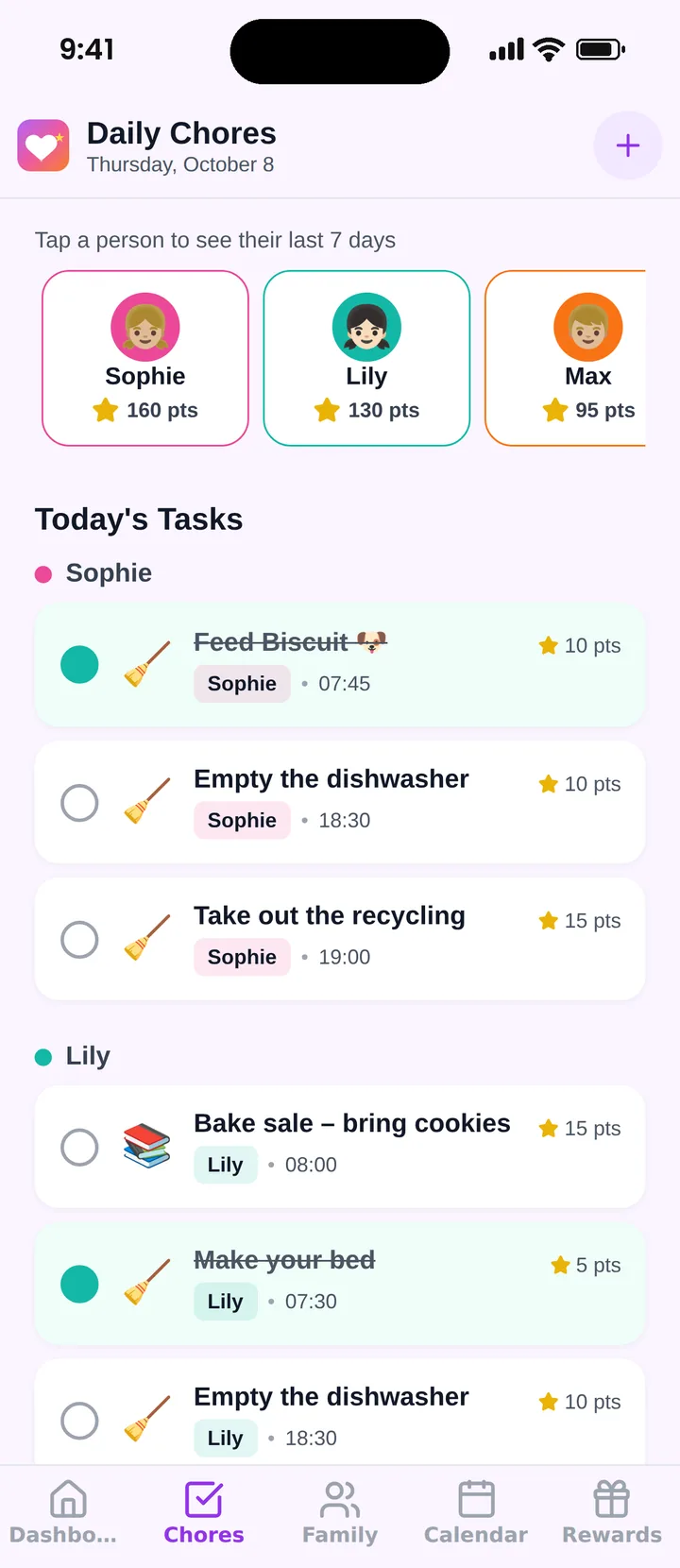
Famiyo is a free family app for iPhone and Android that combines a shared family calendar, chores with points and a rewards shop; kids join with a code, no email needed. As a daily checklist, each step is a task that you assign to a child, and kids see their own tasks on their own phone and tick them off. You can attach points to each task, or leave points out and use the list for structure alone. Tasks repeat daily, weekly or every few days. The free plan includes 1 repeating task and up to 3 family members, and Premium removes those limits, so a full checklist of repeating steps needs Premium. Compare options in our list of the best chore chart apps.
Write one morning list tonight, with your child, and tape it up before bed.
Frequently asked questions
How many items should a kids daily checklist have?
For children under 7, keep each checklist to 4 to 6 steps. School-age kids can handle 6 to 8 steps per block. If you need more, split the day into morning, after school and evening lists instead of one long one.
At what age can a child use a checklist alone?
Many children can follow a picture checklist around age 4 or 5, and a written one once they read comfortably, often by 6 or 7. Expect to walk through it together for the first week or two, then step back.
Should a daily checklist include chores and routine tasks?
Yes, but keep them clearly mixed in order. Routine tasks such as brushing teeth belong to daily life, while chores such as feeding the dog add contribution. Putting both on one list means the child checks one place instead of two.
What do you do when a child ignores the checklist?
Check the list is short enough, in the right order and placed where the child will see it. Stand next to them for a few days without nagging, pointing only at the list. Give it 2 to 3 weeks of consistent use before changing course.
Should a checklist have rewards?
Not required. Many children are happy with the satisfaction of ticking boxes. If a child needs a push, add a small reward for a full week of completed lists, and let them help choose it.
Try Famiyo With Your Family
Chores with points, a rewards shop for kids and one shared family calendar. Set it up in a couple of minutes.



Free to download • No credit card required • Available on iOS & Android