How Much Allowance for a 10-Year-Old? Typical Amounts
A 10-year-old typically gets $7 to $10 a week, with $10 from the dollar-per-year rule. See how to split it, what it covers and how to decide.
By Famiyo Editorial Team3 min read
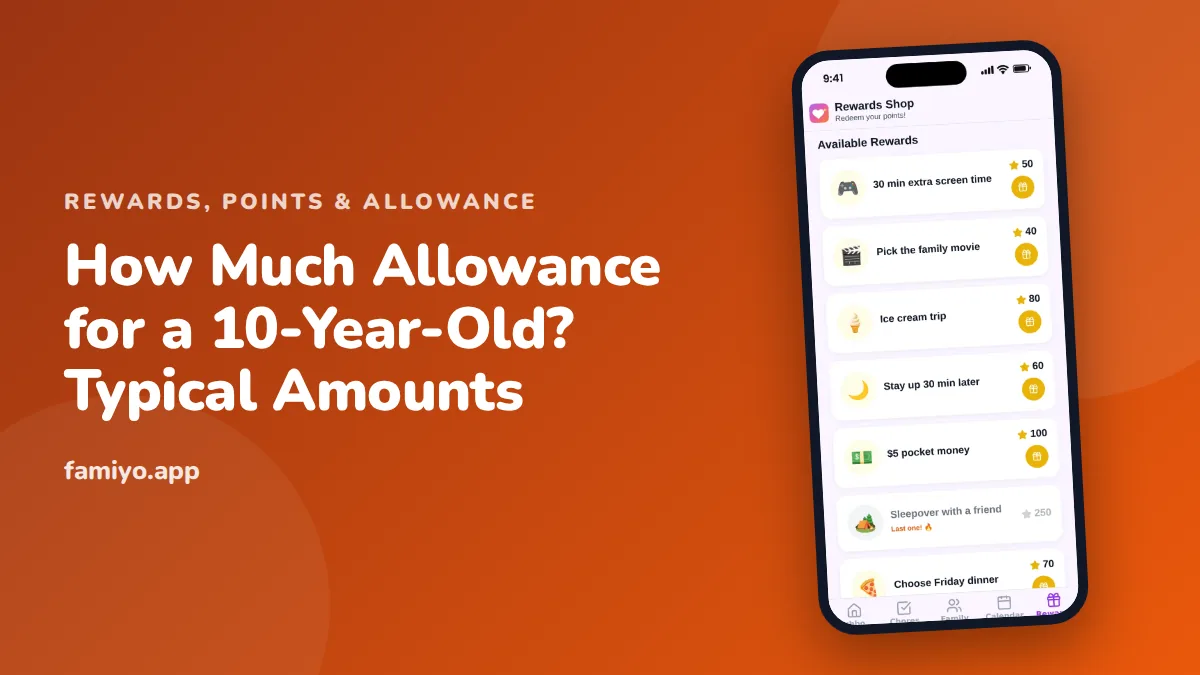
Ten is a good age to start taking allowance seriously. A 10-year-old can count change, wait a few weeks for something they want and notice when the money is gone. Here is what other families typically pay, how to split it and how to land on a number that suits yours.
What is the typical allowance for a 10-year-old?
For ages 8 to 10, the usual weekly range is $7 to $10. The old rule of $1 per week for each year of age puts a 10-year-old at $10. Neither is a standard. They are a place to start.
| Method | Weekly amount for a 10-year-old |
|---|---|
| Typical range for ages 8 to 10 | $7 to $10 |
| $1 per year of age | $10 |
| Monthly equivalent | About $30 to $43 |
| Next age band (11 to 13) | $10 to $15 |
If your child is close to 11, the allowance for an 11-year-old is a natural next step, and our page on allowance for teenagers shows where this goes later.
How to decide on your number
The amount matters less than what it is for. Try three questions.
First, what will your child buy with it? If it only covers a treat and a small toy now and then, $5 to $7 may be enough. If it also covers things like a magazine, a game add-on or a small gift for a friend, aim for $8 to $10.
Second, what can your family comfortably repeat every week for years? Allowance only teaches if it is paid on time, every time. Choose a number you will not resent in February.
Third, how many children do you have? If you pay a 10-year-old $10, the 7-year-old will want the same. Having a ladder by age, which rises each birthday, avoids the argument.
Splitting the money: spend, save, give
A split gives the money a shape. A common version is 50% to spend, 40% to save and 10% to give. Here it is on a few weekly amounts.
| Weekly allowance | Spend (50%) | Save (40%) | Give (10%) |
|---|---|---|---|
| $7 | $3.50 | $2.80 | $0.70 |
| $8 | $4.00 | $3.20 | $0.80 |
| $10 | $5.00 | $4.00 | $1.00 |
Use three jars, envelopes or labeled boxes. At 10, kids can also track the numbers on paper. The savings share needs a goal, such as a $40 game or a bike light. Show them the math: "$4 a week gets you there in 10 weeks."
Should it be tied to chores?
At 10, there are two workable models. One is a flat allowance with unpaid basic chores. The other is a smaller base, with extra pay for bigger jobs. For jobs beyond the daily basics, typical rates are $0.25 to $1 for a small task and $2 to $5 for a big one. A 10-year-old's regular chores usually run about 30 minutes a day, including tasks like cleaning a bathroom sink or helping cook a meal, and these should stay part of belonging to the family.
For the wider picture, read do most kids get paid for chores.
What to do when your child spends it all
They will. A 10-year-old buys a $9 item on the first day and has nothing left by Friday. Resist the urge to top it up. Say, "That's the plan. Next payday is Saturday," and leave it. Running out of money once teaches more than any talk.
If they are saving and never spending, that is fine too, but remind them that spending a little is allowed.
Doing pocket money with Famiyo
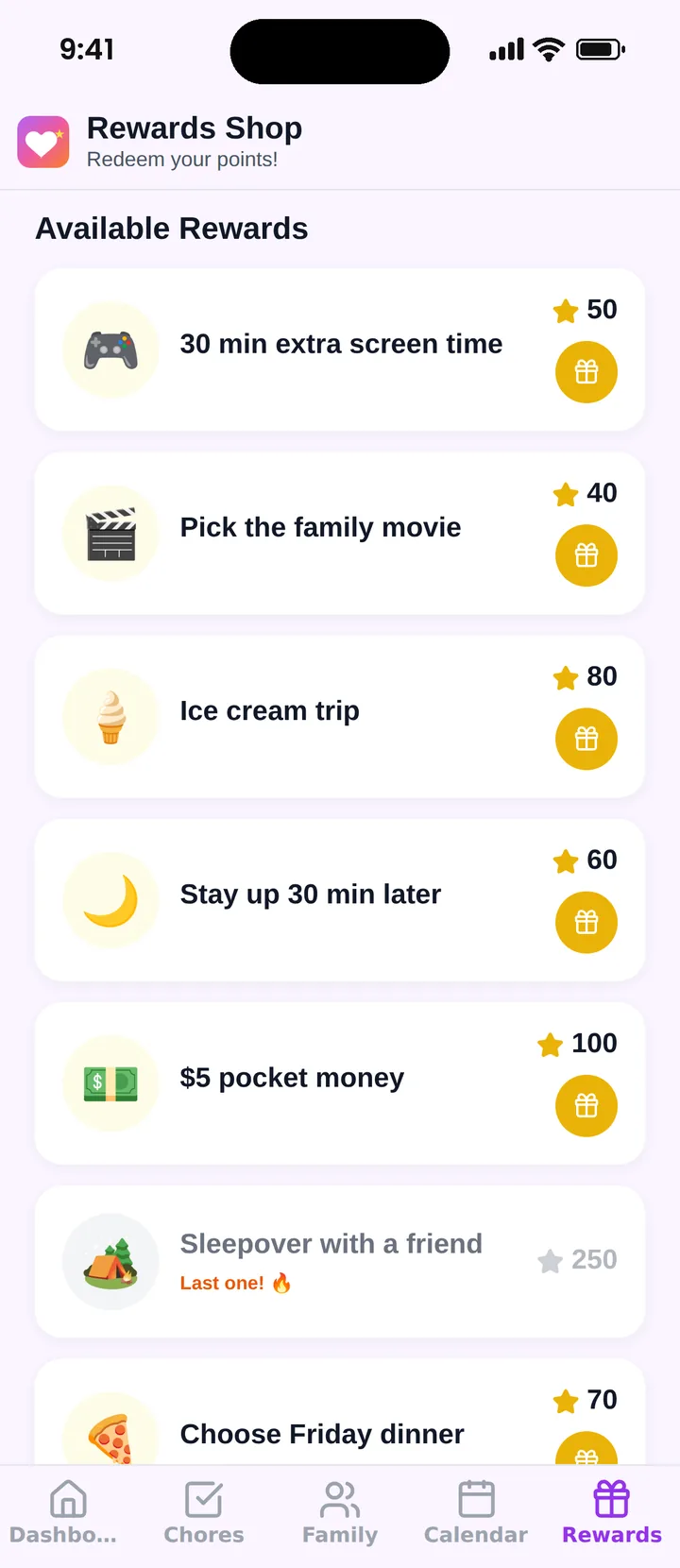
Famiyo is a free family app for iPhone and Android that combines a shared family calendar, chores with points and a rewards shop; kids join with a code, no email needed. Many families use it to run the "earn" side. Chores are worth points: 5 for a small task, 10 for a medium one and 20 for a big one. You then add pocket money as a reward in the rewards shop, priced in points. If you convert at 100 points to $1, a $5 reward costs 500 points. Your child redeems it from their own phone, you get a notification, and the cash is handed over outside the app, because Famiyo never holds real money. See our list of the best allowance apps for kids.
Review it every few months
After a month, ask: did they run out early, or end with a pile? Is the savings goal reachable? Raise the amount at each birthday, or when you hand over a new expense. Write the current rule on the fridge, so it is clear for everyone.
Frequently asked questions
Is $10 a week too much for a 10-year-old?
It is at the top of the usual range of $7 to $10 for ages 8 to 10, and it matches the $1 per year rule. It is fine if it covers things your child buys. If it only funds treats, $7 to $8 is plenty.
Should a 10-year-old's allowance be paid weekly or monthly?
Weekly. Ten-year-olds struggle to plan across a month, and a short cycle lets them feel the results of a choice within days. Pay on the same day every week so it becomes a habit.
Should allowance be tied to chores at age 10?
Many families keep a small base and pay extra for bigger jobs, at $0.25 to $1 for a small extra and $2 to $5 for a big one. Basic family chores such as making the bed stay unpaid.
What should a 10-year-old do with their allowance?
A simple spend, save, give split works well, for example 50%, 40% and 10%. On $10 a week that is $5 to spend, $4 to save toward a goal and $1 to give. Let them choose how to spend their share.
Try Famiyo With Your Family
Chores with points, a rewards shop for kids and one shared family calendar. Set it up in a couple of minutes.



Free to download • No credit card required • Available on iOS & Android