Positive Reinforcement for Kids With ADHD: What Works and Why
Why kids with ADHD need praise and rewards that are faster, more frequent and more specific, with scripts, a points table and fixes for when it stops working.
By Famiyo Editorial Team7 min read
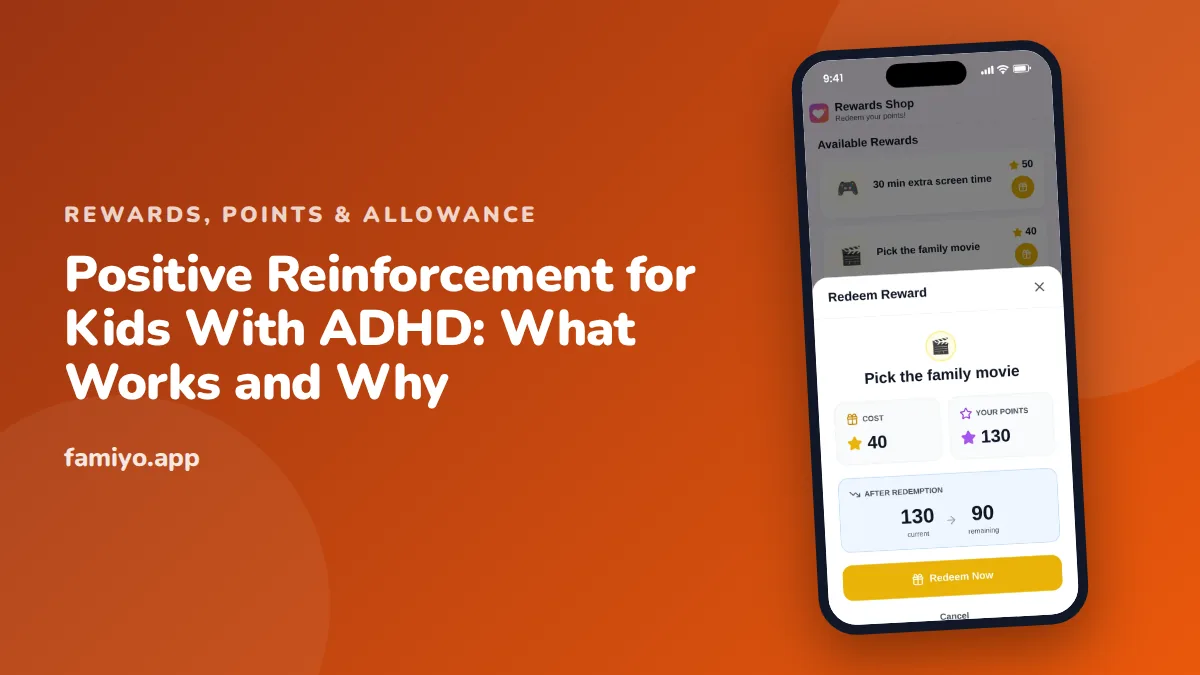
If your child has ADHD, you may have noticed that the usual reward chart barely registers. A sticker promised for Saturday means little on a Tuesday afternoon, and a general "good job" slides right past. This guide explains why positive reinforcement has to work differently for kids with ADHD, then gives you the specific changes, the words to use and a points setup to try this week.
Why the standard approach falls short for kids with ADHD
Positive reinforcement is simple in principle: when a behavior is followed by something the child values, that behavior becomes more likely. The principle works the same for every child. What differs with ADHD is how close together the behavior and the payoff need to be.
ADHD is widely understood as affecting self-regulation and the brain's handling of time and delayed rewards. In practice, a reward that sits hours or days away carries less pull for a child with ADHD than for a sibling of the same age. They aren't ignoring it on purpose. It just isn't vivid enough to compete with whatever is in front of them right now.
There's a second problem. Kids with ADHD often hear a lot of corrections in a day: sit down, focus, stop, you forgot again. When most of the feedback a child gets is negative, praise becomes rare, and rare praise is easy to tune out or distrust.
This is why both the American Academy of Pediatrics and the CDC point families toward parent training in behavior management. The AAP recommends it as the first step for preschoolers with ADHD and alongside other treatment for school-age kids. Much of what these programs teach comes down to the adjustments below. They don't replace a plan from your child's pediatrician or therapist, but they fit inside one.
Four adjustments that make reinforcement work
| Adjustment | Typical reward chart | ADHD-friendly version |
|---|---|---|
| Timing | Sticker at bedtime, prize on Saturday | Praise within seconds, points right away, a small reward within 1 to 2 days |
| Frequency | Praise when the whole task is done | Praise at the start, partway through and at the end |
| Specificity | "Good job today" | "You put your shoes on the first time I asked" |
| Size of steps | "Clean your room" | "Put the Legos in the bin," then the next step |
Timing matters most. If you can only change one thing, close the gap between the behavior and the response. A child who earns 5 points the moment the backpack is packed, and can see the total climb, connects the two. A child who hears "we'll see how the week goes" usually doesn't.
Frequency matters next. Early on, notice the behavior every time it happens. Once it becomes routine, you can thin praise out slowly, for example every second or third time, rather than dropping it overnight.
Specificity tells the child exactly what to repeat. And breaking jobs into small steps gives you more chances to reinforce, which keeps a child with a short attention span inside the task.
What to say: labeled praise with real examples
Labeled praise names the behavior you want to see again. It's short, it's sincere and it's delivered while the moment is still fresh. Here are examples for the parts of the day that tend to be hardest:
- Starting homework: "You sat down and opened your folder right away. That's the hardest part, and you did it."
- Transitions: "I said it was time to turn off the game, and you did it in one try. Thank you."
- Waiting: "You waited for your sister to finish talking before you told your story. That was patient."
- Staying with a task: "You've been working on these spelling words for five minutes straight."
- Remembering on their own: "Your lunchbox is already in the sink. I didn't even have to ask."
- Calming down: "You were really mad and you went to your room to cool off instead of yelling. That took control."
Keep your tone plain. Kids with ADHD are often quick to spot praise that sounds over the top or slightly sarcastic, and "Wow, you actually did it!" can land as a criticism. Matter-of-fact works better than gushing.
Physical cues help too. A thumbs-up from across the room, a hand on the shoulder or a quick high five gives immediate feedback without interrupting the task. If you have a child who struggles with eye contact or touch, use whatever cue they're comfortable with.
Reinforce the start, not just the finish
For many kids with ADHD, getting started is the hardest step. A task like "clean your room" feels endless, so they never begin, and a system that only rewards finished work never gets a chance to pay out.
Reward the first step separately. If homework is the battleground, praise the moment the pencil is out, then again halfway, then at the end. If mornings are hard, praise getting out of bed, then getting dressed, then shoes on, rather than waiting until the car pulls away.
The same idea applies to chores. Split bigger jobs into short parts with their own small payoff. "Tidy your room" becomes three steps: clothes in the hamper, toys in the bins, books on the shelf. Each one is a chance for you to say "Done, nice" and for the child to feel progress. A visual checklist taped to the door does some of the remembering for them.
Turning praise into points and rewards
Praise is the core, but many kids with ADHD also do well with a tangible layer: points they earn right away and spend soon. If you've used a point system for kids' behavior before, the main change is shortening every delay.
Here's a starting setup for a school-age child, using simple point values:
| Target behavior | When it's reinforced | Points |
|---|---|---|
| Start homework within 5 minutes of the timer | As soon as the pencil is on the page | 5 |
| Pack the backpack for tomorrow | Right after it's zipped | 5 |
| Turn off a screen when the timer ends | In the moment | 5 |
| Finish a 10-minute chore, like tidying the room | When it's done | 10 |
| Any of the above without a reminder | Same moment | +2 bonus |
Price the rewards so the first one is close. A small reward like 15 extra minutes of screen time or choosing dessert might cost 30 to 50 points, which a child following this table can reach in a day or two. Medium rewards, such as picking the family movie, can sit around 100 points. Keep the big reward (a day out, a toy around $20, at 300 to 500 points) on the menu too, so the system also gives some practice in saving up, but don't make it the only goal.
Novelty matters for many kids with ADHD. A reward that felt exciting in week one can feel flat by week three. Rotate one or two items on the reward menu every couple of weeks, and ask your child what they'd like to add. For ideas that suit any child, see our guide to positive reinforcement for kids with examples.
When it stops working
Most reinforcement systems wobble at some point. Before you scrap yours, check these common causes:
- The reward is too far away. If your child hasn't redeemed anything in a week, lower the price of a small reward or add a cheaper one.
- Too many targets at once. Three behaviors is plenty. With six, nothing stands out.
- The target is vague. "Be good at dinner" can't be reinforced in the moment. "Stay in your seat until your plate is empty" can.
- Points get taken away. Losing earned points can feel like losing everything, and some kids stop trying altogether. Keep consequences separate from the points.
- The praise dried up. When the points system is running, it's easy to stop saying the words. The words are still doing most of the work.
Give any change 2 to 3 weeks of consistent use before you judge it. ADHD looks different from child to child, and some kids also have anxiety, learning differences or oppositional behavior that changes what works best. If you're seeing lots of defiance, our page on positive reinforcement for kids with ODD covers that pattern, and your child's pediatrician or therapist can help you adjust the plan.
Fast rewards with Famiyo
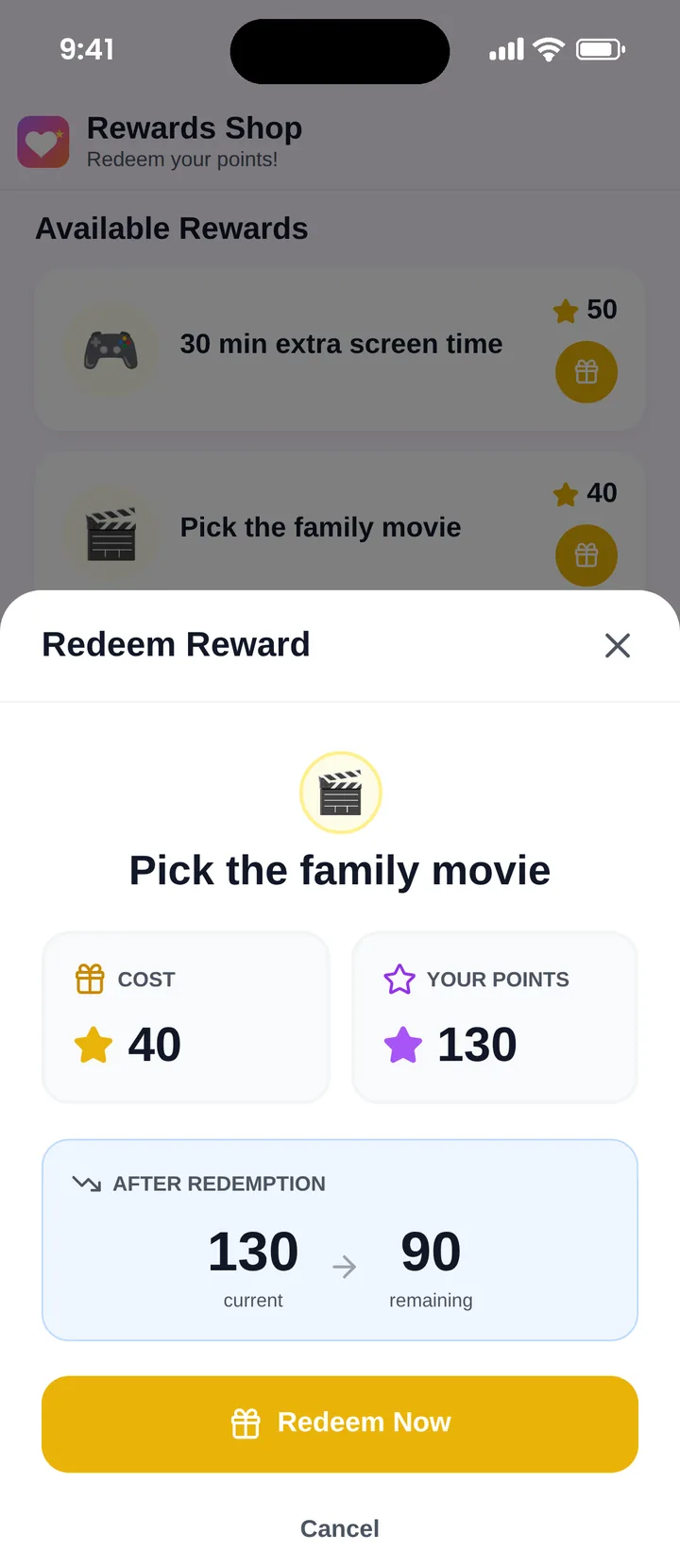
Famiyo is a free family app for iPhone and Android that combines a shared family calendar, chores with points and a rewards shop; kids join with a code, no email needed. For a child with ADHD, the useful part is speed. You give each task its points, and they land on your child's balance as soon as the task is checked off by them or approved by you. In the rewards shop you set prices, how many of each reward are available and when, so you can add a cheap 30-point reward for the first week and rotate items when interest fades. Your child redeems from their own phone and sees how many points they'll have left, and you get a notification when they do. To compare tools, see our list of the best reward chart apps for kids.
Start tomorrow with one hard moment of the day, one sentence of labeled praise and a 5-point reward for it. Add the second behavior only when the first one feels routine.
Frequently asked questions
Does positive reinforcement work for kids with ADHD?
For many children, yes. Parent training in behavior management, which is built largely on positive reinforcement, is recommended by the American Academy of Pediatrics as a first step for preschoolers with ADHD and alongside other treatment for older kids. Results depend on the child, so ask your pediatrician or therapist how it fits your child's plan.
How often should I praise a child with ADHD?
More often than feels natural, especially when you're starting out. Aim to notice small moments of the behavior you want several times an hour during hard parts of the day, like homework or getting ready. Once a habit is solid, you can space praise out gradually instead of stopping it all at once.
Is rewarding a child with ADHD the same as bribing them?
No. A bribe is offered in the middle of a standoff to end it, so it rewards the standoff. Reinforcement is agreed in advance, given after the behavior, and stays the same whether the day went well or badly. The child knows the deal before they start.
Should I take points away for bad behavior?
Be careful with it. Losing points a child already earned can feel crushing for a kid with ADHD and may make them give up on the system. Most families get further by keeping earned points safe and handling misbehavior with a separate, calm consequence agreed in advance.
Try Famiyo With Your Family
Chores with points, a rewards shop for kids and one shared family calendar. Set it up in a couple of minutes.



Free to download • No credit card required • Available on iOS & Android