How Much Allowance Should a Teenager Get?
Most teens get about $15 to $25 a week, but the right number depends on what it has to cover. Here is how to pick an amount and how to pay it.
By Famiyo Editorial Team4 min read
A teenager who asks for money every time they leave the house is a sign the allowance, if there is one, has no job description. Parents of 13 to 17 year olds usually want two things: a fair number, and a system that stops the daily requests. This page gives you the typical amounts and a way to land on your own.
What is a typical allowance for a teenager?
The most quoted rule is $1 a week for each year of age. It is a starting point, not a standard. Typical weekly ranges run from $10 to $15 for ages 11 to 13 and $15 to $25 from age 14 up.
| Age | $1 per year rule | Typical weekly range |
|---|---|---|
| 13 | $13 | $10 to $15 |
| 14 | $14 | $15 to $25 |
| 15 | $15 | $15 to $25 |
| 16 | $16 | $15 to $25 |
| 17 | $17 | $15 to $25 |
If your teen is just turning 13, our page on how much allowance for a 13-year-old covers that jump in more detail.
Why the number matters less than the scope
Two families can pay the same $20 and have opposite results. In one, $20 is spending money for snacks and the movies. In the other, it also has to cover phone games, clothes and rides. The first teen feels rich and the second feels broke.
So decide the scope before the amount. Here are three common setups.
| Setup | What the teen pays for | Rough weekly range |
|---|---|---|
| Pocket money | Snacks, outings with friends, small treats | $10 to $15 |
| Spending plus fun | The above plus games, apps, music, streaming add-ons | $15 to $20 |
| Spending plus basics | The above plus some clothes, personal items, school extras | $20 to $25 and up |
Notice that going up a tier means handing over real responsibility. That is the point. A teen budgeting for sneakers learns more than one who gets $25 and still asks you for sneakers.
How to pick your number in five steps
- List what your teen currently asks you to pay for in a normal month. Skim your own banking app if you need the memory jog.
- Circle the items they should pay for from now on. Start small. Moving everything at once feels like a pay cut.
- Add up the monthly cost of those items and divide by four. That is your weekly number.
- Compare it with the typical range for their age. If you are far outside it, check your list again.
- Write the rule down and tell your teen: "Starting next month this covers X, Y and Z. When it's gone, it's gone."
Revisit the number every six months or at each birthday. Costs and needs change.
Weekly, monthly, or in the app?
Younger teens do better with weekly money because a month is too long to plan for. Somewhere around 15 or 16, a monthly payment makes sense, because it asks them to stretch money across four weeks. Choose a fixed day and stick to it. A late payment teaches a teen that the system is negotiable.
How it gets paid is up to you: cash, a bank transfer, or a teen account that you fund. The method matters less than being predictable. If your teen already has a debit card or a payment app, use it, since managing digital money is the skill they actually need.
Should allowance depend on chores?
There are two workable models. In the first, a base allowance comes with being part of the family, and basic chores are expected whether or not money is attached. In the second, extra jobs earn extra. Paid jobs typically run $0.25 to $1 for a small extra task and $2 to $5 for a big one, so a lawn mowing or a car wash fits the top of that range.
Mixing the two usually works best: a steady base for learning to budget, plus a way to earn more for real extra effort. If you want the bigger picture, see do most kids get paid for chores, and for teens who want to earn beyond the house, ways for kids to make money in the summer has ideas.
Setting it up in Famiyo
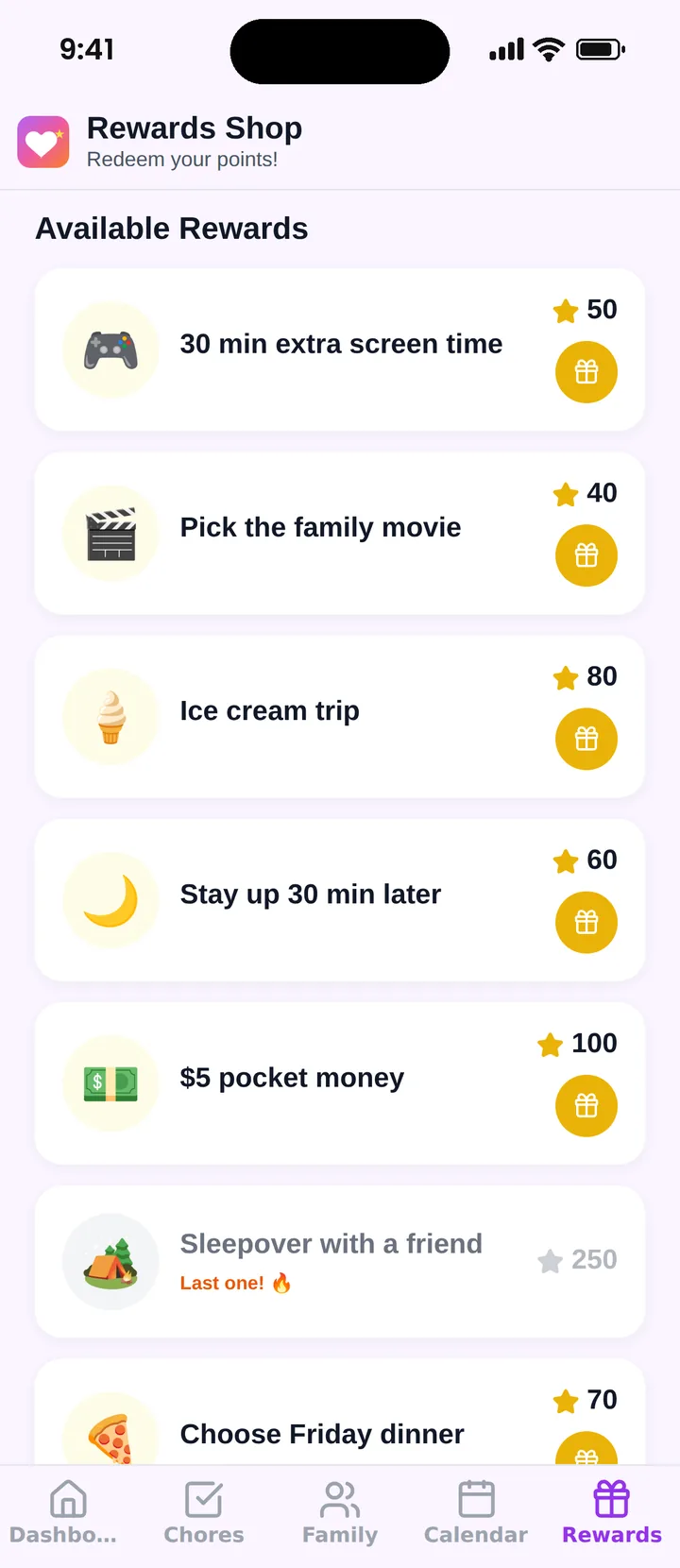
Famiyo is a free family app for iPhone and Android that combines a shared family calendar, chores with points and a rewards shop; kids join with a code, no email needed. For teens, the rewards shop works as the pocket money layer. Chores earn points, and you add "$10 pocket money" as a reward with a price in points. At the default rate of 100 points to $1, that is 1,000 points. Your teen redeems from their own phone and sees how many points they will have left. The money itself still changes hands outside the app. Compare options in our list of the best allowance apps for kids.
What to do when the amount stops working
If your teen is always out of money by Tuesday, the amount is probably fine and the rule is the issue. Hold the line for a few weeks. If they are always left with money and saving it, the scope is too small, so hand over one more expense. If they regularly ask for advances, say once, calmly, "I'm not a bank, but let's look at your plan for next week together."
Frequently asked questions
How much allowance should a 14-year-old get?
Most families land between $15 and $25 a week at 14. The $1 per year rule gives $14. Pick the number after deciding what it covers: snacks and outings need less, while clothes, games and phone extras need more.
Should a teenager get allowance weekly or monthly?
Weekly works for younger teens who run out of money fast. Many families switch to monthly around 15 or 16 so the teen practices planning for four weeks at a time, with a clear rule that no advances are given.
Should teen allowance depend on chores?
Many parents split it. A base amount comes with being part of the family, and bigger one-off jobs such as mowing the lawn or washing the car earn extra. Basic chores like their own laundry stay unpaid either way.
What if my teen spends it all the first day?
Let it happen once or twice and don't top it up. Running out before the week ends is the cheapest money lesson there is. Talk about what they would do differently, then keep the next payday the same.
Try Famiyo With Your Family
Chores with points, a rewards shop for kids and one shared family calendar. Set it up in a couple of minutes.



Free to download • No credit card required • Available on iOS & Android