Kids Motivation: What Really Drives Children
What drives kids' motivation, how it changes from preschool to the teens, when rewards help or hurt, and what to check if a child seems unmotivated.
By Famiyo Editorial Team5 min read
"My kid just isn't motivated" usually means something narrower. A child who won't empty the dishwasher may spend three hours building a city in a video game. So motivation is rarely missing. It's pointed somewhere else. This guide explains what tends to drive children, how that changes with age, where rewards fit in and what to check when your child seems to have run out of drive.
The three needs behind motivation
One of the best-studied frameworks in psychology, self-determination theory, describes three basic needs that keep people motivated over time. They map neatly onto what parents see at home.
- Autonomy: the sense of having a say. A child told "clean your room now" has none. A child told "the room needs to be done before dinner, you pick when" has some.
- Competence: feeling able to succeed. Tasks that are too hard produce avoidance, tasks that are too easy produce boredom, and tasks just within reach are the ones kids stick with.
- Relatedness: feeling connected. Children work hard for people they feel close to and for a group they belong to, which is why "we all pitch in before the movie" lands better than "do your chores."
When a child seems unmotivated, one of these is usually missing. That's a more useful question than "how do I make them want to," because each one points to a concrete change.
How motivation changes with age
What drives a 4-year-old will not move a 14-year-old. The needs stay the same, but what satisfies them shifts.
| Age | What tends to drive them | What usually works | What usually backfires |
|---|---|---|---|
| 3 to 5 | Being with you, doing "big kid" things, immediate results | Doing tasks together, quick visible progress, a sticker or point right away | Rewards that are days away, long instructions |
| 6 to 9 | Mastery, fairness, collecting and counting | Clear rules, points they can track, small rewards every few days | Changing rules mid-week, comparing them to siblings |
| 10 to 12 | Competence, privileges, being trusted | Bigger jobs, choice over when, saving toward something larger | Micromanaging how they do it, public correction |
| 13 to 17 | Independence, identity, peers, money | Ownership of whole tasks, negotiated deals, real money or freedom | Lectures, rewards that feel childish, control without explanation |
Delay is part of the picture too. Young children struggle to work for something they won't get until next month, while teens can save for weeks. Our guide to delayed gratification covers how that skill develops and how to stretch it gently.
Intrinsic and extrinsic: both have a place
Intrinsic motivation means doing something because it's interesting or satisfying. Extrinsic motivation means doing it for an outcome: points, money, praise, avoiding trouble. Parents are often told the first is good and the second is bad. The picture is more mixed.
Research on rewards has found that expected rewards can lower interest in an activity a child already loves. Pay a child to draw, and some will draw less once the payments stop. But most chores aren't intrinsically fun for anyone. Nobody unloads the dishwasher for the joy of it. For tasks like that, an outside push helps a child get started, and the habit can carry on after the reward fades.
A practical rule: use rewards for things that are dull and need to become routine. Leave rewards off things your child already does for love, such as reading, drawing or building. For those, interest and attention from you are enough. If you want to grow inner drive specifically, our piece on intrinsic motivation in kids goes further.
What makes a reward work
Rewards that support motivation tend to share a few features:
- They are predictable. The child knows in advance what earns what.
- They are proportionate. A 5-minute job earns a small amount, a 30-minute job earns more. A common starting point is 5 points for small tasks, 10 for medium and 20 for big ones.
- They come soon enough for the child's age. Preschoolers need something the same day. A 10-year-old can wait a week.
- They include some choice. Picking from several rewards keeps a sense of control, which feeds autonomy.
- They are paired with specific feedback. "You wiped under the toaster too" tells a child what competence looks like.
Screen time is a common reward and can work well if the base limits stay protected. See our guide to earning screen time with chores for one fair way to set it up.
Why a child seems unmotivated
Before reaching for a new chart, run through the usual suspects. They're boring, but they explain a lot.
| What you see | Possible cause | First thing to try |
|---|---|---|
| Starts nothing, irritable, slow mornings | Not enough sleep | Check against AAP guidance: 9 to 12 hours for ages 6 to 12, 8 to 10 for teens |
| Avoids one specific task | Too hard or unclear | Break it into steps and show what "done" looks like |
| Does it only when watched | No ownership | Give a deadline and let them choose the timing |
| Gives up after one mistake | Fear of failing | Praise effort and strategy, not being "smart" |
| Motivated everywhere except home | Low connection around chores | Work side by side for a while |
| Used to care, now doesn't | Rewards too far away, or boredom | Make goals shorter, refresh the reward list |
Some children find it harder than others to get started and keep going. Kids with ADHD, for example, often respond better to immediate, frequent rewards and very short steps. If low motivation is new, lasts for weeks, or comes with changes in mood, sleep, eating or friendships, that's worth raising with your child's pediatrician rather than trying to fix with a reward system.
What parents can say instead
Small changes in wording shift who owns the task. These swap control for choice and judgment for information.
- Instead of "Go clean your room now," try "Your room needs to be done before screen time. Do you want to start now or after your snack?"
- Instead of "Good job," try "You remembered the trash without me asking. That made tonight easier."
- Instead of "Why can't you just do it?" try "What part of this feels annoying? Let's fix that part."
- Instead of "If you don't, no phone," try "Once the dishwasher's done, the phone's yours."
None of these are magic. They lean on autonomy, competence and connection instead of pressure, and over weeks that tends to add up.
How the rewards shop works in Famiyo
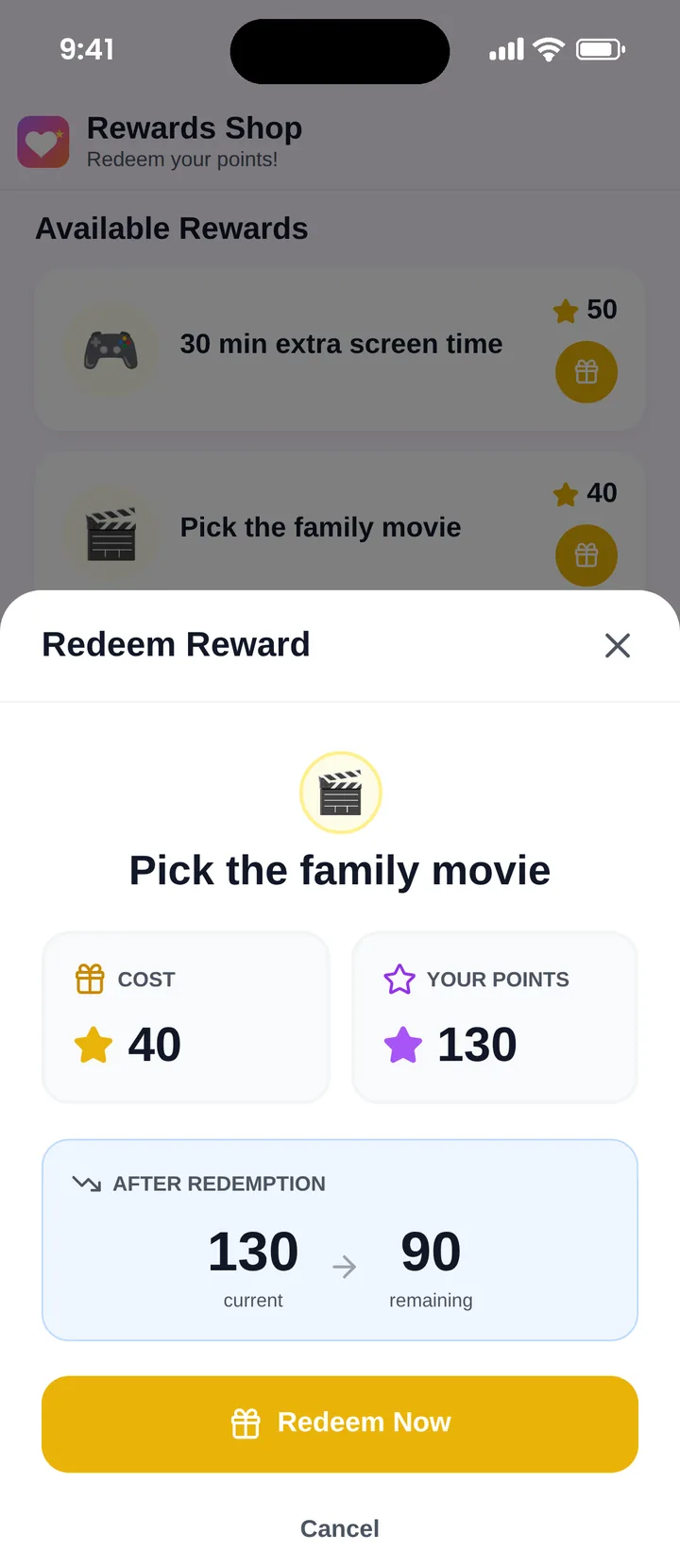
Famiyo is a free family app for iPhone and Android that combines a shared family calendar, chores with points and a rewards shop; kids join with a code, no email needed. Its rewards shop covers the features that make rewards work. You set each reward's price in points, how many are available and when, so "stay up 30 minutes later" at 100 points might be limited to Fridays. Kids redeem from their own phone and see how many points they'll have left, which helps with saving and planning ahead. You get a notification when something is redeemed. A child might afford a small reward of 30 to 50 points every 2 to 3 days, with a big one every few weeks. To compare tools, see our list of the best reward chart apps for kids.
When your teen outgrows points, motivation often shifts toward earning real money, and our guide to a first job for teens picks up there.
Frequently asked questions
What motivates a child the most?
For most children, the strongest drivers are feeling capable, having some say in what they do and feeling connected to the people around them. Rewards and praise add a push, especially for boring tasks, but they work best on top of those needs, not as a substitute.
Do rewards kill a child's motivation?
Not in general. Research on rewards suggests they can reduce interest in an activity a child already enjoys for its own sake, especially when the reward is expected and tied simply to doing it. For chores and other dull tasks, small and predictable rewards tend to help children get started.
Why is my child so unmotivated?
Common causes are too little sleep, a task that feels too hard or too vague, no choice in how it gets done, or worry about failing. Look at those first. If low motivation is new, lasts weeks and comes with changes in mood, sleep or appetite, talk to your child's pediatrician.
How do you motivate a child who doesn't care about anything?
Start from what they do care about, even if it's a video game, and notice what keeps them going there: progress they can see, control and quick feedback. Build those into one small task, keep it short and achievable, and add more only once that one is going well.
Try Famiyo With Your Family
Chores with points, a rewards shop for kids and one shared family calendar. Set it up in a couple of minutes.



Free to download • No credit card required • Available on iOS & Android