First Jobs for Teens: A Parent's Guide
A parent's guide to a teen's first job: when to start, which jobs suit ages 14 to 17, how work permits and paychecks work, and how to handle the money.
By Famiyo Editorial Team6 min read
A first job is the first time your teen finds out what money costs in hours. It can also be the first time they have a boss who does not care about their excuses. This guide covers when to start, which jobs suit which ages, the paperwork nobody warns you about, and how to handle the money once it arrives.
When to start
There is no perfect age. Some teens are ready at 14 and want to work. Others do better at 16 after a year of fewer commitments. Look at readiness, not the calendar.
Signs your teen is ready: they handle their own homework deadlines, they get themselves to commitments on time, and they ask for more spending money than your allowance provides. Signs to wait: grades are slipping, sleep is short, or the motivation is only to escape something at home.
Legal age matters too. In the US, federal rules generally set 14 as the minimum age for most non-farm employment, with limits on hours and tasks for 14 and 15-year-olds. States add their own rules. Informal work like babysitting and yard work usually falls outside those rules, which is why it is where most teens begin.
First job options by age
| Age | Good fits | Notes |
|---|---|---|
| 12 to 13 | Pet sitting, watering plants, shoveling snow, mother's helper | Informal and local, usually neighbors and family friends |
| 14 to 15 | Babysitting, lawn care, tutoring, tech help, some retail and food service, camp helper | Hours are limited by law; check your state |
| 16 to 17 | Retail, restaurants, grocery stores, camp counselor, lifeguard, delivery-free roles, office assistant | More hours and more task types are allowed |
Two categories are worth a second look. Self-employed work, like dog walking or mowing, lets a teen set a price, find customers and see a direct link between effort and earnings. A traditional job teaches punctuality, taking instructions and working with people they did not choose. Neither is better. A teen who does one in summer and the other during the school year gets both lessons.
How to help without doing it for them
You can open doors, but your teen should walk through them. Here is a sensible split.
- Let your teen choose where to apply. Offer ideas, but do not hand them a list of places.
- Help with the resume. A short one-page version is enough: contact details, school, activities, volunteer work, skills and a reference or two.
- Practice an interview in the kitchen. Ask three or four questions, like "Why do you want this job?" and "Tell me about a time you were responsible." Give honest feedback.
- Make them send the applications and make the follow-up calls. A parent's voice on the phone tends to sink the application.
- Drive them to the interview, if needed, but wait in the car.
If your teen gets turned down, treat it as normal. Most people hear no several times before they hear yes.
The paperwork
This is the part that surprises parents.
- Work permit. Many states require working papers for minors. These are usually issued through the school or the state labor department. Check before the first shift.
- Forms for the employer. Expect an identity and work eligibility form and a tax withholding form. Your teen needs their Social Security number and ID.
- A bank account. Employers pay by direct deposit or check. A teen account with a parent as co-owner is a common arrangement.
- Taxes. Teens with low earnings may owe little or no income tax, but they still file forms. Read the current guidance on the IRS website or ask a tax professional, since the thresholds change.
Self-employed work has its own tax rules, which differ from a paycheck. For small amounts, keep a simple record of earnings and expenses.
Set rules for hours and school
Agree on limits before the first shift. A short written agreement keeps everyone honest.
- A maximum number of shifts a week during the school year
- No work on nights before exams
- Grades checked after the first month, with a trigger for cutting hours
- Sleep protected: teens aged 13 to 18 need roughly 8 to 10 hours a night, according to AASM and AAP recommendations
- A heads-up for the family calendar when the schedule changes
Put the shifts on the shared calendar. It saves a lot of "I didn't know you were working Saturday" at 4 p.m.
What the money should be for
This is where families differ. Some let teens keep everything. Others require a split. A framework that works for many:
| Bucket | Share to consider | Purpose |
|---|---|---|
| Spend | Largest share | Going out, food, hobbies, extras |
| Save | A fixed share, moved on payday | A car, college, a trip |
| Responsibility | Agreed items | Phone bill, gas, clothes, subscriptions |
A teen who takes over the cost of their own clothing, for example, can graduate from a clothing allowance for teenagers to a self-funded wardrobe. Say clearly what moves to their paycheck and when. Hidden expectations are what turn good first jobs into resentment.
Keep unpaid family chores in place. A job is not a reason to stop helping at home, though the schedule may need to shift. For fair pay on extra household work, see our guide to chores for teenagers to earn money, and for the bigger picture of how much and how often, allowance for teenagers.
Handling the first paycheck
Sit with your teen and look at the pay stub. Compare the hours worked and the rate to the amount deposited. Explain the difference: withholding, taxes, deductions. Seeing a $120 check become $104 is a better lesson than any lecture.
Then ask what the plan is. You are not controlling the money; you are asking a question you would ask any adult who has just been paid. For a broader approach to money talk, see our guide on how to teach kids about money.
Using Famiyo around a first job
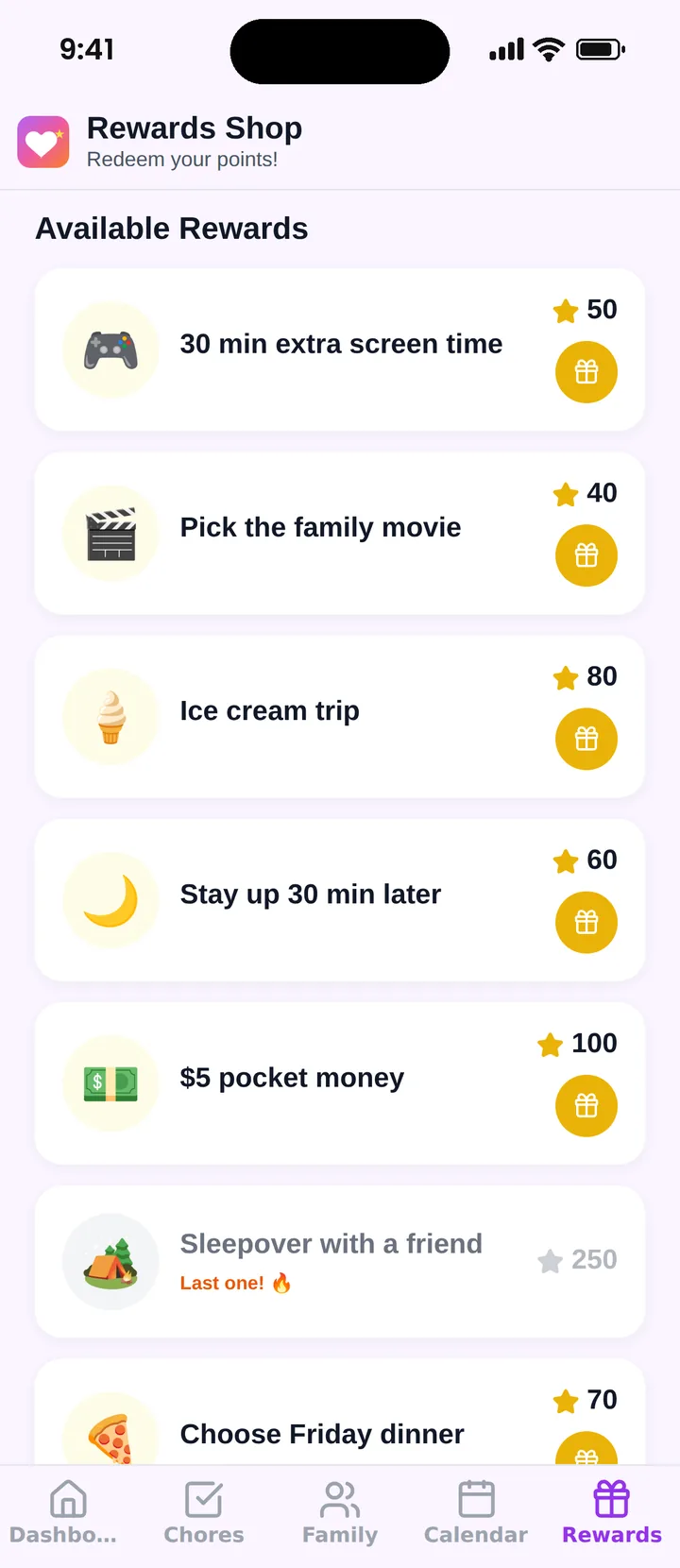
Famiyo is a free family app for iPhone and Android that combines a shared family calendar, chores with points and a rewards shop; kids join with a code, no email needed. It does not track a teen's job or pay. What it does handle is the home side. Put shifts on the shared calendar as repeating events, so everyone sees when your teen works. Keep home chores worth points, and add rewards to the shop, including pocket money, at a price you set. Teens redeem points on their own phone, and the money itself changes hands outside the app. If you want to compare tools, see our list of the best allowance apps for kids.
Safety and the right to say no
Before the first shift, talk about what a teen should do if something feels wrong. Tell them they can say no to a task that is unsafe, to being alone in a closed building late at night, or to anything that makes them uncomfortable. Make sure they know who the supervisor is and that they can call you at any time. Know where they work, how they get home and who else is on the shift. These are ordinary precautions, the same ones you would want for any adult starting a new job.
When it goes wrong
A few problems come up often. The shifts are too many and grades slip: cut hours and review. The boss asks for something unsafe or illegal: step in, since this is where a parent's help is needed. Your teen wants to quit after two weeks: ask for a month, unless something is wrong. The pay seems low: check your state's minimum wage for the age and job. Stay calm, and treat each as a chance to coach rather than rescue.
Frequently asked questions
What age can a teenager get their first job?
In the US, federal rules generally set 14 as the minimum age for most non-farm jobs, with limits on hours for 14 and 15-year-olds. States add their own rules and sometimes require a work permit. Babysitting and yard work are usually treated differently.
What are good first jobs for a 14 or 15-year-old?
Babysitting, pet sitting, lawn care, tutoring younger kids, helping neighbors with tech and some retail or food roles where the employer hires at that age. Lifeguard training often starts at 15. Check local limits on hours and tasks.
Does my teen need a work permit?
It depends on your state and your teen's age. Many states require working papers or an age certificate for minors, usually issued through the school or the state labor department. Look up your state's labor department page before the first interview.
How many hours should a teen work during the school year?
There is no single right number, and legal limits for younger teens are stricter than for older ones. A common family approach is a small number of shifts a week that leave homework, sleep and activities intact. Review grades after the first month.
Should I still give allowance if my teen has a job?
Many families reduce or end regular allowance once a teen earns steady money, and agree on which expenses the teen takes over, such as phone costs or clothing. Keep unpaid family chores either way.
Try Famiyo With Your Family
Chores with points, a rewards shop for kids and one shared family calendar. Set it up in a couple of minutes.



Free to download • No credit card required • Available on iOS & Android