How to Get Kids to Help Around the House
Kids help when jobs are specific, theirs and visible. Here is what to say, what to assign by age, and how to stop being the household's full-time reminder.
By Famiyo Editorial Team5 min read
You ask nicely. You ask again. By the third time your voice has gone flat and a child is lying on the floor as if the request were a medical event. This page covers why that happens and what changes it: what to ask for, how to say it, and how to build a system that does not rely on you being the household's alarm clock.
Why asking for "help" doesn't work
"Can you help me out around here?" is a vague request with no end. Kids can't tell what you want, how long it lasts or when they're free. So they stall, which is a reasonable response to an open-ended obligation.
There's a second problem. When you say "help," you are quietly calling it your job. Your child is a volunteer on your project, and volunteers can leave. A kid who owns the job is in a different position: the dog needs feeding, and it's their dog-feeding.
Both problems have the same fix. Stop asking for help and start handing over specific jobs that belong to them.
Hand over whole jobs, not scraps
A good job has three parts: a clear task, a time or trigger, and a visible finish. "Clean up" has none of them. "Put your dishes in the dishwasher after dinner" has all three.
Match the job to the child. Here is what typically works, using the time ranges most families see:
| Age | Jobs that really help | Daily time |
|---|---|---|
| 2-3 | Toys in a bin, clothes in the hamper, wipe up spills | 5 to 10 minutes |
| 4-5 | Make the bed (roughly), set and clear their own place, water plants | 10 to 15 minutes |
| 6-7 | Sweep, pack the school bag, tidy their room, unload unbreakable dishes | 15 to 20 minutes |
| 8-9 | Load the dishwasher, fold laundry, take out the trash | 20 to 30 minutes |
| 10-12 | Clean the bathroom sink, cook a simple meal with an adult nearby | 30 minutes |
| 13+ | Their own laundry, a family meal, mowing | 30 to 45 minutes |
Start with two or three daily tasks for preschoolers and three or four for school-age kids. Add one bigger weekly job from age 8. Our list of daily chores for kids by age has the fuller breakdown, and the page on how to get teens to help around the house covers the older end, where the negotiation is different.
What to say, word for word
Most nagging is the same sentence repeated at rising volume. Say it once, clearly, and attach it to something that already happens.
| Instead of | Try |
|---|---|
| "Help me clean up!" | "Toys in the blue bin before bath." |
| "Why do I always have to ask?" | "Your jobs are on the list. Check it after snack." |
| "Don't just sit there." | "Your turn: table, then you're free." |
| "This room is a disaster." | "Three things: clothes in the hamper, books on the shelf, cup to the kitchen." |
| "Fine, I'll do it myself." | "I'll wait. Dinner starts when the dishwasher's empty." |
Notice what changed. The sentence names the task, names the moment and says what happens next. There is no guilt in it, and no "again."
The first three weeks, step by step
Habits need a couple of weeks of steady use before you judge them. Here is a way to run that stretch:
- Pick the jobs. Two or three per child, written down. Ask them if they want a say in which ones.
- Show the job once. Do it together the first few times, then watch them do it alone.
- Write what done looks like. "Bed made" means the blanket is up. It does not mean hospital corners.
- Attach each job to a moment: after breakfast, before screens, right after dinner.
- Ask once. If the job isn't done, point at the list instead of repeating yourself.
- Notice what's going well after the first week, and adjust what isn't.
Be ready for Wednesday. Every family has a Wednesday, usually week two, when the novelty wears off and half the jobs get skipped. That is normal and it doesn't mean the system failed. It means the real test started. Hold the line, keep the ask short, and carry on Thursday.
Stop fixing their work
Here is the hard part for parents. When your 7-year-old makes the bed, it will look like a bed that was attacked. If you walk in later and remake it, you have just told them the job was never theirs.
Let it be crooked. Say what was good ("The pillow's in the right place") and teach one improvement at a time. Standards go up over months. Reminding, re-doing and sighing all work against the ownership you're trying to build.
Praise works better when it is specific and quick. "You emptied the whole top rack without being asked" lands. "Good job" slides off. If you use points or small rewards, keep them tied to the job, not to the mood in the house that day.
Let the system do the reminding
If you are the only thing that triggers a chore, you will be needed forever. The goal is to hand the reminder to something else: a written list, a phone notification, the rhythm of the day. Kids who check a list themselves are practicing the skill you actually want, which is noticing what needs doing.
A few routines help here. Keep the list where kids see it at the moment the job is due. Keep points or rewards predictable, so the payoff doesn't depend on your energy level. And do not stack ten jobs on a Saturday. Spread them out.
For other angles on the same problem, see our guide to how to get kids to do chores, which collects 12 strategies.
Doing this with Famiyo
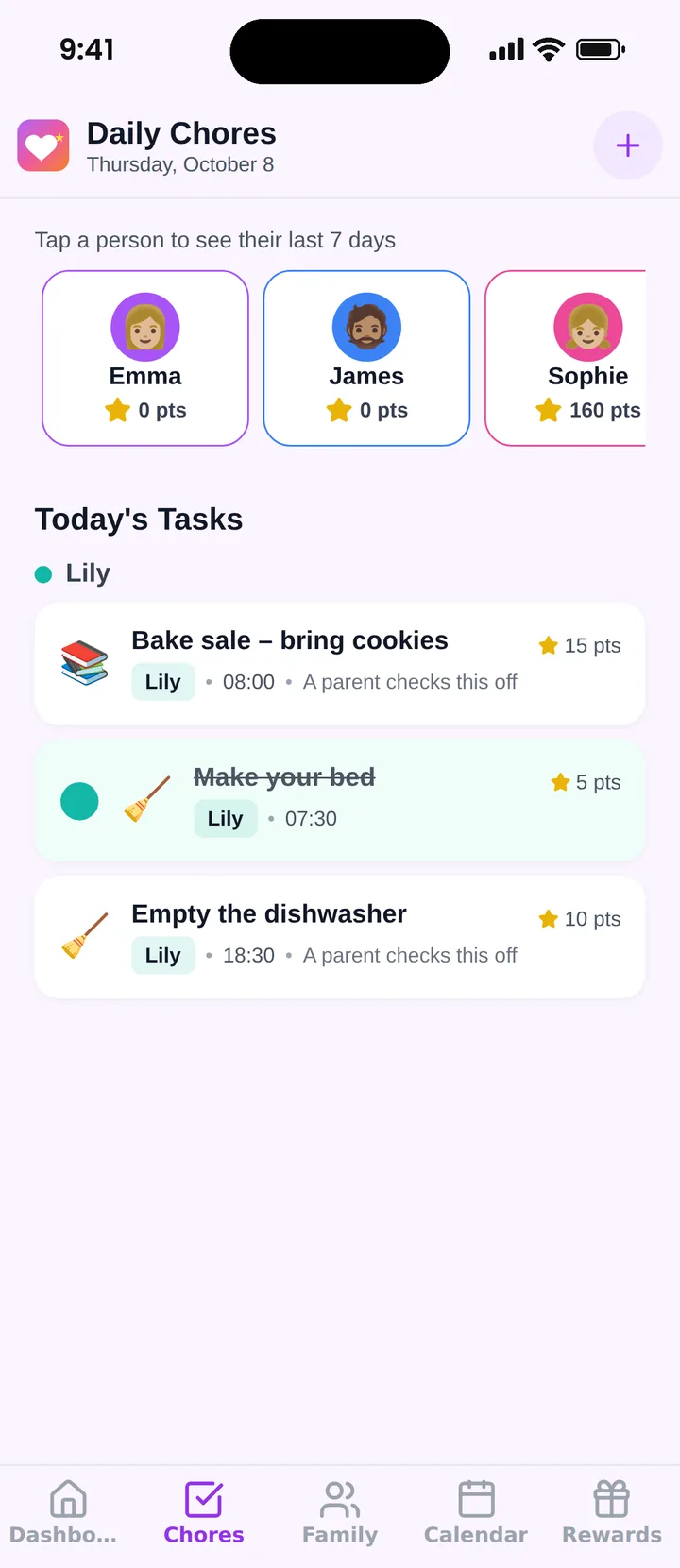
Famiyo is a free family app for iPhone and Android that combines a shared family calendar, chores with points and a rewards shop; kids join with a code, no email needed. You add each job once, set it to repeat and give it points. Your child gets a push notification when a task lands on their phone and checks it off themselves, or you approve it first, whichever you choose. You hear when it's done, so you stop asking.
If you're comparing options, see our list of the best chore apps for kids.
Pick one child and two jobs tonight. Write them down, say them once tomorrow, and see what happens by the weekend.
Frequently asked questions
Why won't my kids help around the house without being asked?
Most kids see the house as your department. If you do the noticing, planning and reminding, they only have to react. Hand over whole jobs with a clear finish line, and the noticing slowly becomes theirs too.
At what age should kids start helping around the house?
Around age 2 or 3, with jobs like putting toys in a bin or clothes in the hamper. Starting small and early makes helping ordinary. Starting at 12 is possible, but expect more resistance because the rules suddenly changed.
Should I pay my kids to help around the house?
Keep basic jobs unpaid, because they live here too. Pay or give points for extra jobs beyond the daily basics, such as washing the car. Many families use points that kids spend on rewards, so the daily jobs still feel like family business.
What do I do when my child just says no?
Stay calm and short. Say, 'The dishwasher is yours before dinner, and screens come after.' Then do not argue. The consequence is the order of the day, not a lecture. Talk about it later, when nobody is annoyed.
How many chores is too many for a child?
Two or three daily jobs for preschoolers and three or four for school-age kids is a sound start. If every day is a fight, you probably gave too many at once. Cut back, win a few weeks, then add one.
Try Famiyo With Your Family
Chores with points, a rewards shop for kids and one shared family calendar. Set it up in a couple of minutes.



Free to download • No credit card required • Available on iOS & Android