Teaching Kids to Cook: An Age-by-Age Guide
Teaching kids to cook, age by age: which kitchen jobs fit ages 2 to 14, when to hand over knives and the stove, first recipes, and how to make it a weekly habit.
By Famiyo Editorial Team6 min read
Teaching kids to cook sounds lovely until you're standing next to a 6-year-old who is cracking egg number three onto the counter. It's slower than doing it yourself, it's messier, and on a Wednesday at 6 p.m. it can feel impossible. It's also one of the few chores that turns into a real life skill and, eventually, a night off for you. This guide covers what kids can do in the kitchen at each age, when to hand over knives and heat, and how to make cooking a regular job instead of a once-a-year pancake event.
What kids can do in the kitchen at each age
Ages here are rough. A careful 7-year-old may be safer with a knife than a distracted 10-year-old. Watch the child, not the calendar.
| Age | Kitchen jobs they can do | First "recipe" |
|---|---|---|
| 2 to 3 | Wash produce in a bowl of water, tear lettuce, stir cold batter, pour pre-measured ingredients | Fruit salad you cut, they mix |
| 4 to 5 | Spread with a butter knife, mash bananas or potatoes, crack eggs into a separate bowl, set the table | Toast with toppings, yogurt parfait |
| 6 to 7 | Measure with cups and spoons, read a short recipe with help, peel with a Y-peeler, cut soft food with a kid knife | Quesadilla (you handle the pan), overnight oats |
| 8 to 9 | Make a simple snack alone, use a paring knife with supervision, stir and flip at the stove with you next to them, use the microwave | Scrambled eggs, pasta with jarred sauce |
| 10 to 12 | Cook a simple meal with an adult nearby, use the oven with mitts, follow a full recipe, plan one side dish | Tacos, sheet-pan chicken and vegetables |
| 13 and up | Plan and cook a family meal, write the grocery list, handle the stove and oven alone | A full dinner of their choice, once a week |
Notice that each stage keeps the earlier jobs. A 10-year-old cooking tacos still washes the lettuce. That's the point: skills stack.
The two scary parts: knives and heat
Most parents stall here, and fair enough. Nobody wants a trip to urgent care over a carrot. The trick is that both knives and heat can be taught in steps, so there's never one big terrifying handover.
Knives
- Butter knife on soft food: bananas, cooked potatoes, cheese slices. Ages 4 and up.
- Nylon or serrated kid knife on firmer food: cucumbers, strawberries, bread.
- Teach the claw grip. Fingertips tucked under, knuckles guiding the blade. Practice it on a banana until it's automatic.
- Teach the flat-side rule. Cut round things (onions, potatoes, apples) in half first, then put the flat side down so nothing rolls.
- Small, sharp paring knife with you at their elbow, usually around 7 to 9.
- Chef's knife for longer prep with you in the room, often by 11 or 12.
A sharp knife is safer than a dull one, because a dull blade slips. Don't hand a kid your oldest, worst knife as a "practice" knife.
The stove and oven
Start with jobs next to heat before jobs on heat. A 6-year-old can hand you the spatula and watch the pancakes bubble. An 8-year-old can stir the pan with you right beside them. Before a child cooks at the stove with you just in the room, they should be able to tell you:
- pot handles turn inward, away from the edge,
- a lid smothers a grease fire, and water never goes on one,
- oven mitts every time, even for "just a second",
- the burner goes off before you walk away.
Ask them to say those back to you. If they can, they're ready for the next step.
How to teach a cooking skill (without losing your mind)
You can't teach knife skills, measuring and timing all in one dinner. One skill per session. The rest of the meal you do yourself, or it's a bowl of cereal night and that's fine.
- Pick one skill for the week, like cracking eggs or using the peeler.
- Show it once, slowly, saying what you're doing. "Tap on the flat counter, not the edge of the bowl. Thumbs in the crack. Pull apart."
- Let them do it while you keep your hands off. This is the hard part. Sit on your hands if needed.
- Repeat the same skill three or four times that week, ideally in different dishes.
- Move on only when they can do it without you narrating.
What you say matters more than what you cook. "Too much salt, let me fix it" teaches them to hand the spoon back. "Taste it. What does it need?" teaches them to cook. Mistakes are fine as long as they're edible. Burnt toast is a lesson. Raw chicken is not, so teach the food safety basics early: wash hands after touching raw meat, keep a separate board for it and use a meat thermometer instead of guessing.
Expect it to fall apart sometimes. Soccer runs late, someone has a meltdown about onions, and the planned "kid cooks Thursday" becomes frozen pizza. That's not failure. Pick it back up next Thursday.
Making cooking a regular chore
A one-off baking project is fun. A standing job is what actually builds the skill. Once a child is around 8 or 9, give them a regular slot that grows with them:
- 8 to 9: makes their own breakfast on weekends and one simple snack a week.
- 10 to 12: cooks one side dish or one simple dinner a week with you nearby.
- 13 and up: owns one family dinner a week, from choosing the meal to cleaning the stovetop.
Make cleanup part of the job. "Cooking dinner" means the pans are washed and the counter is wiped, not that a tower of bowls appears in the sink for someone else. If you have more than one kid, rotating the cooking night keeps it fair, and our guide to chore rotation shows how to balance it across ages.
Boys and girls get the same kitchen jobs. Everybody eats, so everybody learns to cook. We explain why the same list matters in chores for boys and girls.
When your kid just doesn't want to cook
Some kids light up in the kitchen. Others would rather do the bathroom. A few things help with the second group:
- Let them choose the meal. Picking tacos over chili gives them a stake in it.
- Start with the parts they like. A kid who hates chopping might love running the pan.
- Keep it short. Twenty minutes of cooking is a win. Ninety minutes is a hostage situation.
- Don't hover or redo their work. If the pasta is a bit soft, eat the pasta.
If pressure makes things worse, a lighter touch tends to work better than consequences. Our piece on gentle parenting and chores has ideas for asking without a standoff.
Doing this with Famiyo
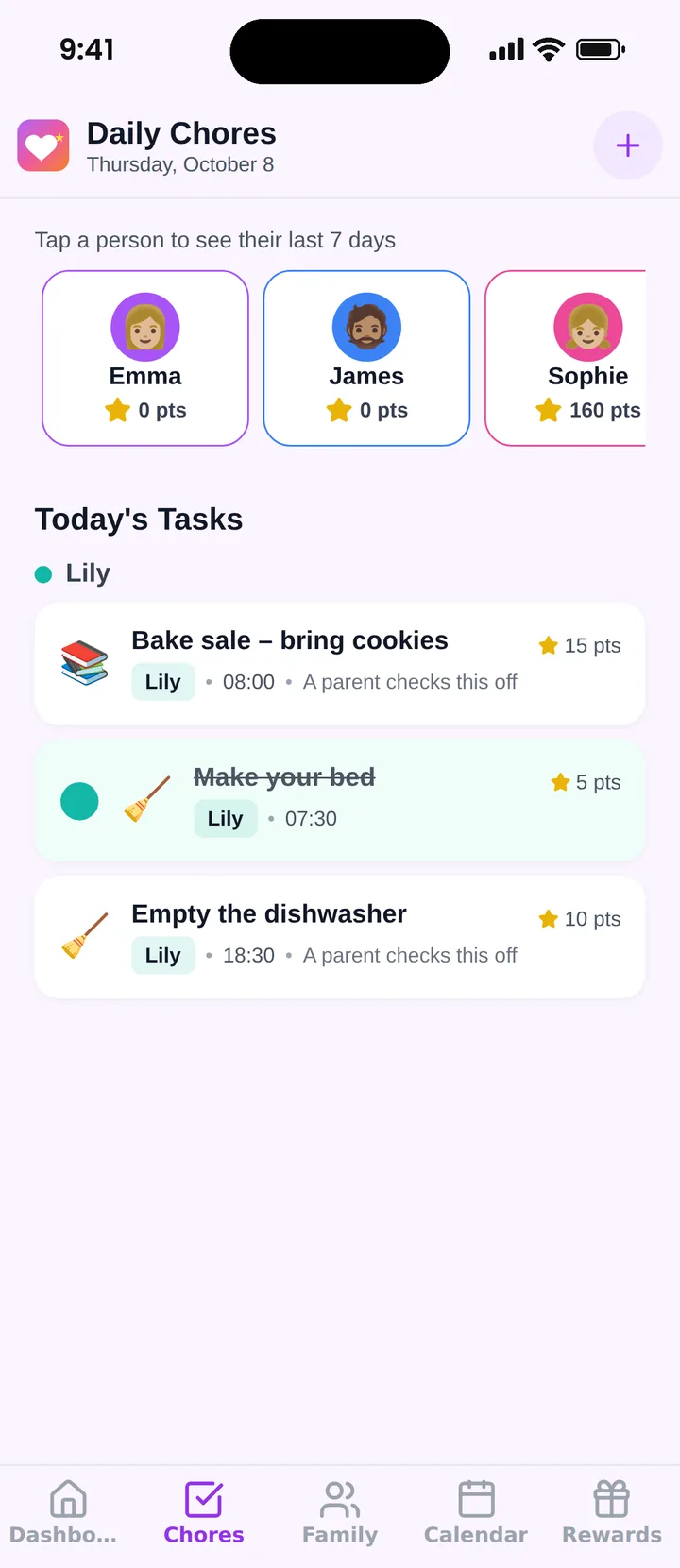
Famiyo is a free family app for iPhone and Android that combines a shared family calendar, chores with points and a rewards shop; kids join with a code, no email needed. Famiyo doesn't store recipes or plan meals, but it can stop you from being the one who reminds. Add "Cook Thursday dinner" as a repeating chore worth 20 points for your 12-year-old, and "Make weekend breakfast" at 10 points for your 8-year-old. Each child gets a push notification when a new task appears and sees it on their own phone. Since cooking includes cleanup, you might choose to approve the chore yourself after the counter is wiped. Points go toward rewards you set, like picking the family movie. For other options, see our list of the best chore apps for kids.
Pick one skill from your child's age row tonight, maybe cracking eggs or using the peeler, and let them do it three times this week before you add anything else.
Frequently asked questions
At what age can a child use a real knife?
Many kids can use a small, sharp paring knife with close supervision around 7 to 9, after practicing with a butter knife or a nylon kid knife. Readiness depends on focus and hand control more than age. Teach the claw grip and a flat-side-down cutting rule first.
When can kids use the stove on their own?
Most kids are ready to cook at the stove with an adult in the room around 10 to 12, and alone for simple meals around 13 or later. Before that, they can stir, flip and watch the pan with you right next to them. Teach handle-turning and what to do if oil catches fire.
What should a child cook first?
Start with something that has few steps and a clear finish: scrambled eggs, quesadillas, pasta with jarred sauce, a sheet-pan of roasted vegetables or overnight oats. Repeat the same recipe three or four times before adding a new one, so the skill sticks instead of the recipe card doing the work.
How do I teach cooking without a huge mess?
Set everything out before you start, use a tray or rimmed baking sheet as the work area, and give one task at a time. Make cleanup part of the recipe, not a separate chore afterward. Expect some mess anyway: it's the cost of the lesson, and it shrinks with practice.
Try Famiyo With Your Family
Chores with points, a rewards shop for kids and one shared family calendar. Set it up in a couple of minutes.



Free to download • No credit card required • Available on iOS & Android