How to Get Kids to Do Chores: 12 Strategies That Work
12 practical ways to get kids to do chores without a nightly fight: smaller lists, clear finish lines, fixed times and what to say when they stall.
By Famiyo Editorial Team5 min read
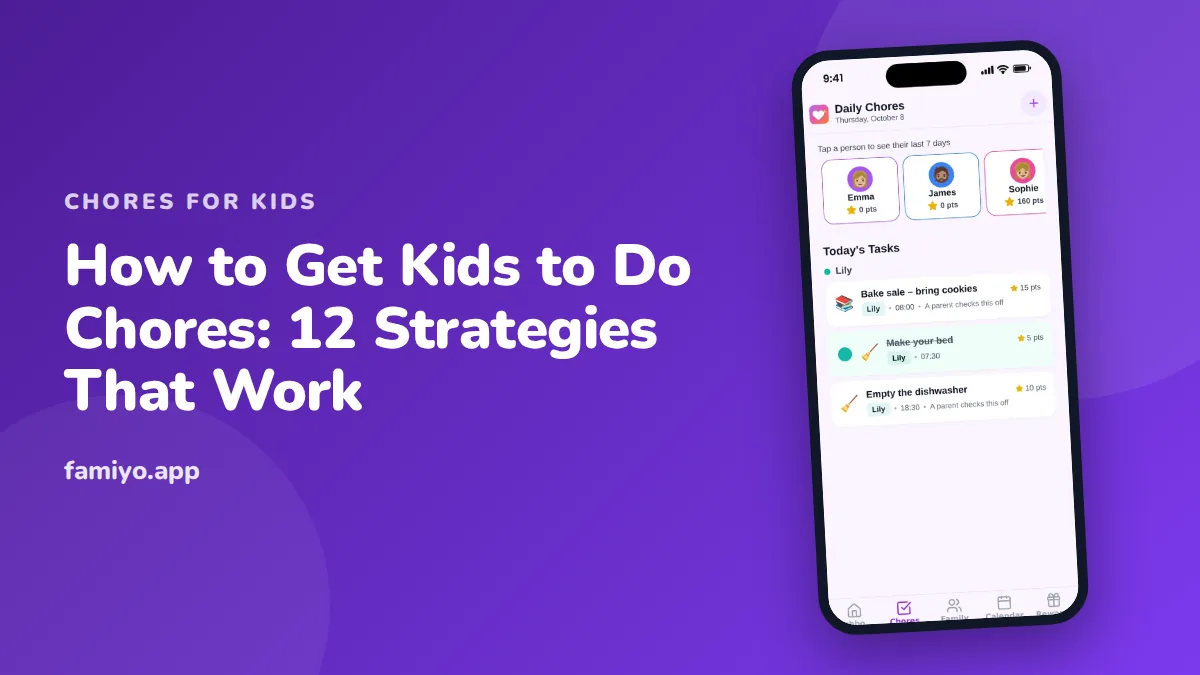
Here's the honest version: kids don't do chores because they love them. They do them because the job is clear, the timing is predictable, and the adult isn't a moving target. Wednesday will still be a mess. Someone will cry over a sock. But the 12 strategies below make the good days more common and the bad days shorter.
Why kids say no in the first place
Before the strategies, it helps to know what you're up against. Usually it's one of four things. The job is too big ("clean your room" is a mountain). The job is unclear (nobody said what done means). The timing is random (you spring it on them mid-game). Or the chore has no connection to anything they care about.
All four are fixable, and none of them means your child is lazy. If you want the longer diagnosis, see why kids don't want to do chores and what helps.
12 strategies, in the order to try them
1. Cut the list in half
If chores are a daily fight, you've probably assigned too many. Start with two or three tasks for a young child and three or four for a school-age one. You can add more once the first ones run on their own.
2. Break the big job into steps
"Clean your room" becomes: clothes in the hamper, books on the shelf, toys in the bin, bed made. Four steps, each with an obvious end. For a younger child, three steps is plenty.
3. Say what done looks like
Write it in one sentence and hold to it. "The table is done when it's wiped and the chairs are pushed in." You can't be annoyed about a standard they never heard.
4. Teach it first
Do it together a few times before expecting it alone. Show, do it side by side, then step back. Kids rarely do a chore badly on purpose. Mostly they were never shown.
5. Tie each job to a moment that already exists
After breakfast, the plate goes to the counter. Before screens, the school bag is packed. Anchoring a chore to something that happens anyway removes the daily decision about when.
6. Make the list visible
A list on the fridge or an app on their own phone works far better than "I told you this morning." The list becomes the one saying what's next, which takes you out of the nagging role.
7. Give choices that all lead to done
"Do you want to do the table or the trash first?" Both get done. Two options hand your child some control, and control is most of what a stalling 7-year-old is after.
8. Count effort with points
Points make a small job visible and let kids see progress. A sensible default: 5 points for a small task of 2 to 5 minutes, 10 for a medium one, 20 for a big one, and 2 extra for doing it without a reminder. Then let those points buy something that matters to them. Our guide to making a chore chart covers a version you can set up in an evening.
9. Make rewards come fast enough
A reward that's three weeks away won't move an 8-year-old on a Tuesday. Aim for a small reward every 2 to 3 days, such as 15 extra minutes of screen time at 30 to 50 points, and save a big one for every 3 to 4 weeks.
10. Do your part out loud
Kids notice who's doing what. Do your own chore in the same window, and say so: "I'm folding towels, you're unloading the dishwasher, then we're both done." Working in the same room turns a punishment into a shared task.
11. Keep your voice flat
Yelling makes the argument about you. Say it once, calmly, and name the next step. If this is your weak spot, our piece on getting kids to do chores without yelling has scripts.
12. Follow through the same way every time
If screens come after chores on Monday, they come after chores on Thursday. Inconsistency teaches kids that pushing back sometimes works, so they push back every time.
What to say when your child stalls
Try these words, in roughly this order.
- "What's next on your list?" This makes your child say the job out loud.
- "I'll set a timer for 10 minutes and we'll see how much gets done." It turns an open-ended task into a game.
- "Screens come on when the dishwasher is empty." State the order, not a threat.
- "I can see that's a lot today. Which one do you want to start with?" Use this one when they're tired or overwhelmed, not when they're stalling.
Don't redo their work while they watch. If it's not quite right, show one fix and let it go. Perfect isn't the goal. Done, and done again tomorrow, is.
When chores fall apart anyway
They will, usually in week two. The novelty wears off, there's a sick day, someone's grandparent visits. That's the moment to shrink the list, not to scrap it. Drop back to one or two jobs for a few days and build up again. A routine needs 2 to 3 weeks of steady use before you can judge it, so a messy second week isn't a verdict.
If your child is under 5, adjust your expectations accordingly: a few minutes and a lot of help. Our list of chores for 4-year-olds gives realistic jobs for that stage.
Letting an app do the reminding
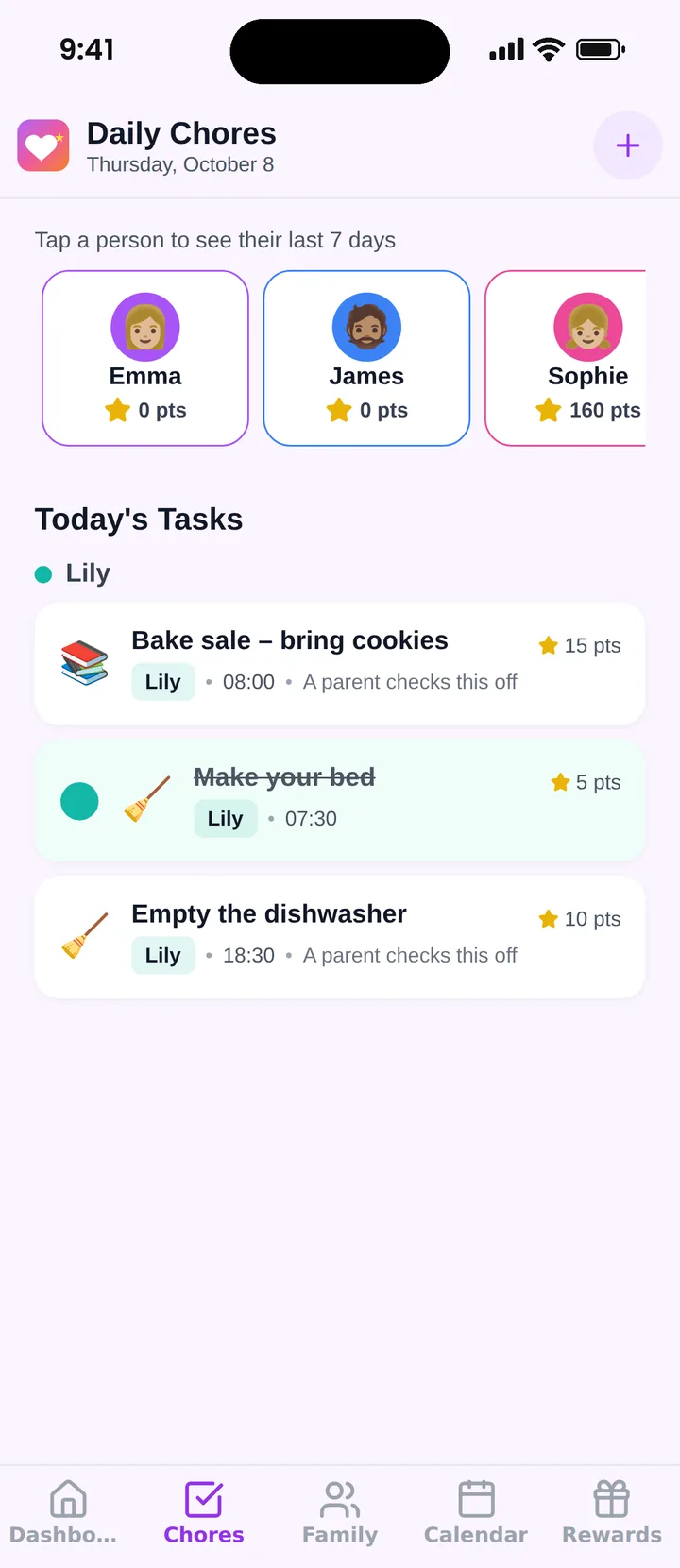
Famiyo is a free family app for iPhone and Android that combines a shared family calendar, chores with points and a rewards shop; kids join with a code, no email needed. For this problem, the useful part is that the app does the nagging for you. Kids get a notification when a new task is assigned, they see their own tasks and points on their own phone, and they check them off themselves, or you approve each one first. You get a notification when a chore is done, so you don't have to go and check.
If you're weighing tools, our list of the best chore apps for kids compares your options.
Tonight, pick one chore, one moment in the day to attach it to, and one sentence that says what done looks like. Start there and leave everything else for next week.
Frequently asked questions
How do I get my child to do chores without nagging?
Move the reminder out of your mouth. Tie each chore to a fixed moment, put it on a visible list or in an app, and let the list say what's next. Ask one question, like 'What's on your list?', instead of repeating the instruction.
What do I do when my kid flatly refuses?
Stay calm, repeat the expectation once, and name the next step: 'The dishwasher gets emptied before screens.' Then follow through without a lecture. Check later whether the job is too big or unclear, since that is the usual cause.
Should I pay my kids to do chores?
Keep basic family jobs unpaid and use points or small privileges to mark effort. Pay only for extra jobs, roughly $0.25 to $1 for a small one and $2 to $5 for a big one, so chores don't turn into a negotiation.
How long before chores become a habit?
Give any new routine 2 to 3 weeks of consistent use before judging it. Expect a wobble in week two, when the novelty wears off. Keep the list short and the timing the same, and it usually settles.
Try Famiyo With Your Family
Chores with points, a rewards shop for kids and one shared family calendar. Set it up in a couple of minutes.



Free to download • No credit card required • Available on iOS & Android