How to Motivate a Child With ADHD to Study: 8 Practical Steps
How to motivate a child with ADHD to study: shorter work blocks, immediate small rewards, a clear start and fewer fights, plus a sample homework hour.
By Famiyo Editorial Team5 min read
It is 5 p.m., the backpack is on the floor, and a ten-minute worksheet has turned into an hour of arguments, snacks and sudden bathroom trips. If your child has ADHD, this is not a character flaw and it is not a sign that you are doing it wrong. Studying asks for exactly the skills ADHD makes harder. Below is what tends to help, why, and how to build it into an ordinary week.
Why studying is harder with ADHD
ADHD is a difference in executive function, the set of skills that help a person plan, start, switch tasks, and keep going when something is boring. Homework needs all of them at once. A child may understand the material perfectly and still be stuck on "where do I begin?"
Reward timing matters too. Many children with ADHD respond more to what is happening now than to a payoff far away, which is why "you'll get a good grade in June" does almost nothing, while "five minutes of your game after this page" can work. The CDC and the American Academy of Pediatrics both point to behavior strategies like clear routines and frequent, immediate positive feedback as part of managing ADHD at home and school.
This article is practical advice, not a diagnosis or treatment plan. If homework is a daily struggle, talk to your child's pediatrician, school counselor or therapist, and ask whether the school can offer supports such as extra time or chunked assignments.
Eight steps that tend to help
- Agree on a start time and place. Same spot, same hour, ideally after a snack and 20 to 30 minutes of movement. A predictable setup cuts the daily negotiation.
- Clear the desk. Phone out of the room, only the materials for this task. Visual clutter competes for attention.
- Write the first step down. Not "do math." Write "open the book to page 42" and "do problems 1 to 3." A concrete first action is much easier to begin.
- Start with something easy. A quick win builds momentum. Put the longest or hardest task in the middle, not first and not last.
- Use a timer. Ten to 15 minutes for younger kids, 20 to 25 for older ones, with a 3 to 5 minute break that involves moving. Let the child see the timer.
- Reward each block, quickly. A point, a check mark, or a few minutes of something they like, given right after the block. More on this below.
- Praise the effort, specifically. "You kept going even when the fractions got annoying" beats "good job."
- Stay close, but don't hover. Sit in the same room doing your own task. Body doubling, as it is sometimes called, helps many kids, as long as you are not correcting every line.
A sample homework hour
Here is how that might look for a 4th grader with 40 minutes of work.
| Time | What happens | Reward |
|---|---|---|
| 4:30 | Snack, run around outside | None, this is the reset |
| 4:45 | Block 1: spelling words, 12 minutes | 5 points |
| 4:57 | Movement break, 4 minutes (jumping jacks, get water) | None |
| 5:01 | Block 2: math problems, 12 minutes | 5 points |
| 5:13 | Break, 4 minutes | None |
| 5:17 | Block 3: read a chapter, 10 minutes | 5 points, +2 if no reminder |
| 5:27 | Pack the bag for tomorrow | 5 points |
At the end, that is 20 to 22 points. At the Famiyo default of 30 to 50 points for 15 extra minutes of screen time, a child could afford a small reward every two or three days. That pace is what keeps it interesting.
How to make rewards work
Rewards help when they are small, immediate and predictable, and they stop helping when they feel like a trap. A few rules.
Give the reward for the block, not the grade. A child with ADHD can work hard and still miss answers. If you only reward results, effort goes unrewarded and motivation drops.
Keep the menu varied. The same reward loses its pull in a couple of weeks. Rotate a few options: extra screen time, choosing dinner, a bike ride with a parent, a friend over.
Never take earned points away as punishment. It breaks trust and makes the system feel unfair. If a day goes badly, the child simply earns fewer points.
Expect to adjust. If your child hits every target easily, make the blocks a little longer. If they are missing most, shorten them. For more on how this fits into the bigger picture, our article on how to motivate a child with ADHD goes beyond homework.
What to say, and what to skip
Words matter at 5 p.m. Some that tend to work:
- "What's the first tiny step?"
- "Let's set the timer for 12 minutes and see what you can get done."
- "I'll sit here while you start."
- "You've done two. One more and then your break."
And a few worth skipping: "You could do this if you just tried," "Why is this so hard for you?" and "Your brother never has this problem." They add shame, and shame makes starting even harder.
If motivation is low across many subjects, not only homework, our guide to how to motivate kids to study covers general approaches. If reading specifically is the battle, see how to motivate kids to read.
Setting up the rewards in Famiyo
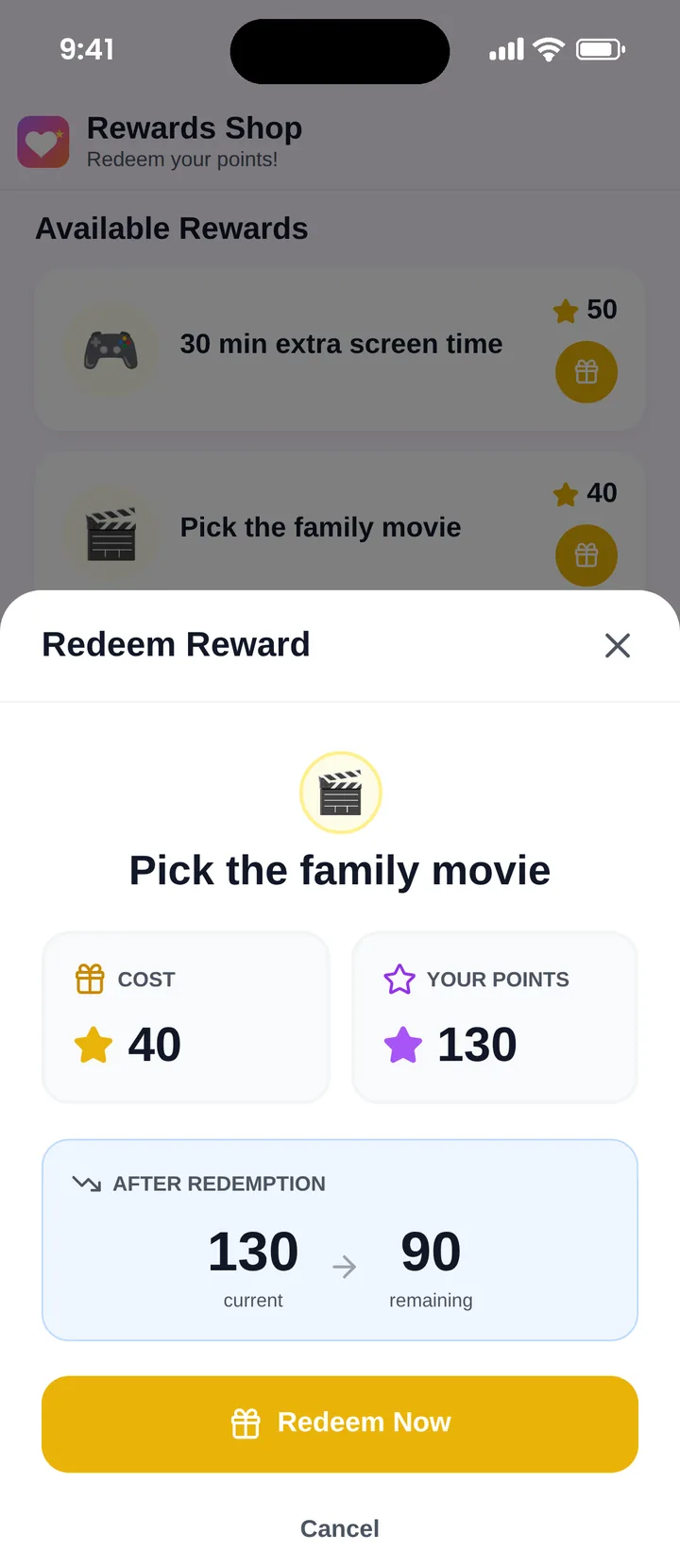
Famiyo is a free family app for iPhone and Android that combines a shared family calendar, chores with points and a rewards shop; kids join with a code, no email needed. For study routines, make each homework block a task worth points, then stock the rewards shop: you set the price in points, how many are available and when. Your child redeems from their own phone and sees how many points they will have left, so the payoff is visible right away. Rewards can have limits, which keeps a favorite from being claimed every day. For other tools, see our list of the best reward chart apps for kids.
Start this week
Pick one subject, one 10 to 15 minute block and one small reward. Run it for two or three weeks, since a new routine needs that long before you can judge it. Change one thing at a time. If it still feels like a fight after that, bring your notes to the pediatrician or the school.
Frequently asked questions
Why can't my child with ADHD just start studying?
Starting is often the hardest part. ADHD affects executive function: planning, getting going and holding attention on something that isn't interesting. It isn't laziness or defiance. A clear first step and a short timer lower the barrier to starting.
How long should a child with ADHD study at a time?
Short blocks work better than long ones. Many families use 10 to 15 minutes for younger children and 20 to 25 for older ones, followed by a 3 to 5 minute break. Adjust to what your child can actually sustain, not the clock.
Do rewards work for kids with ADHD?
Often yes, when they are small, immediate and predictable. Rewards that are weeks away tend to lose their pull. Many pediatricians and behavior therapists recommend frequent, small rewards as part of an overall plan.
Should I take away screens if homework isn't done?
Using screen time as a reward after homework works better than removing it as a punishment. A clear rule like 'homework block, then screens' is predictable. Taking screens away after a bad night often leads to more conflict and less work.
Try Famiyo With Your Family
Chores with points, a rewards shop for kids and one shared family calendar. Set it up in a couple of minutes.



Free to download • No credit card required • Available on iOS & Android