Why Kids Should Not Get Paid for Chores (and When They Should)
The case that kids should not get paid for chores, where it breaks down, and a split that works: unpaid family jobs, paid extras, and an allowance for money lessons.
By Famiyo Editorial Team6 min read
"Do I pay my kid to unload the dishwasher?" Most parents land on one of two camps within the first few minutes of searching. Some say pay for everything, because that is how the real world works. Others say pay for nothing, because nobody pays you to be a member of a household.
Both camps have a point. This guide lays out the case for not paying kids for chores, tests it against what happens in real homes, and ends with a setup that borrows the best from both. If you only want the pros and cons, our page on whether kids should get paid for chores is the short version.
The case for not paying kids for chores
The core argument is about what a chore is. Making your bed, clearing your plate and putting laundry in the hamper are not jobs. They are the ordinary upkeep of a place where you live. Adults do not invoice their families for cooking dinner. Children who learn that helping is simply what people in a family do tend to carry that idea into adulthood.
Here are the arguments that come up most.
Pay can crowd out helping. If a child is paid for taking out the trash, helping becomes a deal, and a deal can be turned down. The moment they have enough money, the incentive to help is gone. A child who is not paid has no such off switch.
It teaches the wrong price list. Paying $2 for something that takes 5 minutes and $0 for something else sets up questions you did not mean to raise. Why is my sister paid more? Why do I get nothing for walking the dog?
It can swallow your bargaining power. Once tasks have a price, every request becomes a negotiation: "How much for the living room?" Parents describe it as having to pay for cooperation.
It muddles two separate lessons. Chores teach responsibility and contribution. An allowance or other money practice teaches saving, spending and budgeting. Tying them together means that when a child skips chores, they also skip the money lesson.
Quality gets worse over time. Some kids start doing the minimum for the money. Others stop caring about a standard that was never about the money to begin with.
These are real patterns, and many families see them. They are also not universal, which brings us to the other side.
Where the "never pay" argument breaks down
Not paying for chores is a good default. It is not a law, and a few things get in the way.
Kids need some practice with money. If chores are unpaid and you do not give an allowance either, a child gets very little hands-on time with money. A 10-year-old who has never decided between saving and spending will be less ready at 16.
Some jobs really are extra. Washing the car, raking the whole yard or clearing the garage are not part of a typical child's daily load. Paying for them is closer to a first job than a wage for being a family member, and it can teach that extra effort earns extra reward.
Teenagers sometimes need a way to earn. A teen who wants a larger purchase can reasonably take on bigger jobs. Our guide to paid chores for 9-year-olds shows how the extras scale as children grow.
Pure unpaid duty does not suit every child. Some respond well to a clear incentive, and a few need it to get started on a task they find hard. That is fine as long as the system does not swallow the basics.
A split that works: three buckets
Most families who like the "no pay" argument but still want money lessons end up with three separate buckets.
| Bucket | What goes in it | Paid? |
|---|---|---|
| Family jobs | Daily basics: make the bed, clear your plate, put laundry in the hamper, feed the pet | No |
| Extra jobs | Clearly beyond the basics: wash the car, rake the yard, clean the garage | Yes, small amounts |
| Allowance | A regular amount for money practice, not linked to chores | Yes, same each week |
For the extra jobs, typical amounts are $0.25 to $1 for a small extra and $2 to $5 for a big one. For the allowance, a common rule of thumb is $1 per week for each year of age, so an 8-year-old gets $8, with typical ranges of $3 to $7 at ages 5 to 7, $7 to $10 at ages 8 to 10, $10 to $15 at ages 11 to 13 and $15 to $25 from 14. It is a starting point, not a standard.
For younger children, a simple split into spend, save and give, for example 50%, 40% and 10%, makes the allowance teach something. For more on that, see our guide to teaching kids money management.
The key rule is that the daily family jobs stay unpaid and stay expected. The allowance is not a salary, and it is not taken away when a chore is missed. If a chore is missed, the consequence is about the chore: it still needs doing, probably before screens or an outing.
What to say when a child asks "how much will you pay me?"
Short, calm and repeatable works best. Scripts you can adapt:
- For a daily chore: "That one is part of living here, so it's not paid. Everyone in the family does their share."
- For a real extra: "That's a bigger job. I'll pay $3 if you do the whole car, inside and out. Want it?"
- For a negotiation: "The price is set. You can say yes or no."
- For a child who says they will skip it: "You can skip the paid extra. The daily one still needs doing."
Do not pay on the spot to stop a complaint. That teaches that complaining works.
Points as another option
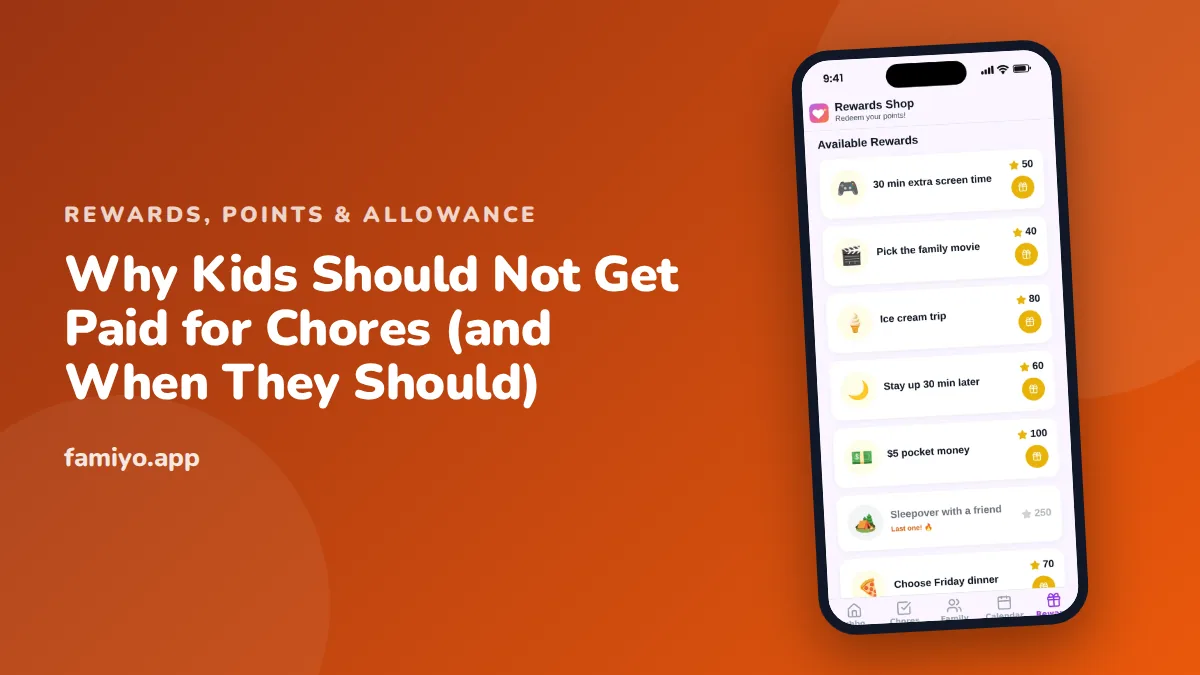
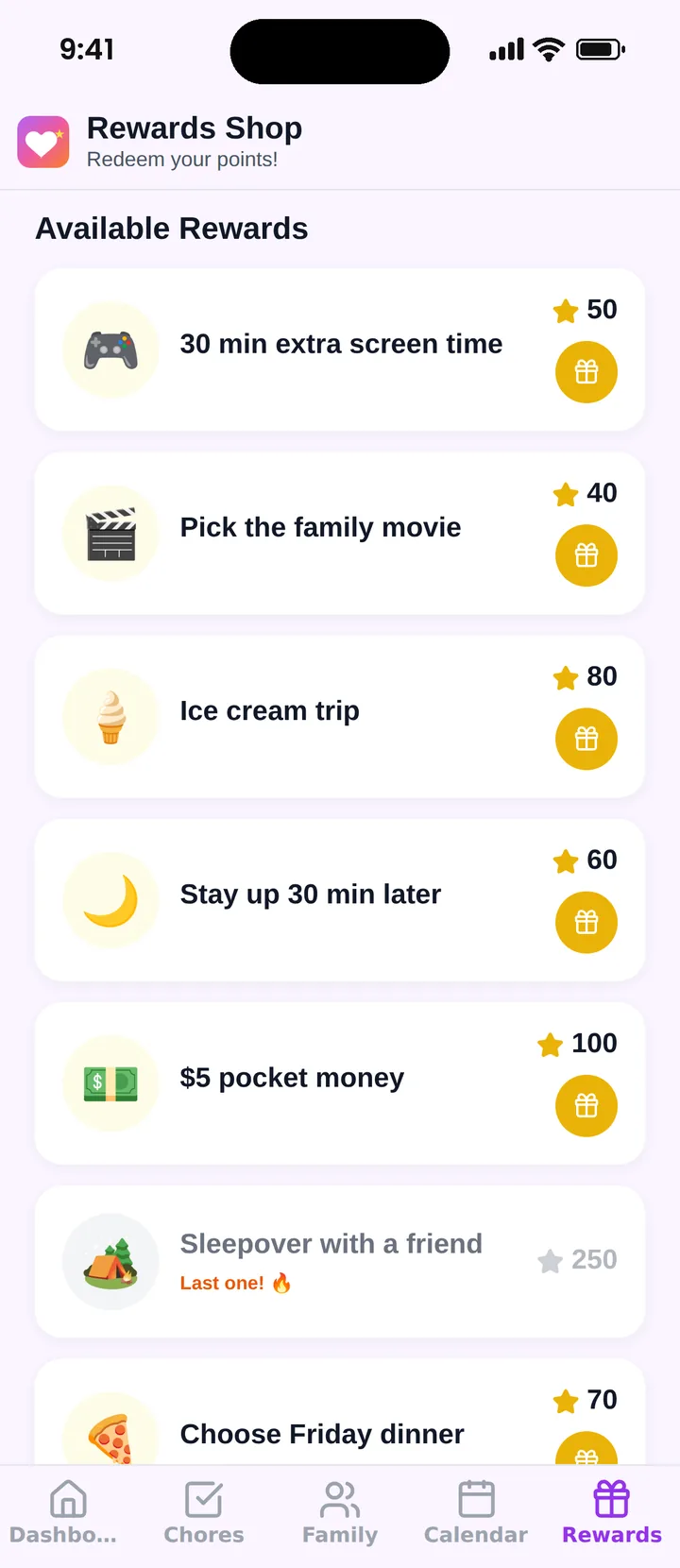
If you want kids to feel they earn something without wages, points are a useful middle route. The child earns points for jobs and spends them on rewards you choose: extra screen time, a pick of the family movie, a day out. That feels like earning, and it keeps the household work separate from cash. Our chore point system guide shows how many points a chore should be worth.
If you want to convert points into money for some purpose, a simple rate is 100 points to $1. Many families skip this step and keep points and money apart.
For a look at what the research and the debate say about whether rewards help or hurt a child's own motivation, see our article on whether a reward system is good or bad for kids.
How to do this in Famiyo
Famiyo is a free family app for iPhone and Android that combines a shared family calendar, chores with points and a rewards shop; kids join with a code, no email needed. The app handles the points side of the three buckets. Daily family jobs can be listed as chores with no points or a few, and extras can carry more. In the rewards shop, you set up rewards with a price in points, how many are available and when, and children redeem from their own phone. Pocket money can be one of the rewards, but the money itself changes hands outside the app, because Famiyo does not hold or move real money. Compare tools in our list of the best allowance apps for kids.
Make the decision once
Write your three buckets on a sheet and share it with both parents. List which jobs are family jobs, which are paid extras and what the allowance is. Tell the children at a calm moment, not mid-argument. Review it in a few months, because a rule that suits a 6-year-old will need changing at 9.
Frequently asked questions
Why shouldn't kids get paid for chores?
Because chores are how family members share the work of a home. If every task has a price, kids may learn to help only when the pay is right, and they can simply decline when they don't need the money.
Should kids get paid for any chores?
Many families pay for extra jobs beyond the daily basics, such as washing the car or raking leaves. Typical amounts are $0.25 to $1 for a small extra and $2 to $5 for a big one. Basic family-member chores stay unpaid.
If I don't pay for chores, how do kids learn about money?
Give a small regular allowance that is not tied to chores. The typical rule of thumb is $1 per week for each year of age. Kids can then practice saving, spending and giving without chores being the price.
What if my child says 'I won't do it unless you pay me'?
Stay calm and say the job is part of living here, so it is not for sale. Offer a paid extra if one exists, and keep the daily chore expected. Do not negotiate on the spot.
Can points replace pay for chores?
Yes. Points that kids spend on rewards you choose, such as screen time or a family movie pick, give a sense of earning without turning household work into a wage. Pocket money can be one of the rewards.
Try Famiyo With Your Family
Chores with points, a rewards shop for kids and one shared family calendar. Set it up in a couple of minutes.



Free to download • No credit card required • Available on iOS & Android