How to Create a Reward System for Kids in 5 Steps
Build a reward system for kids in 5 steps: pick behaviors, choose points, price rewards, set rules and review after 3 weeks. Includes a price table and examples.
By Famiyo Editorial Team5 min read
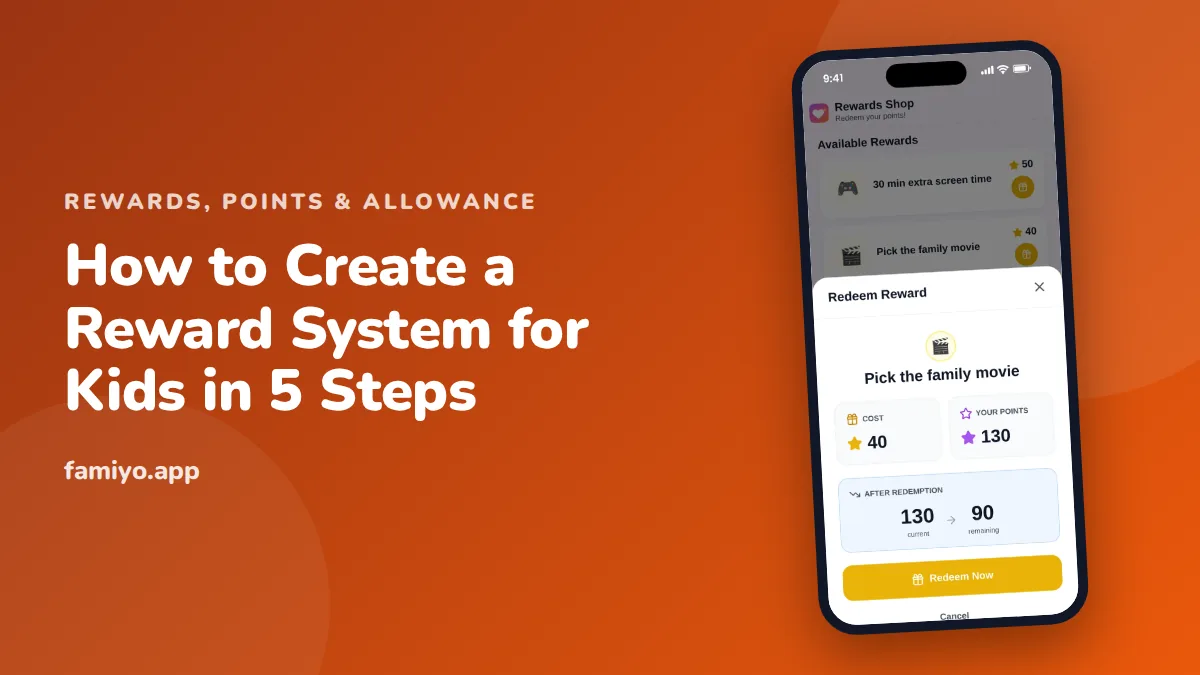
Most reward systems fail for ordinary reasons. The rewards are too far away, the rules change when a parent is tired, or the list of things to earn points for is so long nobody can remember it. The good news is that a working system needs only five decisions. Here they are in order, with the reasoning behind each so you can adapt them to your own kids.
Why the design matters more than the prizes
Behavioral research has long found that behavior followed by something a child values tends to be repeated, and the American Academy of Pediatrics' parenting guidance favors praise and rewards for wanted behavior over punishment. What the research can't tell you is how to set the details for your child, and the details are where systems live or die. Timing, size, clarity and consistency matter more than whether the prize is a sticker or a movie night.
A system also shouldn't be the whole of your parenting. Treat it as scaffolding: it helps a new habit stand up, then you reduce it. How quickly that happens depends on the child.
Step 1: Choose 3 to 5 specific behaviors
Start with what you actually want to see more of. Be specific enough that a stranger could tell whether it happened.
| Vague | Specific |
|---|---|
| Be good | Use a calm voice when asked to stop a screen |
| Help around the house | Empty the dishwasher before dinner |
| Be responsible | Pack the school bag the night before |
| Do homework | Start homework by 4:30 and finish it before dinner |
Pick behaviors a child can really do. If your 6-year-old can't yet fold laundry, it doesn't belong on the list. For ideas by age, see our token system for kids' behavior, which goes deeper on choosing targets.
Aim for positive wording ("keep hands to yourself") over "don't" statements. Children earn points for doing something, not for the absence of trouble.
Step 2: Choose a currency and assign points
Points work better than stickers for children over about 5, because they can be saved, spent and compared. Start with the same scale for everything and keep it small:
| Task size | Example | Points |
|---|---|---|
| Small (2 to 5 minutes) | Make the bed, feed the pet | 5 |
| Medium (10 to 15 minutes) | Empty the dishwasher, tidy the room | 10 |
| Big (30 minutes or more) | Clean the bathroom, mow the lawn | 20 |
| Bonus | Done without a reminder | +2 |
The bonus matters. It rewards the exact thing you're after, a child acting before being asked, and it makes the independent version of the task worth more than the nagged version.
Step 3: Price the rewards so they're reachable
The most common design mistake is setting prices too high. A child who can't see a reward coming within a few days loses interest, and young children can't wait a month for anything. Aim for a child to afford a small reward every 2 to 3 days and a big one every 3 to 4 weeks.
| Reward size | Examples | Price |
|---|---|---|
| Small | 15 extra minutes of screen time, choose dessert | 30 to 50 points |
| Medium | Pick the family movie, stay up 30 minutes later | 100 points |
| Big | A day out, a toy around $20 | 300 to 500 points |
Let your child help choose the menu. A reward they picked is worth more to them than one you assumed they'd like. Mix prices so there's always something nearby to aim for, and include experiences with you (a bike ride, baking together), which often matter more than objects.
If you also pay allowance, keep it separate from the system, or convert points at a fixed rate such as 100 points to $1. Our guide on how much allowance by age covers that choice.
Step 4: Write the rules, and keep them boring
Write down a few rules and post them where everybody can see. A good set looks like this:
- Points are earned only for the listed tasks, and each is worth the same every time.
- A task is done when it meets the "done" description, agreed in advance.
- Points are never taken away as punishment. Misbehavior gets a separate, calm consequence.
- Rewards are spent when the child chooses, within the dates and limits you set.
- A parent keeps their word, even on a bad Tuesday.
Rule 3 is the one that most often breaks systems. Taking earned points away feels like punishment for something done earlier, and children quickly stop trusting the currency. If you need a consequence, give it separately.
If your child has ADHD or is autistic, shorter steps, faster rewards and visuals usually help. See our guide to a token system for kids with ADHD, and check with your child's pediatrician or therapist about what suits them.
Step 5: Review after two to three weeks
New habits need two to three weeks of consistent use before you judge them. Then ask three questions.
- Are they earning something every day or two? If not, lower prices or simplify tasks.
- Are they earning everything instantly? Raise the bar a bit or add a harder job.
- Are they still interested? If the menu feels stale, swap in new rewards chosen together.
Change one thing at a time. If you modify behaviors, points and prices in one go, you won't know which change helped. After a couple of months, many families gradually add praise, shrink the list and let the habit carry itself.
Setting it up in Famiyo
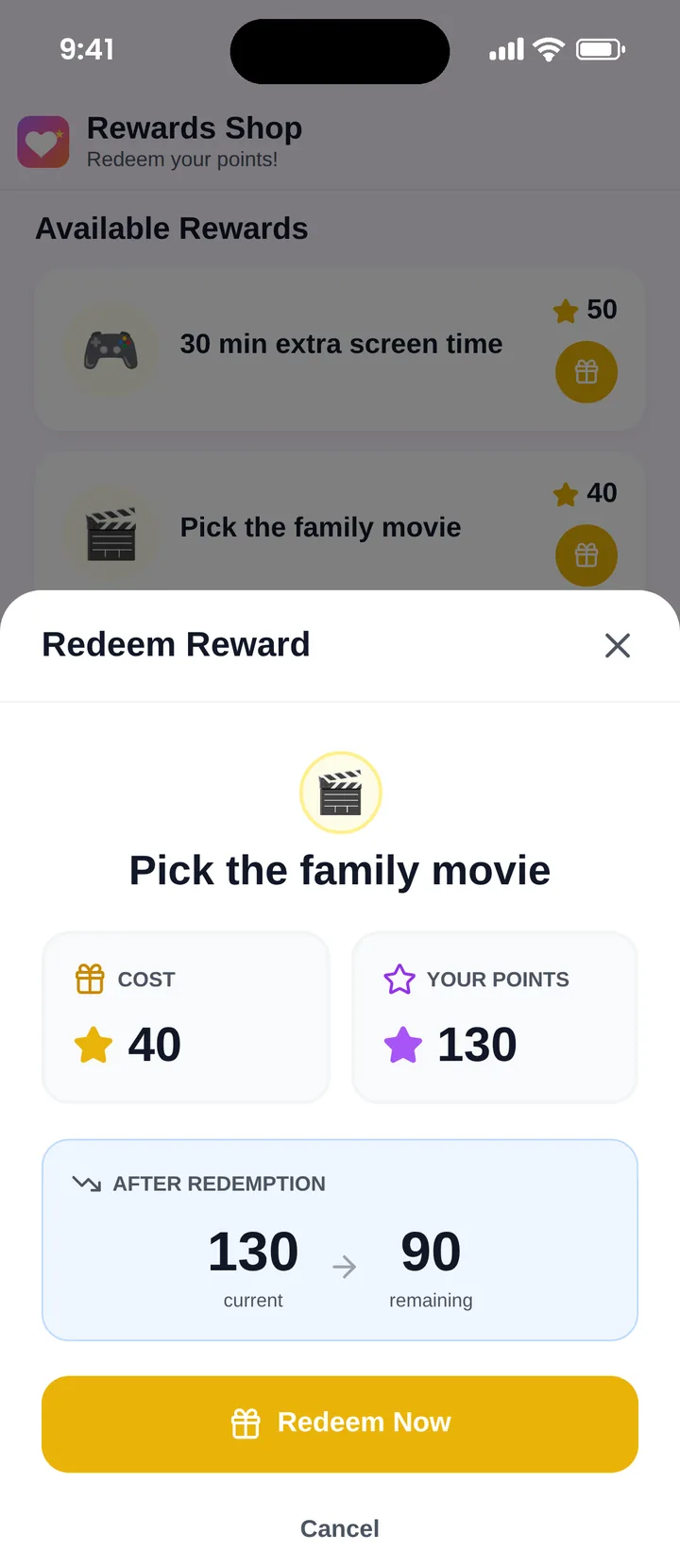
Famiyo is a free family app for iPhone and Android that combines a shared family calendar, chores with points and a rewards shop; kids join with a code, no email needed. In the rewards shop you create each reward with a price in points, how many are available and when. Kids redeem from their own phone, and the screen shows what the reward costs and how many points they will have left, which makes saving a visible choice. You can see all of it in our guide to the best reward chart apps for kids.
Start with one week
Write your 3 to 5 behaviors and 6 rewards on one sheet of paper tonight. Tell your child what they can earn and what's on the menu, then keep to it for a full week before changing anything.
Frequently asked questions
What are the steps to make a reward system for kids?
Choose a few specific behaviors, assign points, set reward prices so small rewards are quick to earn, write rules everyone understands, and review after two to three weeks. Change one thing at a time when adjusting so you can see what made the difference.
How many behaviors should a reward system track?
Three to five is plenty. Preschoolers do better with two or three. A long list spreads attention thin and makes it hard for a child to see what earns the most progress. Add new behaviors only after existing ones become habits.
What are good rewards that don't cost money?
Choosing the family movie, extra time at bedtime, picking dinner, a game night, one-on-one time with a parent or 15 extra minutes of screen time. Experiences and choices often motivate children longer than small toys, and they cost nothing.
How long should a reward system last?
Give it two to three weeks of consistent use before judging it. Many families keep points for months, then slowly lean on praise and habit as behaviors become routine. Revisit the list every month or two as your child grows.
Try Famiyo With Your Family
Chores with points, a rewards shop for kids and one shared family calendar. Set it up in a couple of minutes.



Free to download • No credit card required • Available on iOS & Android