How to Teach Kids Financial Responsibility
Teach kids financial responsibility with an age-by-age plan: small allowance, spend-save-give jars, real choices and mistakes, plus how to handle digital money.
By Famiyo Editorial Team5 min read
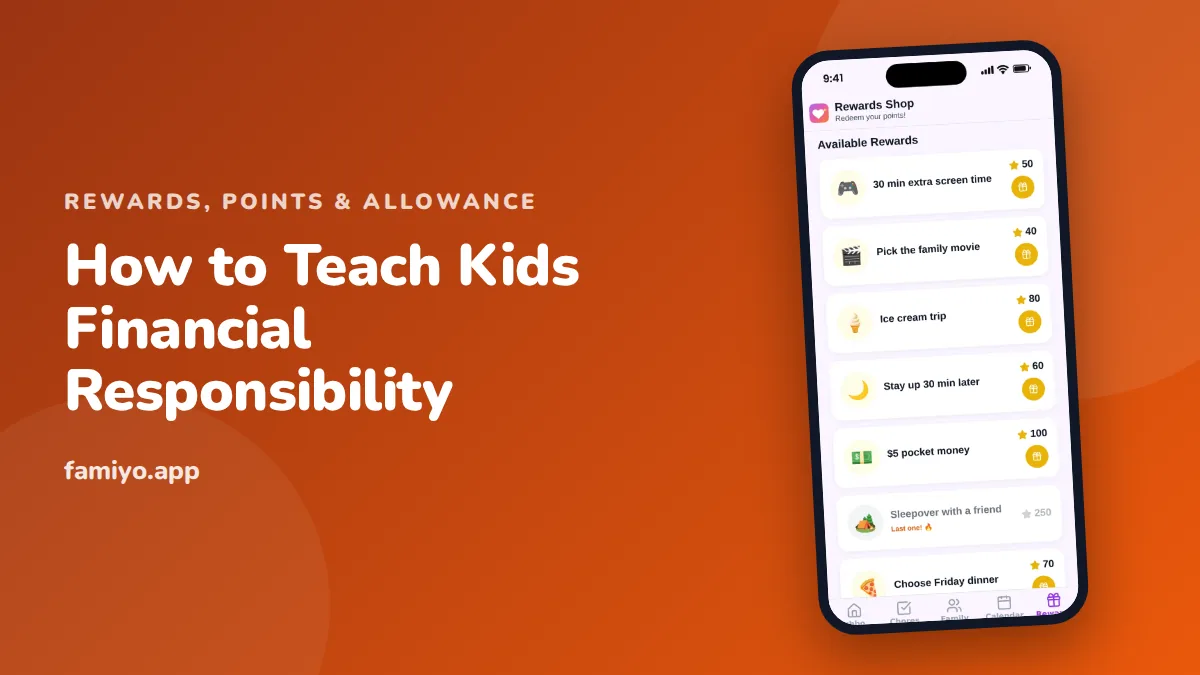
Kids don't learn money from being told about money. They learn it by holding a small amount, wanting something, and deciding. The job for a parent is to set up a safe place for that to happen, and to keep talking while it does. Here is a plan for that, matched to the way kids actually see money now: mostly as a tap on a phone.
Start with a small, regular amount to manage
Financial responsibility is a practice, not a lesson. Practice requires something to practice with. A fixed amount, handed over on the same day each week, gives a child a budget they can plan against. Irregular handouts ("here's a few dollars, you were good") teach nothing about planning.
The usual rule of thumb is $1 per week for each year of age, so an 8-year-old gets $8. Treat it as a starting point. These ranges are common:
| Age | Typical weekly amount | What it should teach |
|---|---|---|
| 5 to 7 | $3 to $7 | Money is limited; waiting for something |
| 8 to 10 | $7 to $10 | Saving toward a goal, comparing prices |
| 11 to 13 | $10 to $15 | Planning a week or month, covering small costs |
| 14+ | $15 to $25 | Budgeting for real expenses, like snacks or clothes |
Whether allowance should be tied to chores is a real debate. We cover it in why kids should not get paid for chores (and when they should). A middle path many families like: basic chores are unpaid because everyone lives in the house, and bigger extra jobs earn $0.25 to $1 for small ones and $2 to $5 for big ones.
Use spend, save and give
For younger kids, splitting money into three jars makes the choices concrete. A common starting split is 50% spend, 40% save and 10% give. If an 8-year-old gets $8, that's $4 to spend, $3.20 to save and $0.80 to give.
Keep the jars visible and physical for as long as possible. Kids who can see the pile of bills grow understand saving in a way a bank balance can't give them at age 6. When they're older, a savings account or a bank's youth account is a natural next step, and our guide to teaching kids money management goes through that.
Let small mistakes happen
This is the hardest part and the most useful. Say your 7-year-old spends all of this week's allowance on a toy that breaks on day two. You'll want to replace it. Don't. Ask a question instead: "What would you do differently next time?" Then say nothing else.
A lost $6 at age 7 is cheap tuition. The same lesson at 17 costs a lot more. Rescue them from real danger (a scam, a purchase that's unsafe), not from disappointment.
If your child saves for three weeks for something and finally buys it, say what you noticed: "You waited and you got it." Skip the speech about saving.
Make digital money visible
The tap-and-go world makes money invisible. A child who has never seen you hand over cash may assume it comes out of the card for free. A few habits help:
- Narrate purchases out loud. "That's $4.50. I'm skipping it, we have coffee at home."
- Show the balance. When you pay with your phone, let them see the screen once in a while.
- Talk about in-app purchases and game currency before they happen. Set a rule: spending real money in a game needs a parent first.
- Compare prices together on a phone. Looking up two options and picking one is a real skill.
- Let them handle a small online or tap payment under your eye, such as paying for a snack.
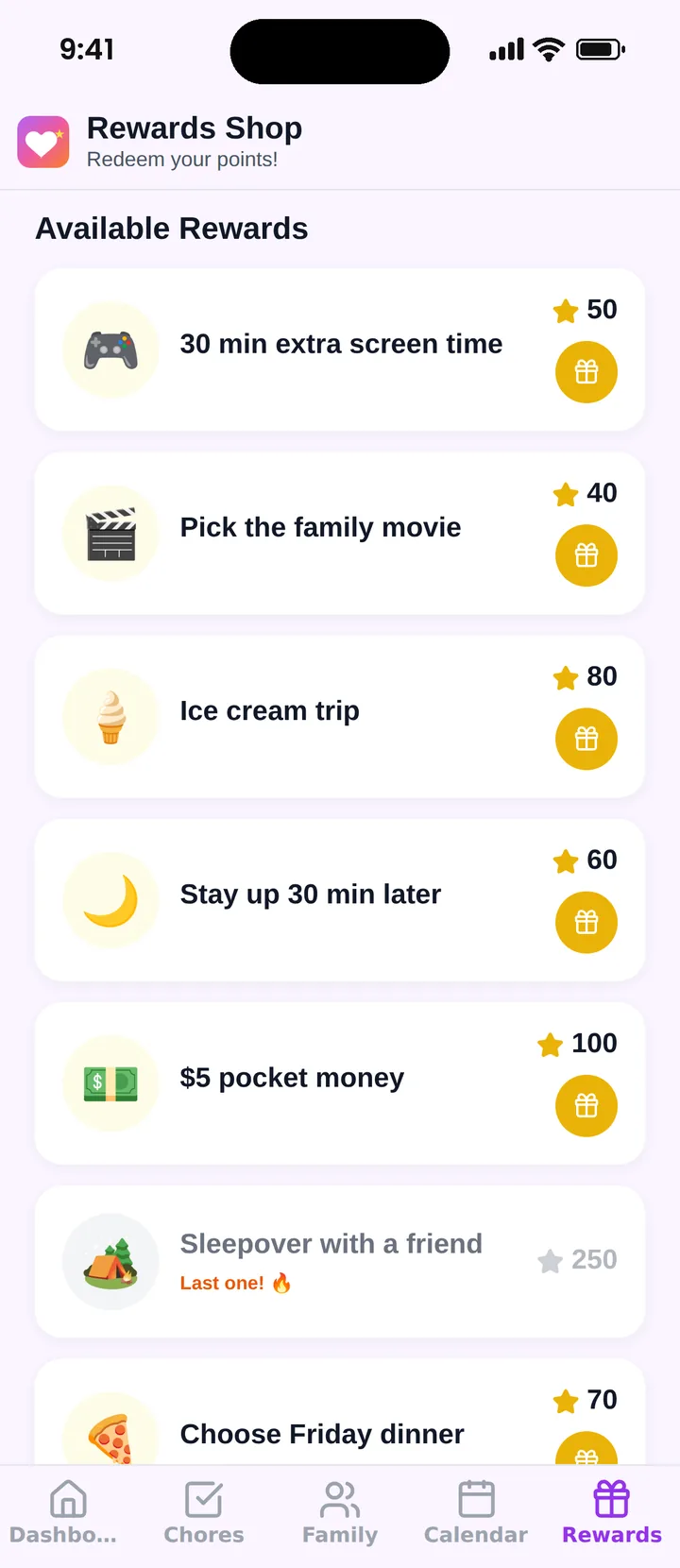
Points are another way to make a balance feel real. A child who earns 10 points for a job and can see 300 points waiting in a shop starts to think in terms of price and waiting. If you want to convert, 100 points equals $1.
Build habits that scale with age
| Age | A habit to build | How |
|---|---|---|
| 4 to 6 | Wait for a want | Put a toy on a "wish list" and revisit it in a week |
| 7 to 9 | Save for a goal | Choose a $20 toy, mark progress on a chart |
| 10 to 12 | Compare and decide | Give a fixed amount for a trip or event and let them plan |
| 13+ | Budget real costs | Hand over a clothing or phone-credit budget and let them manage it |
Older kids need more freedom to do it. See how to teach teens to be responsible with money for the next stage, including first jobs and accounts.
Talk about money in ordinary moments
The best money conversations are short and happen in the car or at the store. Ask a question and let your child answer: "We have $30 for the party gift. What would you pick?" or "That game is $12 and you have $9. How many weeks until you can buy it?" You are teaching arithmetic and patience at once.
Say out loud why you make the choices you make, including the boring ones. "We're not buying that today because we're saving for the trip." Children copy what they hear more than what they're told, and hearing you weigh a cost is a lesson no worksheet gives.
Be honest about limits too. Kids can handle "we can't afford that right now" far better than a vague "maybe later." It also makes it easier to say yes when you can.
Where points and pocket money fit in Famiyo
Famiyo is a free family app for iPhone and Android that combines a shared family calendar, chores with points and a rewards shop; kids join with a code, no email needed. Kids earn points for chores, then exchange them for rewards you set in the shop, including pocket money. The money itself changes hands outside the app, and Famiyo doesn't hold or move it. You decide each reward's price in points and how many are available, and kids see what they'll have left before they redeem. If your family likes the idea of an app-based balance, see our list of the best allowance apps for kids.
Next step
This week, pick one amount and one payday. Put the three jars on a shelf, explain the split in one minute, and let your child decide how to use the first week's money. Then keep your mouth shut about the purchase.
Frequently asked questions
At what age should kids start learning about money?
Around age 4 or 5, when they can count and understand that things cost something. Start with a small weekly amount and a clear jar for saving. By 8 to 10 they can plan for a goal over several weeks, and teens can manage a monthly budget.
How much allowance teaches responsibility without spoiling kids?
A common rule of thumb is $1 a week for each year of age, though it's only a starting point. Typical ranges are $3 to $7 for ages 5 to 7, $7 to $10 for 8 to 10, $10 to $15 for 11 to 13 and $15 to $25 for 14 and up.
Should I let my child waste money on something silly?
Yes, within reason. A $6 toy that breaks in a week teaches more at age 7 than a lecture will, and the cost is small. Let them feel it, ask what they'd do differently, and don't bail them out with extra cash.
How do I teach financial responsibility when everything is digital?
Make money visible. Show kids the amount leaving your account when you tap your phone, talk through why you buy or skip things, and use points or a balance they can watch go up and down so spending still feels real.
Try Famiyo With Your Family
Chores with points, a rewards shop for kids and one shared family calendar. Set it up in a couple of minutes.



Free to download • No credit card required • Available on iOS & Android