How to Make Money as a 10-Year-Old: 15 Safe Ideas
15 safe ways a 10-year-old can make money, from pet care and yard help to a lemonade stand, with realistic earnings, safety rules and a note on handling the cash.
By Famiyo Editorial Team5 min read

At 10, a child starts to want money for specific things: a game, a skateboard, a gift for a friend. They are old enough to understand a price and a deal, and young enough that almost everything has to pass through a parent. Below are 15 ideas that are realistic for the age, how much they roughly pay, and the ground rules that keep it safe.
Start at home
The easiest first customers are the people who live with your child. A paid extra at home carries no safety risk and gives them a chance to practice the basics of earning: agree a price, do the work to a standard, get paid. The line to hold is that daily basics, like making the bed and clearing plates, stay unpaid. Extras are paid. For a long menu of those, see our list of extra chores kids can do for money.
| Idea | Typical pay | Time |
|---|---|---|
| Wash the family car | $2 to $4 | 30 minutes |
| Rake leaves or clear the yard | $2 to $5 | 45 minutes |
| Clean out the garage with a parent | $3 to $5 | 1 hour |
| Organize a closet or the toy shelf | $1 to $2 | 30 minutes |
| Wash the dog | $1 to $2 | 30 minutes |
A reasonable range for a small extra job is $0.25 to $1 and for a big one $2 to $5, so the numbers above sit within that.
Jobs for neighbors and family friends
Once a child has done a few jobs at home, trusted neighbors and relatives are the natural next step. The rules for a 10-year-old are simple: stay close to home, work in daylight, and have a parent know who is hiring and where the child will be.
- Water plants and bring in mail while neighbors are away. A few dollars per visit.
- Walk a small, calm dog with a parent along or on a route you both know. Pay varies, often a few dollars a walk.
- Feed a neighbor's pet while they are away for a weekend, if the pet is easy and a parent comes too.
- Help an older neighbor carry groceries or sort a yard, with a parent nearby.
- Wash neighbors' cars on a Saturday morning, with a bucket, sponge and a parent supervising.
- Pick up sticks and weeds for a neighbor's garden.
Always agree on the price with the adult in advance, and keep the first few jobs short. Babysitting is not a good fit at this age, even for short stretches.
Selling things your child makes
A 10-year-old with a creative streak can sell what they make. This teaches a lot about costs and profit that a chore never does.
- Lemonade or snack stand. Work out the cost of cups and lemons, then the price, and check what the child actually keeps. A good first lesson in profit.
- Friendship bracelets or beaded keychains, sold to family and at school events where it is allowed.
- Hand-painted rocks, cards or bookmarks sold at a school fair or a table in front of the house.
- Baked goods at a bake sale. Check any local rules on food sold to the public, which vary.
- Recycling cans or bottles where deposits are offered, with an adult handling the trip to the center.
The parent helps with the setup, the money box and any local rules, and the child does the making and selling. Ten-year-olds are often excellent at this part.
What to keep offline
This is where a tech-savvy parent earns their keep. A 10-year-old should not run an online shop, post products on public marketplaces, or take payments through an app in their own name. Most platforms require older users, and the privacy risks of listing a child's name, address or photo are real. If your child wants to sell something bigger, a parent opens and runs the listing, handles the messages and payments, and the child does the product.
The same goes for videos and "influencer" ideas. They are fun to talk about, but making money online as a child is a conversation for later, and our guide to jobs for kids under 13 covers more offline options in the meantime.
Ground rules for any job
Print these or read them aloud before the first job.
- A parent knows about every job: who, where and how long.
- Daylight only, close to home.
- The price is agreed before the work starts.
- Never go into a house alone with someone you do not know well.
- Tell a parent right away if anything feels wrong, and it will never be a punishment to say so.
- Homework and basic chores come first.
What to do with the money
Earning is half the lesson. The other half is deciding what happens next. A simple split for younger kids is spend, save and give, for example 50%, 40% and 10%. A 10-year-old can handle three jars or three lines in a notebook. Let them spend their share on something real, even something you would never buy, and let them feel the choice.
Rules of thumb on allowance for kids around this age are $7 to $10 a week, which gives a sense of where earned money sits. It is usually a top-up, not a replacement. If you are wondering how pocket money and earnings fit together, our guide to allowance ideas for a 10-year-old walks through money, points or both.
Tracking earnings with points
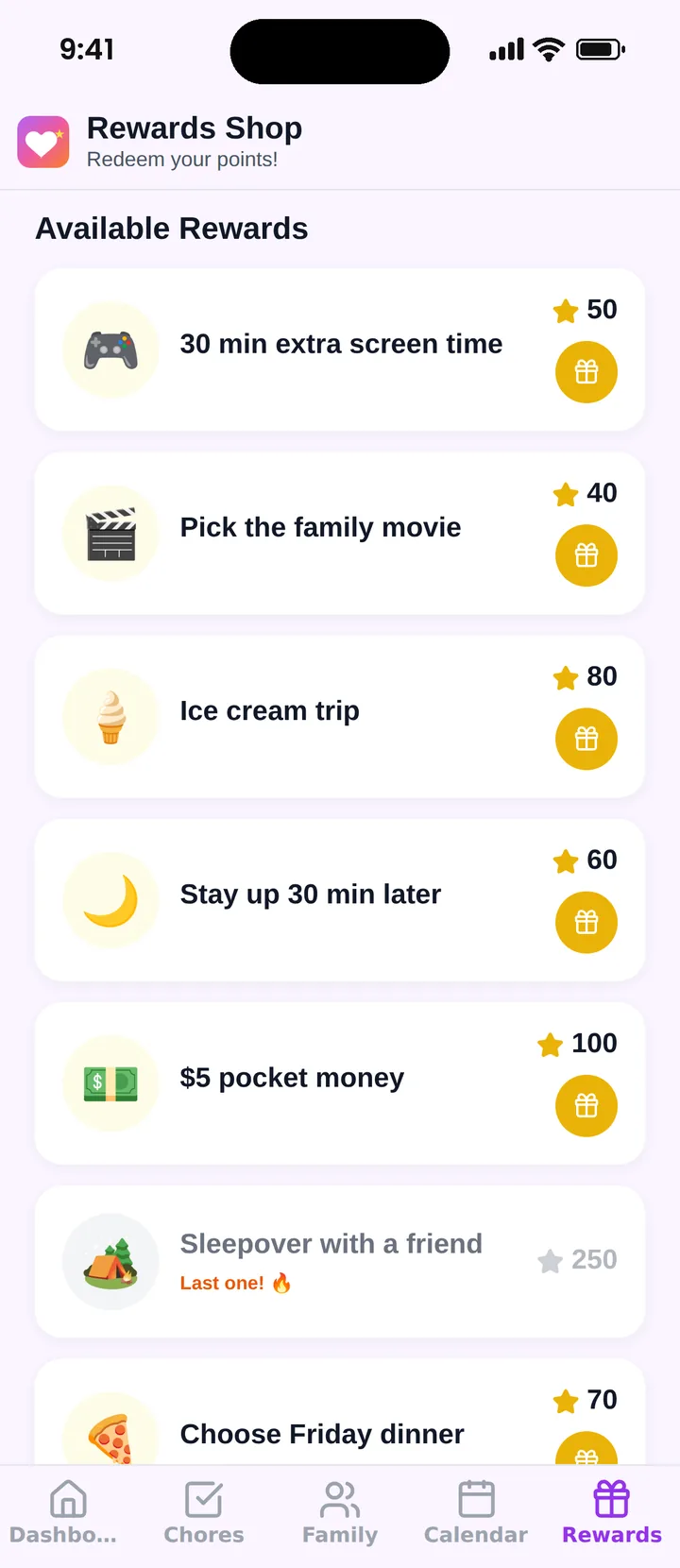
Famiyo is a free family app for iPhone and Android that combines a shared family calendar, chores with points and a rewards shop; kids join with a code, no email needed. For a 10-year-old earning from several small jobs, points keep the tally simple. You add each extra job as a chore with a point value, and at 100 points to $1 a $3 car wash is 300 points. Your child sees their balance on their own phone and spends it in the rewards shop on whatever you have listed, including pocket money (the cash changes hands outside the app). Compare options in our best allowance apps for kids.
Pick one to try this week
Choose one idea from above, set a price with your child and write down the job, the standard and the pay. Let them do it, pay them straight away, and ask what they would change next time.
Frequently asked questions
Can a 10-year-old have a real job?
Formal employment is generally closed to a child this young, since most places set a minimum working age, often 14 or older with limits. What a 10-year-old can do is small, supervised neighborhood work and family jobs. Check your local rules if you are unsure.
How much can a 10-year-old earn?
It depends on the job and how often it comes up. Extra chores at home usually pay $0.25 to $5 each. A neighborhood job such as pet care or yard help may pay a few dollars per visit. Expect pocket money, not an income.
Can a 10-year-old make money online?
Not on their own. Most platforms require users to be older, and selling or posting in public carries privacy risks. If your child has a product idea, a parent can run the account and the payments, with the child doing the making.
How should a 10-year-old handle the money they earn?
Use a simple split such as spend, save and give, for example 50%, 40% and 10%. Keep a jar or a written balance so the child can see the total grow, and let them make one real choice about spending.
Try Famiyo With Your Family
Chores with points, a rewards shop for kids and one shared family calendar. Set it up in a couple of minutes.



Free to download • No credit card required • Available on iOS & Android