Kids Progress Tracker: What to Track and How to Use It
A kids progress tracker works when it shows effort a child can see. Learn what to track by age, a 10-minute weekly review and the mistakes that backfire.
By Famiyo Editorial TeamUpdated 6 min read
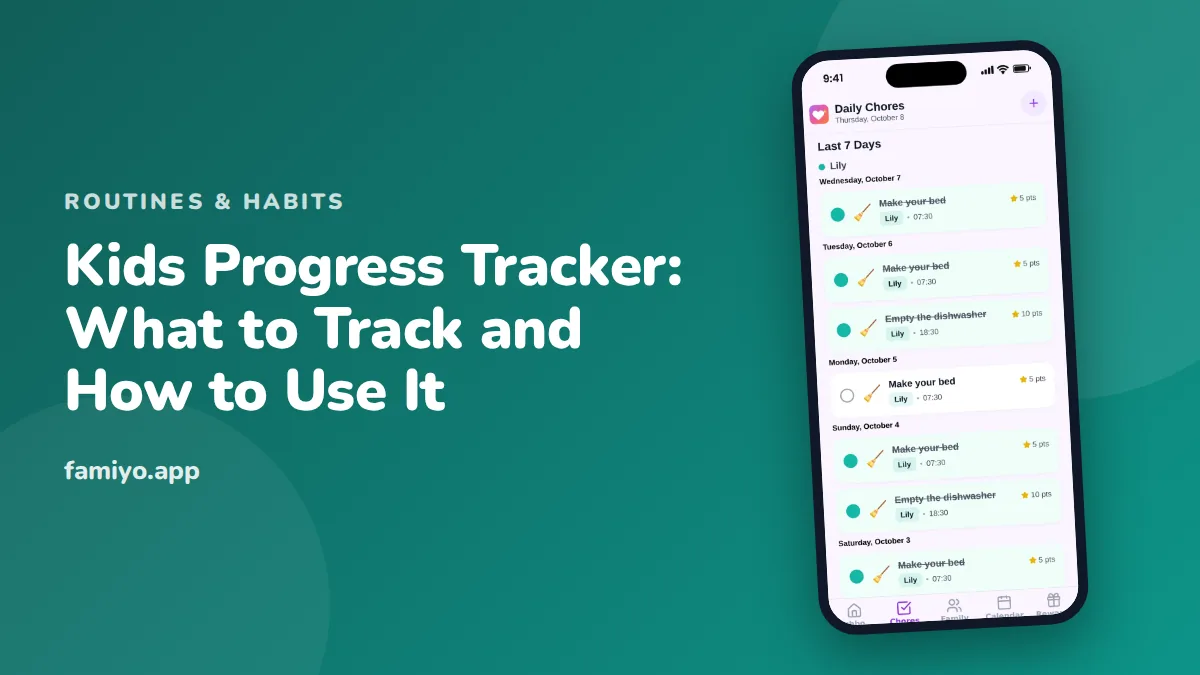
You can tell a lot about how a week went from the pile by the front door, but your child can't. To a 7-year-old, last Tuesday is ancient history, and a month of small efforts disappears. A progress tracker makes the effort visible. This guide covers what is worth tracking at each age, how to run a short weekly review, and the habits that turn a tracker from a motivator into something kids resent.
What should you track for kids?
Pick actions, not outcomes. A child can control whether they sat down to read for 15 minutes. They cannot fully control whether the book was interesting or whether the spelling test went well. Trackers built on actions give kids something they can win today.
A good tracker item passes four tests: the child can do it alone, you can tell when it is done, it takes under 30 minutes, and it repeats. "Practice piano for 10 minutes" passes. "Be nicer to your sister" fails the second test, because nobody can see done.
Limit the list. Three or four items is the sweet spot for one child, in line with the common guidance of 3 to 4 daily tasks for school-age kids. Each new item competes for the same attention.
What to track at each age
The right items change fast as a child grows. Use this as a starting menu and pick from one row.
| Age | Good things to track | How the child sees it |
|---|---|---|
| 4-5 | Make the bed, feed the pet, put toys away | Stickers or a picture row, checked together |
| 6-7 | Pack the school bag, tidy the room, read 10 minutes | A simple list they tick themselves |
| 8-9 | Homework started before screens, one weekly big job, practice sessions | A weekly view with a streak count |
| 10-12 | Laundry to the hamper, instrument minutes, a personal goal | Points total and last-7-days view |
| 13+ | Their own picks: workouts, study blocks, a savings goal | A private tracker they share a summary of |
For a deeper menu of simple targets by age, see our list of goals for 10-year-olds, and for tracking daily self-care and sleep habits specifically, the healthy habit tracker for kids goes further.
The 10-minute weekly review
The review is where a tracker earns its place. Without it, you have a list that gets ticked and ignored. With it, a child learns to look at their own week and decide what to do next. Choose one fixed time, like Sunday after dinner, and keep it short.
- Look at the last 7 days together. Let your child read it out first. Do not start with what is missing.
- Name one thing that went well, with specifics: "You packed your bag six nights out of seven. That's a big change from last month."
- Ask one question about a miss, with real curiosity: "Thursday is blank. What happened that day?"
- Pick one tiny change for the next week. One. "Set my bag by the door before dinner."
- Close it. Say thanks, move on to something fun. If the review turns into a lecture, the child will start hiding the chart.
A review that goes badly is usually too long, too negative, or held when everyone is tired. If you notice a child going quiet, shorten it to three minutes for a few weeks.
A sample week and what it tells you
Say your 9-year-old tracks four things: packing the bag, homework started before screens, feeding the dog and 15 minutes of reading. At the Sunday review the grid shows bag 6 of 7, homework 4 of 7, dog 7 of 7, reading 3 of 7. Resist the urge to fix everything.
What the numbers say is clear: the dog is automatic, the bag is nearly there, and homework and reading are the weak spots. They probably share a cause, since both happen in the same late-afternoon window. So the one change might be "snack, then 15 minutes of reading, then homework" and nothing else. Next week you look again. A tracker is good at this kind of small detective work, because patterns jump out when seven days sit side by side.
A tracker also tells you when to add something. If every box has been ticked for three weeks, the habit has settled. Retire that item or move it to a weekly check, and add one new thing. That keeps the list short and keeps the child growing.
Which numbers matter, and which ones mislead
A streak looks motivating until one missed day wipes it out. Some children, especially perfectionists, will quit rather than see the number reset. If that sounds like your child, count "days done this week" instead of "days in a row". A week of 5 out of 7 is a success, not a failure.
Totals are good for long projects. If your child has earned 340 points over a month, the total shows how much steady effort adds up, and it gives them something to spend toward. Weekly counts are better for habit building, because they reset and give a fresh start every Sunday.
Be careful with comparison. A progress tracker for two children should never put them on one chart with a winner. Different ages and different strengths mean the same task is harder for one child. Compare each child with their own last week, nobody else.
Avoid tracking things that feel like character judgments, such as "good attitude" or "was kind". They are hard to define, and a child reads a low score as "I'm bad" rather than "I missed a task".
How tracking supports habits and responsibility
Seeing a run of ticked boxes builds the belief that "I'm someone who does this", and that belief is stronger than any reminder you give. Over a few weeks, a task moves from "I have to" toward "that's just what I do". Our article on how to build good habits in kids lays out the stages in detail, and the piece on how to teach kids accountability shows how to talk about a missed day without blame.
A tracker also pairs with small rewards, but keep that light. For ideas on how to do it without turning every task into a trade, read how to reward your child without spoiling them.
Tracking for a child who struggles with time or focus
If your child finds it hard to start tasks or to keep track of time, a tracker can help, but keep it lighter. Choose one or two items, make each step very small, and show the result straight away. Our guide on how to help kids with ADHD with time management goes through what tends to help. For anything beyond everyday ups and downs, the child's pediatrician or therapist is the right person to ask.
Mistakes that make kids hate the tracker
- Checking it in secret and then confronting the child. If the chart is a gotcha, it will die within a month.
- Adding items every week. Ten items means nothing gets done well.
- Taking points away as punishment. A tracker records effort, so deductions turn it into a threat.
- Tracking only the failures. Make sure the screen shows what went right.
- Dropping the review. Without it the numbers become wallpaper.
Using the last-7-days view in Famiyo
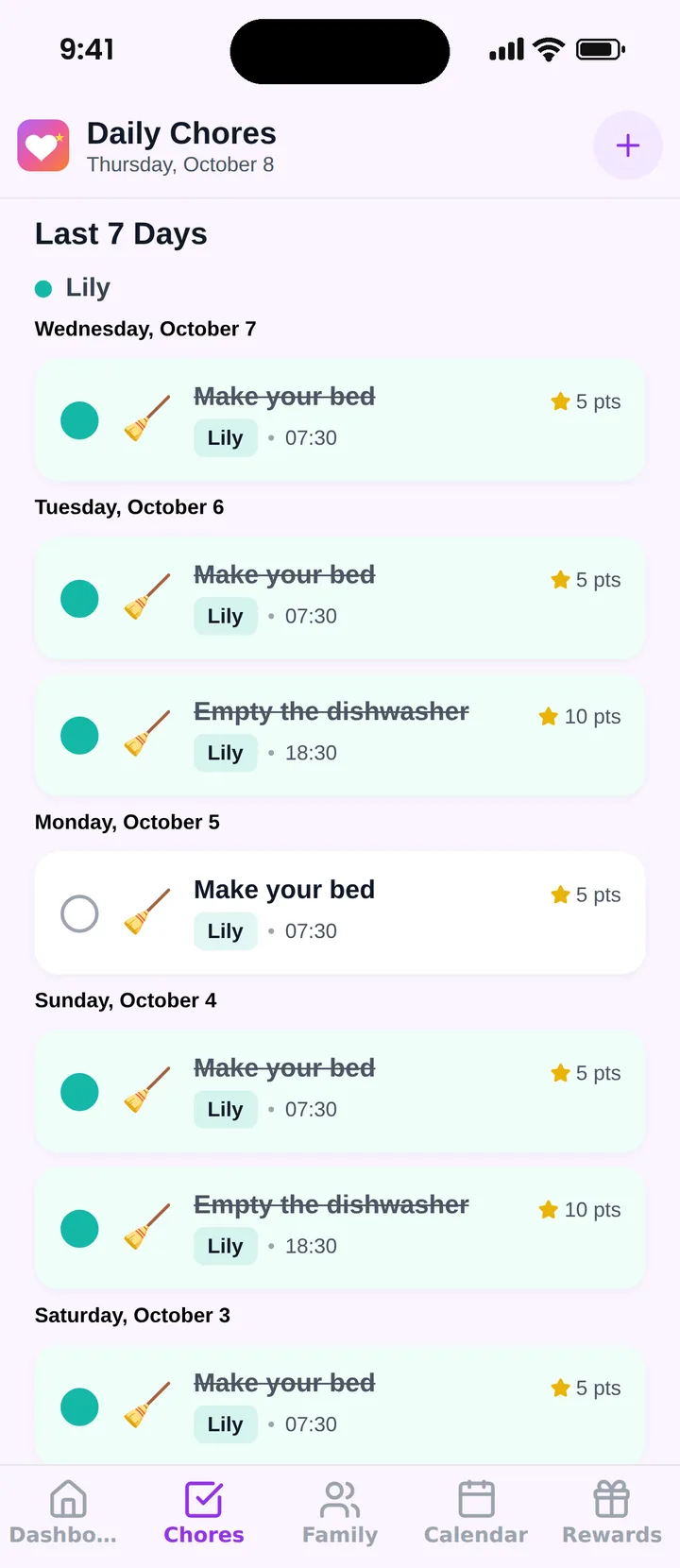
Famiyo is a free family app for iPhone and Android that combines a shared family calendar, chores with points and a rewards shop; kids join with a code, no email needed. For progress tracking, you can open any child's last 7 days of chores, see points this week and in total, and spot the top performer of the week. That makes the Sunday review quick, since the whole week is on one screen. Kids can tick off their own tasks or wait for you to approve.
Browse our ranking of the best reward chart apps for kids if you want to compare trackers.
This Sunday, pick one night and one question to ask: "What are you proudest of from this week?"
Frequently asked questions
What should I track for my child?
Track actions your child fully controls: chores finished, reading minutes, practice sessions, packing the bag. Avoid tracking outcomes they can't control alone, such as grades or how they felt. Three or four items is plenty for one child at a time.
How often should we look at the progress together?
Once a week works for most families. A short sit-down of about 10 minutes on a fixed day, like Sunday after dinner, keeps it routine. Daily checks tend to feel like surveillance, and monthly ones are too far from the actions.
Is it bad to track my child's progress?
Not when the child can see it and it highlights effort. It backfires when it is used to compare siblings, to shame a missed day, or when a parent checks it in secret. Track with your child, not on them.
What do I do when the numbers drop?
Get curious before you correct. Ask what got in the way that week: a trip, a cold, a new schedule. Then shrink the goal for a few days so a win is easy again. A dip usually points to a busy week, not a bad kid.
At what age should kids start tracking their own progress?
Around age 5 or 6 with a picture chart, and from about 8 they can fill in their own numbers. Teens can keep their own tracker and share a summary when they choose to.
Try Famiyo With Your Family
Chores with points, a rewards shop for kids and one shared family calendar. Set it up in a couple of minutes.



Free to download • No credit card required • Available on iOS & Android