Kids Routine App: Set Up Morning and Evening Routines
A kids routine app works when the steps are few, the times are fixed and the child ticks them off. Get sample morning and evening routines and a setup plan.
By Famiyo Editorial TeamUpdated 5 min read
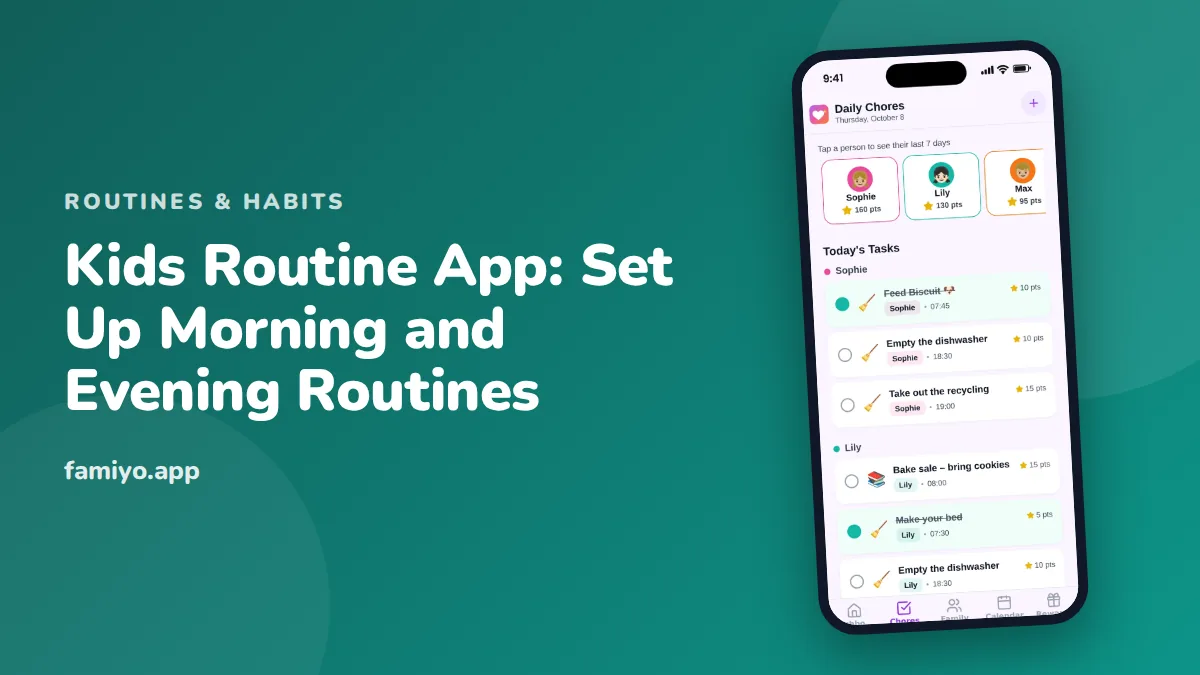
At 7:10 on a school morning, the shoes are missing, someone is still in pajamas and you've said "hurry up" four times. The routine is not the problem; the lack of one written down is. When a child can see what comes next, you stop being the narrator. This guide shows how to build a morning and an evening routine, with realistic times, then run them in an app so they happen on repeat without a daily argument.
What makes a routine stick?
Three things: a short list, a fixed trigger and a child who owns the ticking.
A short list means 4 to 6 steps for a child under 7, which is the range visual routines work best in. A fixed trigger means each routine starts at the same time or after the same event, such as "after breakfast" or "when the bath is done". The trigger does the remembering. A child who owns the ticking checks things off themselves, and that is the difference between a routine and a list of orders.
Allow time to settle. Give a new routine 2 to 3 weeks of consistent use before judging it. The first few days are always bumpy, and changing it daily means it never sets.
A sample school-morning routine
School-age kids need about 30 to 45 minutes from wake-up to leaving. Here is a realistic example for an 8-year-old leaving at 7:45.
| Time | Step | Minutes |
|---|---|---|
| 6:55 | Wake up, bed made roughly | 5 |
| 7:00 | Get dressed, teeth | 10 |
| 7:10 | Breakfast, plate to the sink | 20 |
| 7:30 | Shoes, jacket, school bag by the door | 10 |
| 7:40 | Free time or 5 minutes of reading | 5 |
| 7:45 | Leave | 0 |
The last block is a buffer, and it is the most useful line on the list. Without a cushion, one lost shoe wrecks the schedule. If you need a fuller checklist with adjustments for different ages, our guide to a morning routine for kids has one.
A sample evening routine
Evenings run in two parts: the after-school stretch and the wind-down. Bedtime itself usually takes 20 to 30 minutes and starts at the same time every night.
| Time | Step | Notes |
|---|---|---|
| 3:30 | Snack, unpack the bag | Lunchbox out, papers on the table |
| 4:00 | Homework | A short break halfway |
| 5:00 | Free play, outside if possible | No screens yet |
| 6:00 | Dinner, one household job | Clear own plate |
| 7:00 | Pack the bag for tomorrow | The fix for most mornings |
| 7:30 | Bath, pajamas, teeth | 10 to 15 minutes |
| 7:50 | Stories, lights out at 8:15 | Screens off about 1 hour earlier |
Sleep needs shape the clock: kids 6 to 12 need 9 to 12 hours, and 3 to 5-year-olds 10 to 13 hours including naps, so work backward from the wake-up time. Our article on bedtime routines for kids covers the wind-down in detail, and the one on after-school routines is the place for the 3 to 6 p.m. stretch.
Build the routine with your child
Children follow a plan they helped to write. Sit down on a weekend, when nobody is rushed, and do this.
- Ask your child to say what they do from waking to leaving. You will often learn about steps you didn't know about.
- Put the steps in order and cut anything that is not needed. Four to six is the target.
- Agree on the time each step starts. Be honest: a child who needs 15 minutes to eat shouldn't get 5.
- Let your child pick the order of any steps that can move, like getting dressed before or after breakfast. Choice lowers resistance.
- Add the routine to your app or chart and run it for a week without changes, as a trial.
- Review after the first week: which step failed most often? Change that one.
Then step back. The point is that the child, not you, reads the list.
Routines for different ages
A 4-year-old needs the routine to be physical and picture-led: four steps, such as clothes, breakfast, teeth, shoes, with a parent beside them for every one. A 7-year-old can read a short list and tick it, though you will still prompt the first week. By 10, a child can own the whole morning, with you as an early-warning voice at the 10-minute mark. Teenagers usually want to set their own alarm and their own order, and the most useful thing you can do is agree the leaving time and let the rest be theirs.
Match the tool to the age too. Picture charts and stickers suit the youngest, and an app starts to make sense when a child can read independently and has a device that is theirs or shared at a fixed time.
When the routine falls apart
It will, usually on a Wednesday. A child is sick, a trip breaks the pattern, or a new school schedule starts. Don't read this as failure. Go back to the smallest version: two steps in the morning, two at night. Rebuild from there over a week.
If one step fails again and again, ask three questions. Is it at the wrong time? Is it too big, with several jobs hiding inside? Is it in the wrong order, such as brushing teeth before breakfast? Fixing the step almost always works better than adding a consequence.
Weekends and holidays need their own, looser version. A weekend morning might have only three steps and no deadline. Keeping a loose routine through the break makes the return to school far easier, and our guide to the Christmas break routine for kids shows how to do it when school is out for two weeks.
Why routine apps help, and where they stop
An app helps with repetition: the routine repeats every day without you rewriting it. It reminds the child, shows what is done, and lets both parents see it. It also moves the "you need to hurry" from your mouth to the screen, which many children accept more easily.
It can't fix a schedule that is too tight, a child who isn't getting enough sleep or a house where the bag is never in the same place. If you are dealing with a very busy school year, our guide to the homework routine for kids shows how to protect that part of the afternoon. Children with ADHD or anxiety often benefit from fewer steps and visual cues, and a talk with the child's pediatrician or therapist is a good idea if routines are a constant struggle.
Running the routine in Famiyo
Famiyo is a free family app for iPhone and Android that combines a shared family calendar, chores with points and a rewards shop; kids join with a code, no email needed. For routines, you add each step as a chore, set it to repeat daily, weekdays or every few days, and give it points if you wish. Kids see their tasks for today and tick them off, or wait for a parent to approve. The today screen shows what each child has finished so far, and new tasks trigger a push notification on their phone.
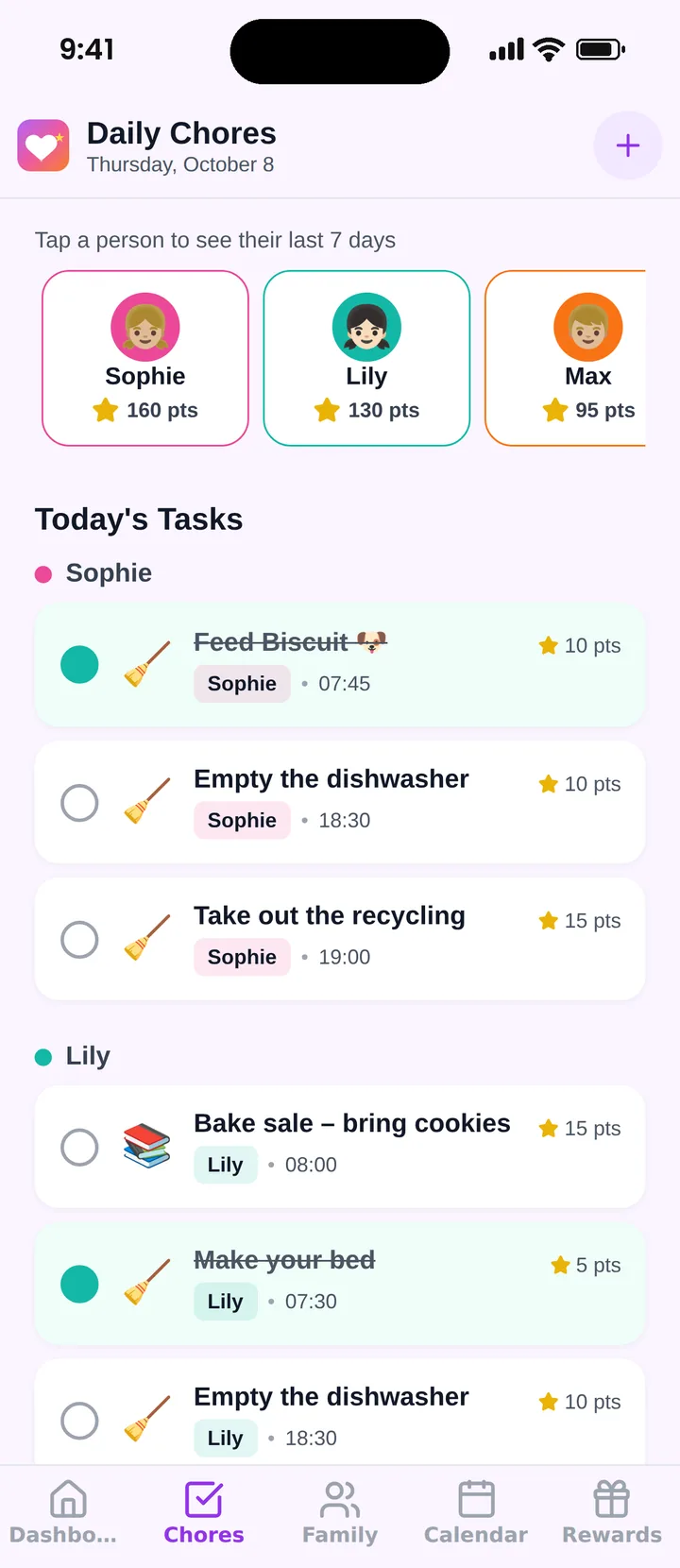
On the free plan you get 1 repeating task, so a full routine of several repeating steps needs Premium. Compare apps in our list of the best family organizer apps.
Tonight, write down your child's morning in six steps, and try it for the next five school days.
Frequently asked questions
How many steps should a kids routine have?
For children under 7, 4 to 6 steps is the sweet spot. Older children can handle a few more, but a long list is easy to ignore. If a step takes more than 10 minutes or has several parts hidden inside it, split it or drop it.
How long should a morning routine take?
A morning routine for school-age kids usually takes 30 to 45 minutes from wake-up to leaving. Work backward from departure time, add a 10-minute buffer, and set the wake-up accordingly. If you always run late, the routine is too long.
How long before a new routine sticks?
Give it 2 to 3 weeks of steady use before judging it. The first week is usually messy. If a step keeps failing after three weeks, change the step, the time or the order, not the child.
Should I use the app or a printed chart for a young child?
A printed picture chart is often easier for ages 3 to 5. An app suits 6 and up, since it can repeat every day and send reminders. Some families use both, with the same steps in the same order.
Try Famiyo With Your Family
Chores with points, a rewards shop for kids and one shared family calendar. Set it up in a couple of minutes.



Free to download • No credit card required • Available on iOS & Android