Kids Responsibilities at Home: What to Expect by Age
What responsibilities kids can handle at home by age, from toddlers to teens, split into taking care of themselves, their stuff and the household.
By Famiyo Editorial Team4 min read
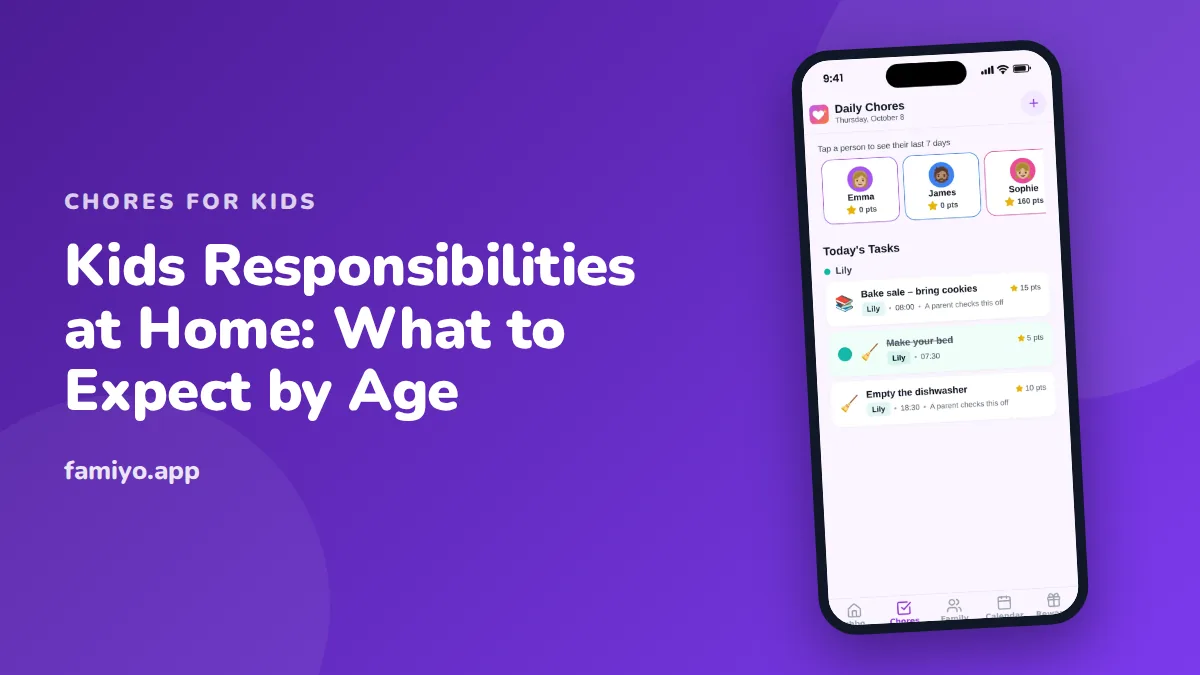
Ask ten parents what their kids should be responsible for and you'll get ten answers, mostly based on whatever happened this morning. This page gives a calmer reference: what children can usually handle at each age, split into three buckets so you can see where your kid is strong and where they're coasting. Treat it as a guide, not a grade. Kids vary, and a rough week doesn't mean you've failed.
The three kinds of responsibility
Chore lists tend to lump everything together, which is why a child can empty the dishwasher perfectly and still lose their shoes every day. It helps to separate three areas.
Self-care: brushing teeth, getting dressed, sleeping on schedule, eating what's served, asking for help.
Their own stuff: toys, backpack, clothes, bike, devices, homework, money.
The household: the jobs that keep a shared home running, such as dishes, laundry, trash and pets.
A child usually masters them in that order. Self-care first, then their things, then the shared space. Expecting a 5-year-old to notice that the trash is full skips two steps.
What to expect at each age
The table gives realistic expectations. The typical time per day comes from the chores-by-age ranges we use across Famiyo, and it is the household part only.
| Age | Self-care | Their own stuff | The household | Time per day |
|---|---|---|---|---|
| 2-3 | Wash hands, help get dressed | Toys in a bin, clothes in the hamper | Wipe up spills, help feed a pet | 5 to 10 minutes |
| 4-5 | Dress themselves, brush teeth with a check | Make the bed (roughly), match socks | Set and clear their own place, water plants | 10 to 15 minutes |
| 6-7 | Morning routine with a checklist | Pack the school bag, tidy their room | Sort laundry by color, sweep, empty unbreakable dishes | 15 to 20 minutes |
| 8-9 | Get ready for school mostly alone | Start homework without being chased | Load the dishwasher, take out the trash, vacuum one room | 20 to 30 minutes |
| 10-12 | Manage their own morning and bedtime | Keep track of schedule and gear | Clean a bathroom sink and toilet, cook a simple meal with an adult nearby | 30 minutes |
| 13+ | Sleep, health and mood habits | Own laundry, money, phone rules | Cook a family meal, shop from a list, mow the lawn | 30 to 45 minutes |
Sleep is a responsibility too, and an easy one to neglect. The American Academy of Pediatrics recommends 9 to 12 hours for ages 6 to 12 and 8 to 10 hours for ages 13 to 18, so a teen who is "responsible" but running on five hours isn't winning anything.
How many responsibilities is too many?
A rule of thumb that holds up: 2 to 3 daily tasks for preschoolers, 3 to 4 for school-age kids, and one weekly big job from age 8. Count the whole day, including homework and activities. If a 9-year-old has two hours of homework and soccer, the household list shrinks.
Warning signs that you've gone too far are not subtle. Tears at the same hour every day. A chore that takes 40 minutes because it's a negotiation. A kid who does everything on the list but nothing else, ever.
How to hand a responsibility over
Handing over doesn't mean disappearing. Most kids need four stages.
- You do it while they watch and you say what you're doing.
- You do it together, and they take more each time.
- They do it while you stay in the room, available but quiet.
- They own it. You check the result, not the process.
Stage 4 is where parents stumble. If you redo the bed after your 6-year-old makes it, you've told them the job is yours. Accept an uneven blanket. Say what you noticed: "You put the pillow at the top without me asking."
Not every job transfers smoothly. A child with ADHD may need more steps written down and more time at stage 3, and our list of chores for kids with ADHD shows how to break them up.
When responsibility slips
It will. The honest version: Wednesdays are where good systems go to die. A kid who did everything on Monday and Tuesday will leave a wet towel on the floor on Wednesday, and you'll feel your patience go with it.
Before you reach for a lecture, check three things. Is the job still clear? Is it still the right size? Has something else changed, such as a new school year, a growth spurt or a bad week with friends? Most slips are a mismatch rather than defiance. If your child flat-out refuses, there's a separate plan in our article on what to do when your child refuses to do chores.
Natural consequences are useful when they're safe. A forgotten lunch means a school lunch. A towel left out means a damp towel tomorrow. Skip the consequences you invent in anger. They tend to be too large and impossible to enforce.
Let something other than you do the reminding
A reminder from a parent feels like criticism, even when it's friendly. A reminder from a list, a timer or a phone doesn't carry the same weight. This is the quiet reason most families do better with a system than a speech. For a broader plan, see our weekly chores for kids guide.
Where an app takes over the reminding
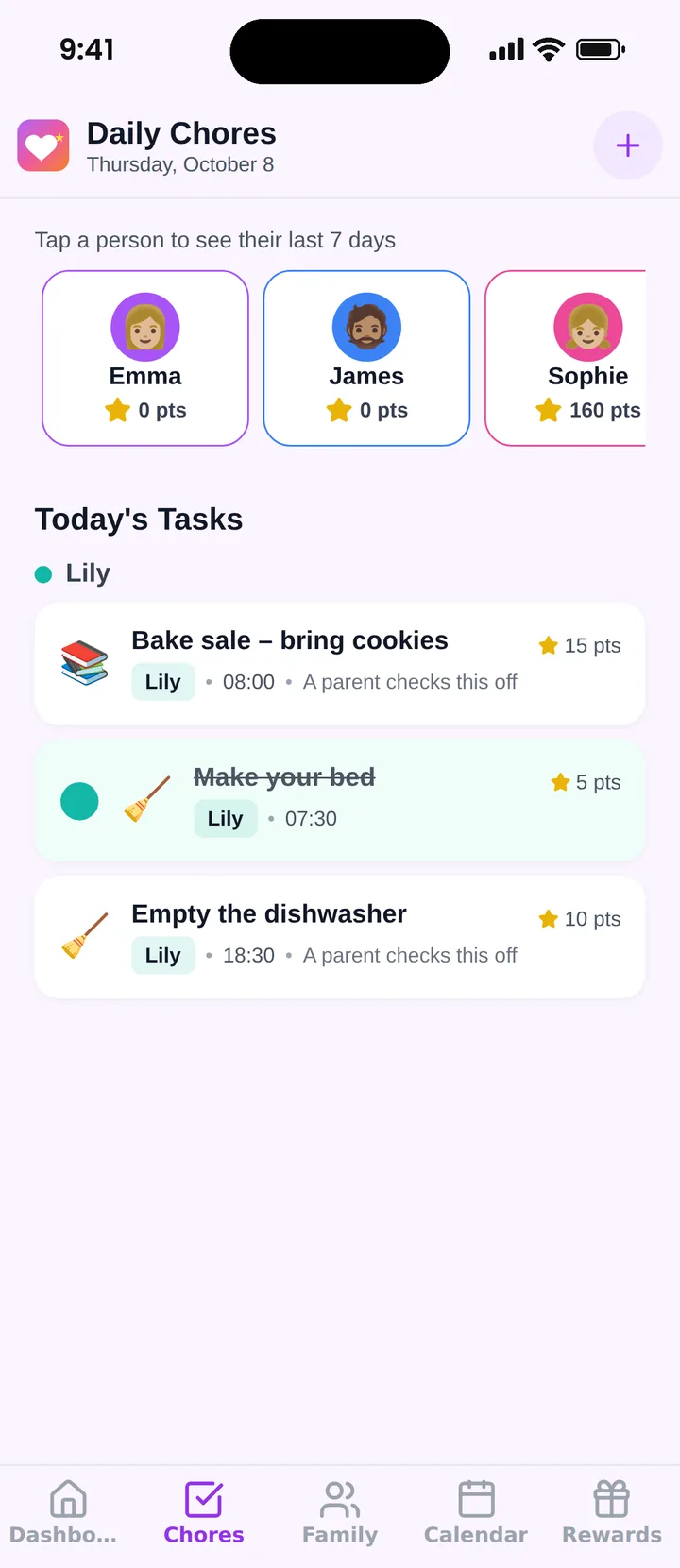
Famiyo is a free family app for iPhone and Android that combines a shared family calendar, chores with points and a rewards shop; kids join with a code, no email needed. Each child sees only their own tasks and points on their own phone. They get a notification when a new task arrives, so you don't have to say it, and they check it off when done. You get a notification when a chore is complete, and you can choose whether jobs need your approval. Points can be spent in a rewards shop you stock. Browse our list of the best chore apps for kids if you're comparing options.
Pick one area where your child is ready to own something this week, write down what done looks like, and let it be theirs.
Frequently asked questions
What are responsibilities for a child at home?
A child's responsibilities are the things the family expects them to handle without being rescued: caring for their own body and belongings, doing a share of the household work, and keeping simple commitments like homework or feeding a pet.
What is the difference between a chore and a responsibility?
A chore is a specific job with an end, such as emptying the dishwasher. A responsibility is a broader area a child owns, such as getting ready for school on time. Chores usually sit inside responsibilities.
At what age should kids be responsible for their own homework?
Most children can start owning homework around age 8 or 9, with a parent nearby for help rather than supervision. Younger kids need a parent to set up the time and place. By middle school, the plan is mostly theirs.
How do I teach responsibility to a child who forgets everything?
Shrink the job, make it visible and attach it to something that already happens, like feeding the dog right after breakfast. Let natural consequences do some of the teaching. A reminder system that is not you also helps.
Try Famiyo With Your Family
Chores with points, a rewards shop for kids and one shared family calendar. Set it up in a couple of minutes.



Free to download • No credit card required • Available on iOS & Android