What to Do When Your Child Refuses to Do Chores
Your child says no to chores. Here is a calm step-by-step plan: what to say, what to skip, what consequences work, and how to stop the daily argument.
By Famiyo Editorial Team5 min read

It is 5:40 pm. You asked nicely. You asked again. Now your child is lying on the hallway floor insisting the dishwasher is not their problem, and you are one more sentence away from yelling. This page walks through what to do right then, what to change before tomorrow, and how to get chores back to something boring and normal.
First, stop the fight, not the chore
When a child refuses, the instinct is to win. Resist it. A battle over one chore on one evening teaches nothing except that you can both get loud. The goal is a household where chores happen with a sigh, not a standoff.
So in the moment, drop your voice and say one clear sentence: "The dishwasher needs emptying before you have your tablet. Do you want to do it now or after your snack?" Then stop talking. No lecture about how hard you work, no list of everything you do. Walk away if you need to. A refusal that gets no audience loses most of its power.
If the child is truly melting down, wait. A child in the middle of a tantrum cannot do anything useful, including chores. Come back in ten minutes and repeat the sentence.
Check four things before you blame attitude
Parents often assume defiance when the real issue is simpler. Run through these:
- Is it clear? "Clean your room" means something different to you and to a 7-year-old. "Clothes in the hamper, books on the shelf, bed made" is a finish line.
- Can they actually do it? Compare the job with their age. A 5-year-old can make a bed roughly, but a full room clean-up is too much at once. Check the typical ranges in our guide to household chores for kids by age.
- Were they taught? Most kids refuse jobs they feel they will do badly. Show it, do it together, then let them try alone. We lay out the method in how to teach kids to do chores step by step.
- Is the timing bad? Right after school, hungry, or in the middle of a game is a rough moment. Pick a time that is the same every day and tied to something else, like "after dinner" or "before screens."
If your child struggles with focus or transitions, a different approach may help, and our list of chores for kids with ADHD has options.
What to say, and what to avoid
Words matter, and a few swaps change the mood. These are lines you can use as written.
| Instead of | Try |
|---|---|
| "Why are you so lazy?" | "This is part of being in the family. What would make it easier?" |
| "I'm not asking again." | "I'll check back in ten minutes." |
| "You never help!" | "I need your help with the laundry. Do you want the towels or the shirts?" |
| "If you don't, no tablet for a week." | "Chores first, then screens. It's your call when." |
| "Fine, I'll do it myself." | "I'll start, and you finish the last part." |
Notice that none of these are clever. They work because they are calm, short and give the child a choice inside a fixed rule. The rule stays put (the job gets done). The details, like when and which part, are up for grabs.
Consequences that work
A consequence should be small, immediate and linked to the task. Long punishments are hard to enforce and easy to resent.
- Chores before screens. The tablet is simply not available until the job is done. You do not need to be angry about it.
- Chores before the activity. A friend can come over once the room is picked up.
- Fix it later at a worse time. If they skip it, they do it during something they would rather be doing, without the grumbling lecture.
Avoid taking away things unrelated to the chore, like a birthday party, and avoid threats you will not carry out. A threat you drop teaches the child to wait you out.
What about paying? Money or points can help motivate, but they cannot be the only answer. Basic family jobs stay unpaid, with rewards reserved for extras. A common split is $0.25 to $1 for a small extra job and $2 to $5 for a big one.
Reset the system, not the child
If refusal has become a daily event, the setup usually needs changing. Start with these four moves over a week:
- Cut the list. Go down to 2 or 3 tasks for a preschooler and 3 to 4 for a school-age child. Too many tasks is the most common reason for a revolt.
- Hold a short family meeting when everyone is calm. Ask what feels unfair, then pick chores together.
- Make the expected time visible: a chart, a picture list or a spot on the family calendar.
- Notice when it goes well. A quick "thanks, that was quick" lands better than praise sprayed everywhere.
Give any new routine two to three weeks before you decide it has failed. Wednesdays will still fall apart now and then. That is fine. A calm return on Thursday matters more than a perfect week.
For a weekly plan that balances the load, see weekly chores for kids.
Letting an app do the reminding
Most chore fights are really reminder fights. You say it, they hear nagging, you say it louder. Moving the reminder out of your mouth removes much of the friction.
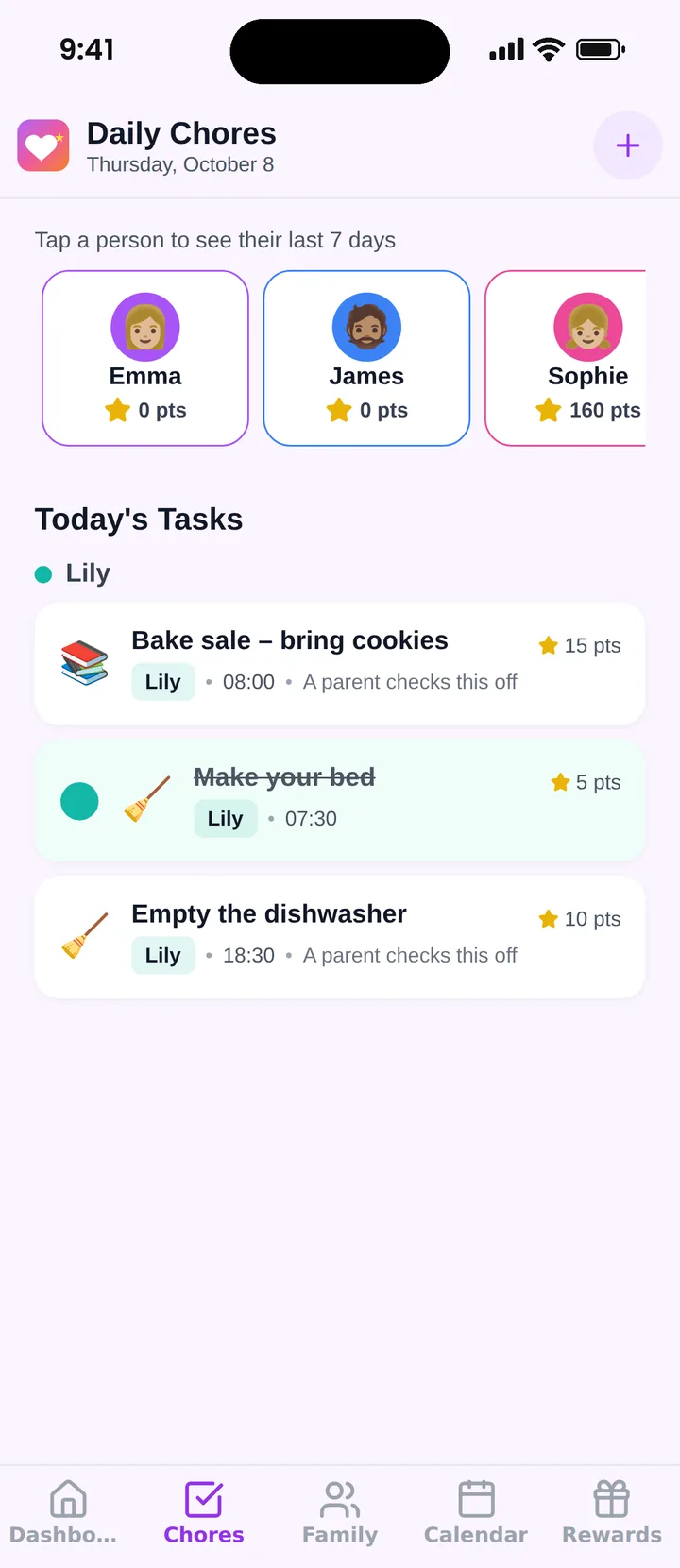
Famiyo is a free family app for iPhone and Android that combines a shared family calendar, chores with points and a rewards shop; kids join with a code, no email needed. Set a chore to repeat, give it points, and your child gets a push notification about the new task on their own phone. They see their list, check things off, and watch their points go up, while you hear when a job is done. You can choose whether a parent approves each task. Many families find that the app becomes the one saying "it's time," not them. See our best chore apps for kids for more options.
When to ask for help
Occasional refusal is normal. If your child refuses almost everything, seems anxious or upset about tasks, or the conflict spills into other parts of life, mention it to their pediatrician or a family therapist. Sometimes the issue is bigger than chores, and it deserves a proper look.
Frequently asked questions
Should I punish a child who refuses to do chores?
Punishment tends to turn chores into a fight. A natural consequence works better: the job comes before screens or a favorite activity, and it waits until it is done. Keep your voice flat, say it once, and follow through without extra drama.
Is it normal for a child to refuse chores?
Yes. Almost every child pushes back at some point, often when a chore is new, boring, too hard or arrives at a bad moment. Refusal is information. It usually points to a fixable problem with the task, the timing or the way it was asked.
What if my child says chores are unfair?
Listen, because sometimes they are right. Sit down when everyone is calm, list who does what, and adjust if one child carries more. If the split is fair, say so kindly and hold the line. Kids accept rules more easily when they helped shape them.
Should I do the chore myself to avoid a fight?
Occasionally, on a rough day, sure. As a habit it teaches the child that refusing works. If you do step in, say so plainly ('I'm doing it today, you're doing it tomorrow') so the expectation stays alive.
Try Famiyo With Your Family
Chores with points, a rewards shop for kids and one shared family calendar. Set it up in a couple of minutes.



Free to download • No credit card required • Available on iOS & Android