Daily Chores for Kids by Age: What to Do Every Day
Daily chores for kids by age, from 2 to 13+: what each age can do every day, how many minutes it takes, when to fit it in, and how to build up gradually.
By Famiyo Editorial Team4 min read
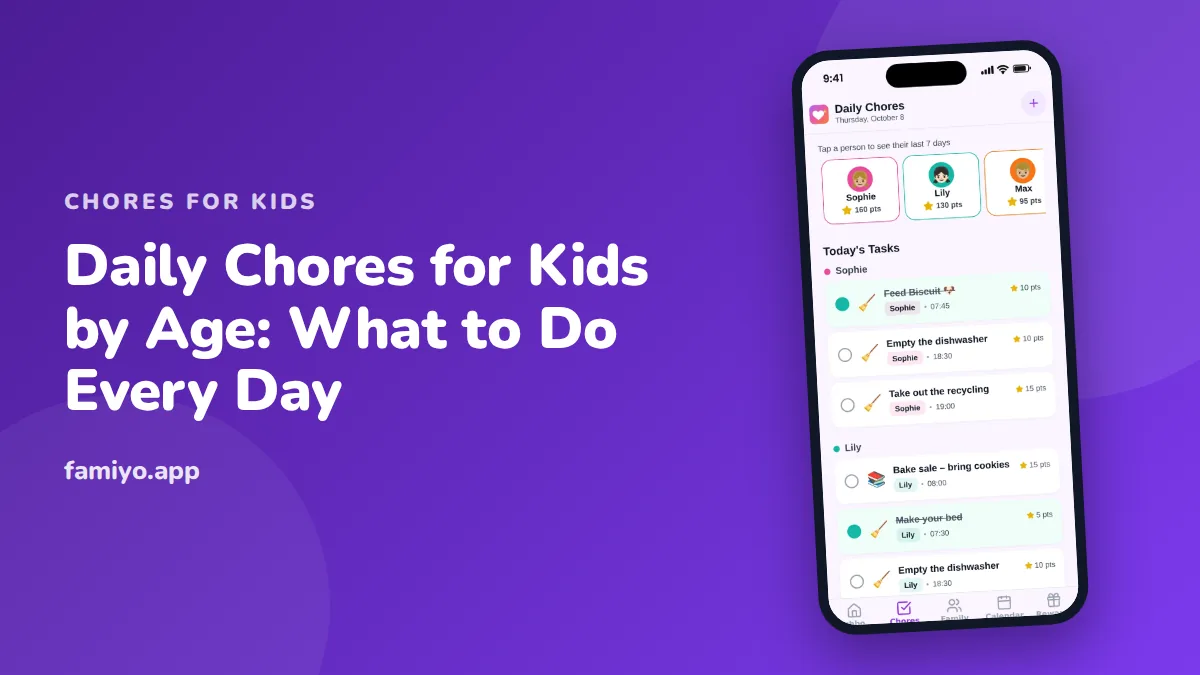
Weekly chore plans get the attention, but the daily ones do the real work. They are the small, repeated jobs that become habits: the bed, the plate, the shoes, the bag. A child who learns them early barely notices them by age 10.
Below is what each age can reasonably do every day, how long it should take, and when in the day it fits best. Think of it as a ladder. Each rung keeps the jobs from the one before and adds a little.
Ages 2 to 3: 5 to 10 minutes
Toddlers want to help, and the help is messy. That is fine. You are building the idea that everyone puts things back, not producing a clean floor.
- Put toys in a bin (before dinner or before bath)
- Put dirty clothes in the hamper (at undressing)
- Wipe up a spill with a cloth when it happens
- Help feed a pet by pouring dry food with you
Keep it to two jobs at first. Do it alongside them. Our guide to chores for toddlers has more on this stage.
Ages 4 to 5: 10 to 15 minutes
Children this age follow a short sequence and like being trusted with a real task.
- Make the bed, roughly (morning)
- Set and clear their own place (mealtimes)
- Put away shoes and backpack (after school or nursery)
- Match socks or water a plant (evening)
- Feed a pet, with you checking
A picture checklist helps because many are not reading yet. If you want a closer look at this stage, see chores for preschoolers, including what does not work.
Ages 6 to 7: 15 to 20 minutes
Now they can handle a short list on their own, if the list is written down.
- Make the bed and tidy the room (morning and before bed)
- Pack the school bag (night before)
- Empty unbreakable dishes from the dishwasher (after dinner)
- Sweep the kitchen floor or table area (after dinner)
- Sort laundry by color (when you do laundry)
This is the age where reminders start to shift from "do it" to "check your list." Keep your reminders short, and resist the urge to redo their work while they are watching.
Ages 8 to 9: 20 to 30 minutes
Eight is a turning point. Kids can take responsibility for a whole job from start to finish.
- Make the bed, tidy the room (morning)
- Load the dishwasher (after dinner)
- Take out the trash (before bed or on trash day)
- Fold and put away their own laundry (as it comes)
- Make a simple snack (after school)
From age 8, add one weekly bigger job, like vacuuming one room. For what is possible just ahead, see chores for 9- to 12-year-olds.
Ages 10 to 12: about 30 minutes
Tweens can be trusted with real household work, and they often like the independence.
- Everything from the 8 to 9 list, with less supervision
- Clean the bathroom sink and toilet (a few times a week)
- Cook a simple meal with an adult nearby (one night a week)
- Change bed sheets (weekly)
- Wash the car (monthly or seasonal)
At this age the daily list should still be short. Homework and activities take more of the afternoon, and chores get squeezed. Three or four daily jobs plus the weekly ones are usually enough.
Ages 13 and up: 30 to 45 minutes
Teenagers should be running parts of the home, not helping with a parent's list.
- Do their own laundry start to finish
- Cook a family meal (once a week or more)
- Shop from a list
- Mow the lawn
- Help with younger siblings
Note that those are weekly rhythms more than daily ones, so the daily list stays small: bed, dishes, a quick tidy, plus their rotating job. We cover this in daily chores for teenagers.
All ages at a glance
| Age | Daily jobs | Time per day |
|---|---|---|
| 2-3 | Toys in a bin, clothes in the hamper, wipe spills | 5 to 10 minutes |
| 4-5 | Make the bed, set and clear their place, put away shoes and bag | 10 to 15 minutes |
| 6-7 | Tidy room, pack school bag, empty dishwasher, sweep | 15 to 20 minutes |
| 8-9 | Load dishwasher, laundry, take out trash, simple snack | 20 to 30 minutes |
| 10-12 | Bathroom sink and toilet, simple meal, sheets | 30 minutes |
| 13+ | Own laundry, family meal, shopping, mowing | 30 to 45 minutes |
How to add chores without a fight
Add one job at a time. If a child has managed their list for two to three weeks, add another. If they are slipping, take one away and try again later. The rule of thumb: 2 to 3 daily tasks for preschoolers, 3 to 4 for school-age kids.
Teach before you expect. Show the job once, do it together once, watch them do it once, then step back. Say out loud what "done" looks like: "Bed made means the pillow is up and the blanket is pulled over."
Link each job to a time anchor. "After brushing teeth, make your bed." This works far better than "sometime this morning."
If the reminders turn into shouting, our article on getting kids to do chores without yelling is a useful reset.
Tracking daily chores in Famiyo
Famiyo is a free family app for iPhone and Android that combines a shared family calendar, chores with points and a rewards shop; kids join with a code, no email needed. For daily chores, you assign an age-right job to each child, give it points, and set it to repeat. A 5-year-old and a 12-year-old can each have their own list for the same day, and each child can earn a different number of points for the same task.
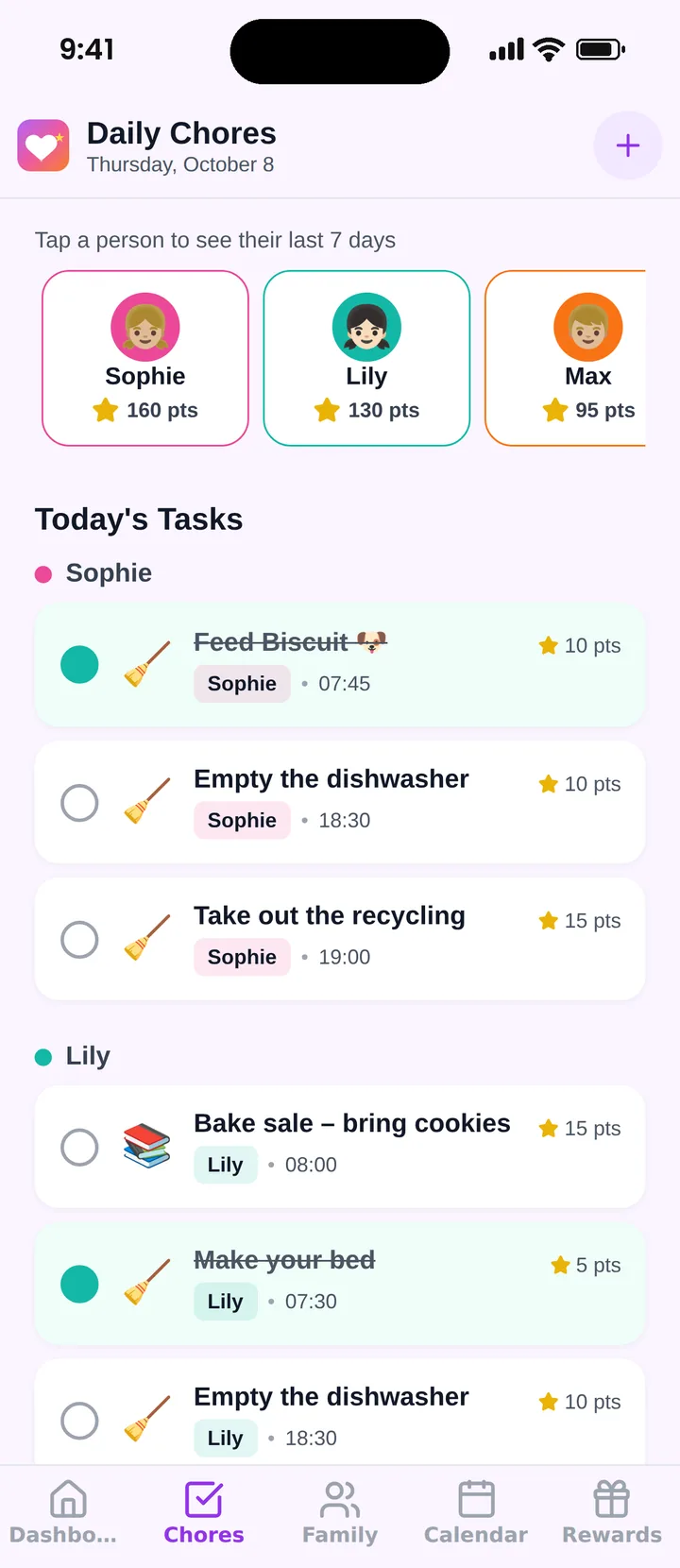
Kids check off their own tasks, or a parent approves them, whichever you choose. You get a notification when a chore is done. The free plan covers up to 3 family members and 1 repeating task, and Premium removes the limits. See our list of the best chore apps for kids for a comparison.
Pick your child's age band, choose the first two jobs, and attach each one to a moment in the day.
Frequently asked questions
How many daily chores should a child have?
Two or three for preschoolers and three or four for school-age kids. Weekly bigger jobs can be added from age 8. If a child keeps missing their list, the list is usually too long, so remove one job before adding any consequence.
What daily chores can a 5-year-old do?
Make the bed (roughly), set and clear their own place at the table, put dirty clothes in the hamper, match socks, water plants or help feed a pet. Ten to 15 minutes a day is a sensible total, with a parent nearby.
When is the best time of day for chores?
Anchor each job to something that already happens: bed after waking, plate after dinner, bag after school. Attaching a job to an existing routine makes it automatic faster than setting a separate chore hour that competes with play and homework.
Should daily chores be paid?
Usually not. Daily jobs are part of belonging to the household. Points toward rewards can make them more motivating without turning them into a wage, and paid money is better kept for bigger extra jobs outside the daily list.
Try Famiyo With Your Family
Chores with points, a rewards shop for kids and one shared family calendar. Set it up in a couple of minutes.



Free to download • No credit card required • Available on iOS & Android